
HVAC Team Accountability:Why Expectations Must Be Documented

HVAC team accountability becomes difficult when expectations are not clearly documented.
Many HVAC companies assume their teams understand what is required. Leaders explain things verbally, give instructions during meetings, or rely on past habits. At first, this approach seems to work. However, as the business grows, confusion slowly begins to appear.
Different team members start interpreting expectations in different ways. Because of this, accountability becomes inconsistent.
Why Accountability Often Feels Unfair
In many HVAC businesses, accountability problems do not start with poor employees. Instead, they begin with unclear expectations.
For example, a technician may believe the job only requires completing the repair. Meanwhile, a manager expects detailed documentation, customer communication, and follow-up notes.
Since these expectations were never written down, the technician feels surprised when leadership raises concerns.
As a result, frustration grows on both sides.
Verbal Instructions Do Not Scale
When companies are small, verbal communication can work for a while. Owners often speak directly with technicians, dispatchers, and installers every day.
However, as the company grows, relying on verbal instructions becomes risky.
New technicians join the team.
Office staff rotate responsibilities.
Supervisors interpret instructions differently.
Without documented expectations, every person begins creating their own version of the process.
Over time, HVAC team accountability becomes inconsistent across the organization.
Documentation Creates Clarity
Clear documentation removes uncertainty. Instead of relying on memory, teams can follow defined expectations.
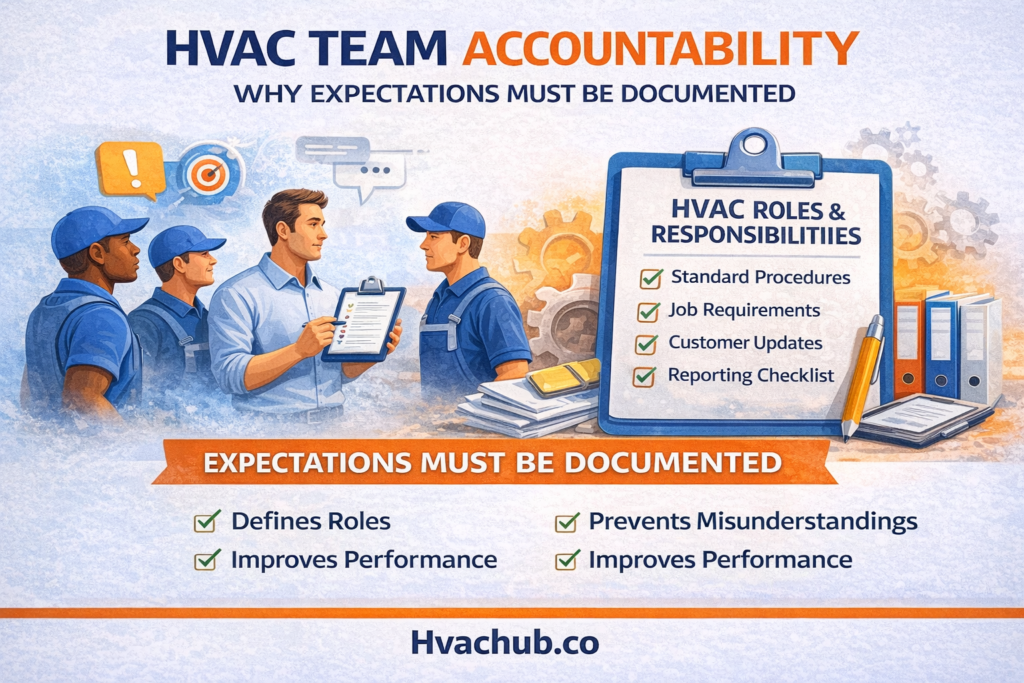
For example, a documented process might include:
• Service call documentation standards
• Installation quality checklists
• Customer communication guidelines
• Job completion reporting requirements
When expectations are visible and accessible, employees understand exactly what good performance looks like.
Because of that clarity, accountability becomes fair and predictable.
Strong Teams Prefer Clear Standards
Interestingly, high-performing technicians often prefer structured expectations.
Clear standards help them work confidently because they know what leadership expects. In addition, documented processes reduce misunderstandings between field teams and office staff.
Instead of debating what should happen, teams can follow the agreed-upon process.
Consequently, trust inside the organization improves.
Leadership Sets the Standard
Accountability systems always begin with leadership. When leaders define expectations clearly, teams naturally follow stronger habits.
However, when expectations remain vague, accountability becomes emotional instead of structured.
That situation often leads to unnecessary tension between supervisors and technicians.
Documenting expectations helps prevent those conflicts before they start.
Structure Strengthens Accountability
HVAC companies operate in fast-moving environments. Jobs move quickly, service calls arrive unexpectedly, and teams must respond efficiently.
For that reason, structure becomes essential.
Well-documented expectations create consistency across dispatch, service, installations, and management. When every role understands its responsibilities, HVAC team accountability becomes easier to maintain.
Instead of reacting to mistakes, leaders can focus on improving systems.
Clear standards make difficult personnel decisions easier to handle. For related management challenges, see when an HVAC business needs to let an employee go, how avoiding hard conversations affects the team, and making team meetings more effective.
Final Thought
Accountability rarely fails because people do not care.
More often, it fails because expectations were never clearly documented.
When HVAC companies define responsibilities, document processes, and communicate standards openly, accountability becomes part of the culture rather than a constant struggle.
Clear expectations create stronger teams, better coordination, and more consistent performance.
Join the HVAC Community Hub
If you want practical frameworks that help HVAC businesses strengthen leadership, improve accountability, and build reliable operational systems, join now HVAC Community Hub.
Inside the community, HVAC owners and professionals share insights designed to help companies grow with clarity, structure, and long-term stability.
Responses