
HVAC Strategy Execution Gap: Why Plans Fail Daily

Many HVAC owners have clear goals. They plan to improve operations, strengthen customer experience, grow revenue, or reduce chaos. On paper, the strategy looks solid. Yet, weeks later, nothing seems to change. This disconnect is known as the HVAC strategy execution gap – the space between what a business plans to do and what actually happens day to day.
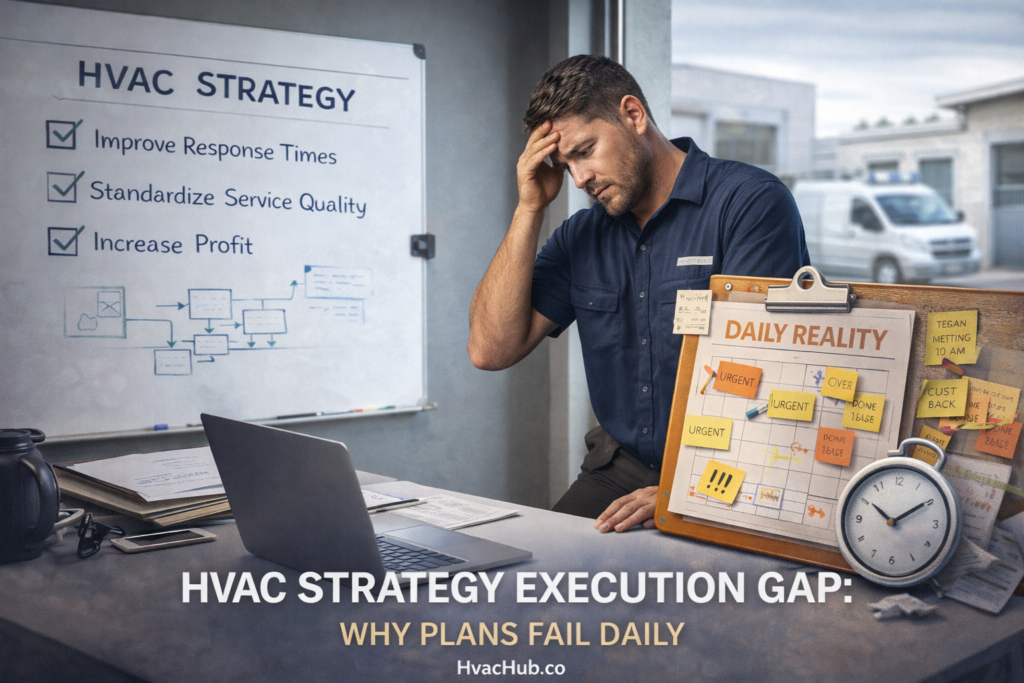
The issue is rarely a lack of vision. Most HVAC owners know where they want to go. The challenge is turning strategy into consistent execution across teams, systems, and daily decisions.
1. The HVAC Strategy Execution Gap Starts With Good Intentions
Most HVAC strategies fail quietly, not dramatically.
Owners set goals like:
- Improve response times
- Standardize service quality
- Increase profitability
- Reduce owner involvement
But without clear execution paths, these goals remain ideas. Day-to-day urgencies quickly take over, and strategy gets postponed “until things slow down.”
2. Strategy Execution Gap Grows When Strategy Isn’t Operationalized
Strategy often stays at a high level.
Examples include:
- “We need better systems”
- “We should improve communication”
- “We need more accountability”
Without breaking strategy into processes, roles, and routines, teams don’t know how to act differently. Execution fails because expectations are unclear.
3. HVAC Strategy Execution Gap Is Fueled by Reactive Operations
Reactive environments make execution difficult.
When teams are constantly:
- Handling last-minute changes
- Managing emergencies
- Fixing avoidable issues
- Responding instead of planning
Strategy loses priority. Execution becomes inconsistent because there’s no space to implement change.
4. Strategy Execution Gap Widens Without Clear Ownership
Plans fail when no one owns execution.
Common signs include:
- Everyone agrees on the goal, but no one is responsible
- Decisions wait for the owner
- Tasks fall between roles
- Progress isn’t reviewed
Execution improves dramatically when ownership is clear and accountability is visible.
5. Strategy Execution Gap Exists Without Measurement and Feedback
Strategy requires feedback loops.
Many HVAC businesses don’t track:
- Whether changes are being followed
- If new processes improve outcomes
- Where execution breaks down
- What adjustments are needed
Without measurement, execution becomes optional instead of expected.
6. HVAC Strategy Execution Gap Is Reinforced by Communication Gaps
Even good plans fail when communication is inconsistent.
Problems arise when:
- Strategy is discussed once and forgotten
- Teams don’t understand the “why”
- Updates are informal or inconsistent
- Feedback only flows upward
Clear, repeated communication aligns daily actions with long-term goals.
7. Closing the HVAC Strategy Execution Gap
Businesses that close the gap focus less on planning and more on execution systems.
They:
- Translate strategy into simple processes
- Assign clear ownership
- Build routines around execution
- Review performance regularly
- Adjust based on real data
Execution becomes part of the operating rhythm, not an extra task.
Final Thoughts
The HVAC strategy execution gap isn’t a leadership failure — it’s a systems challenge. Strategy only creates value when it’s supported by structure, clarity, and consistent follow-through. HVAC businesses that bridge this gap gain momentum, confidence, and control over their growth.
If you want to learn how modern HVAC businesses turn strategy into daily execution…
👉 Join the HVAC Community Hub
Where HVAC owners learn to align vision with action and build businesses that actually follow through.

Responses