
HVAC Technician Accountability Without Killing Morale

HVAC technician accountability sounds simple in theory. Set standards. Track performance. Correct mistakes. Move forward.
In reality, it’s one of the hardest leadership balances in this industry.
You tighten standards because callbacks are costing money. You push documentation because jobs are slipping through cracks. You demand consistency because customers expect it.
And then suddenly, morale drops.
Your best technician seems distant. The team gets quieter in meetings. Small mistakes turn into bigger frustration.This is where many HVAC owners get stuck.
The Real Problem Behind HVAC Technician Accountability
Most owners don’t struggle with accountability because they’re too strict. They struggle because they mix accountability with emotion.
When margins are tight and mistakes are expensive, pressure builds. Naturally, conversations become sharper. Feedback becomes reactive. Accountability turns personal instead of structured.
Technicians don’t usually leave because standards are high. They leave when expectations feel unclear or unfair.
There’s a difference.
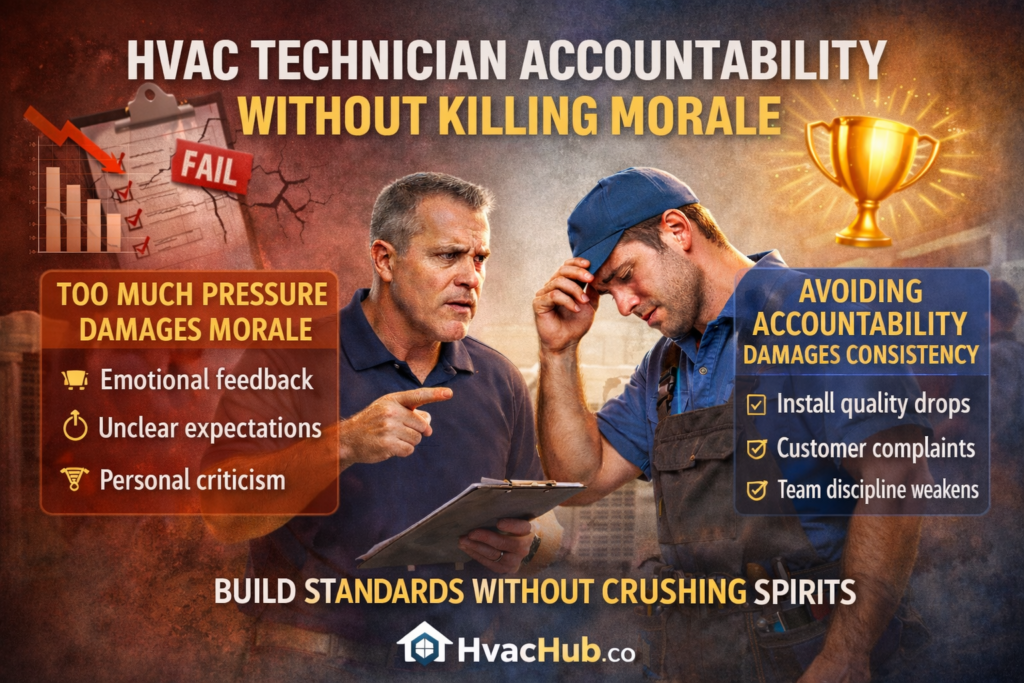
Clear accountability says there is an install checklist, a defined callback target, and a clear way performance is measured. Emotional pressure says, You keep messing up, Why can’t this be simple? or I can’t keep fixing your work. One builds clarity. The other builds resentment.
Why Avoiding Accountability Is Worse
Some owners swing the other way and relax standards to protect morale. That feels safer. However, it creates a different problem.
Without HVAC technician accountability, install quality drops, documentation becomes inconsistent, team discipline weakens, and customer complaints increase. Soon, good technicians feel frustrated because no one is held to the same standard. Morale doesn’t improve. It just shifts.
What Healthy Accountability Looks Like
Strong HVAC businesses separate standards from personality.
First, define measurable expectations. Callback percentages, completion accuracy, and customer feedback create objective conversations because numbers remove emotion. Second, coach privately and consistently. When technicians know feedback is about growth rather than blame, they listen differently. Third, recognize wins as aggressively as you correct mistakes, since accountability without recognition feels one-sided. Finally, build systems instead of constant supervision. When processes are clear, accountability feels predictable rather than threatening.
The Leadership Reality
HVAC technician accountability will always create tension. Leadership isn’t about avoiding that tension. It’s about managing it with structure and consistency.
High standards protect your reputation. Clear communication protects your culture.
The goal isn’t to choose between performance and morale. The goal is to build both.
If you want to talk through real leadership challenges like this with other owners, join the conversation inside the HVAC Community Hub.
👉 HvacHub.co
Responses