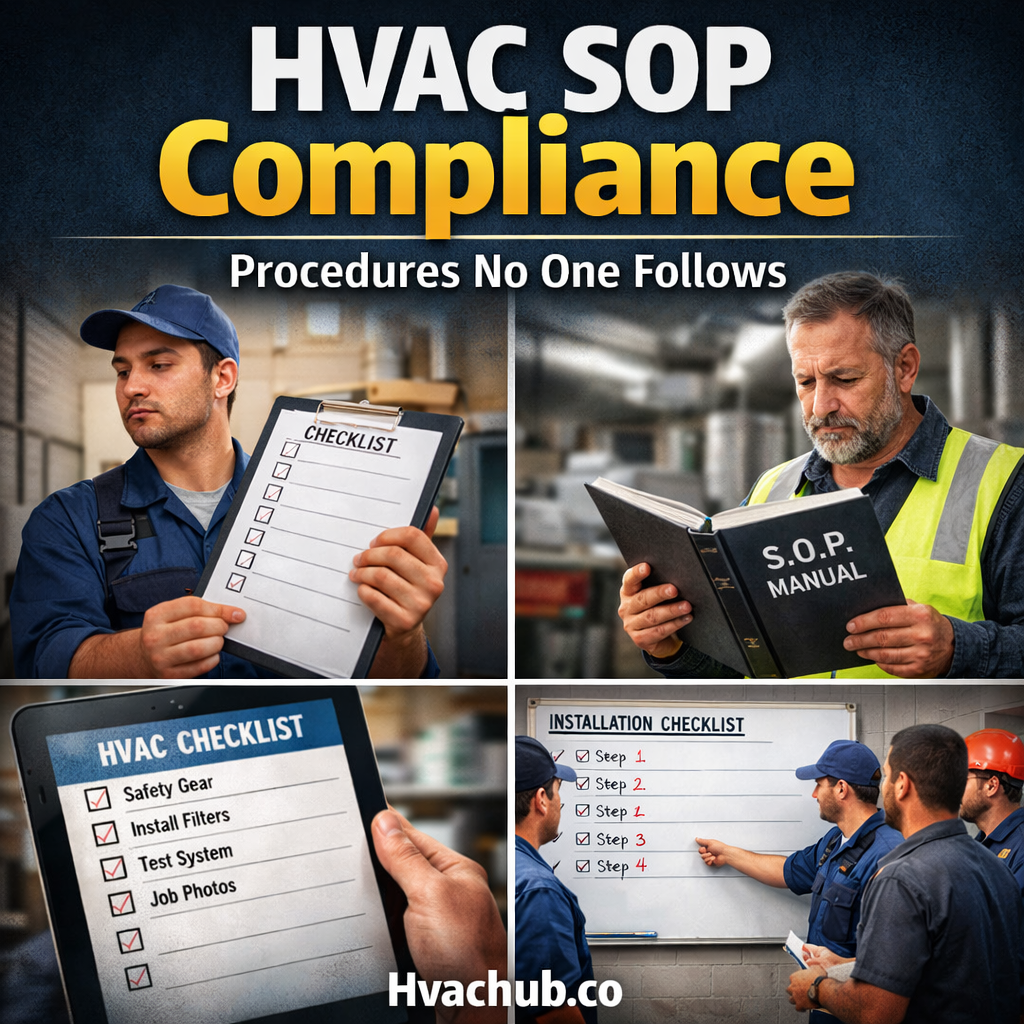
HVAC SOP Compliance: Procedures No One Follows

HVAC SOP compliance breaks down in many growing companies, even when documented procedures already exist.
Most teams have written checklists, install steps, and service standards. However, over time, people stop following them consistently.
As a result, performance slowly drifts.
The problem is not missing systems. Instead, it is weak follow-through.
Why Procedures Lose Power Over Time
At first, new processes receive attention. Supervisors review work carefully, and teams follow the checklist.
However, urgency begins to interfere.
A job runs late.
Someone skips a step.
A supervisor overlooks the shortcut.
Although each exception feels small, repeated exceptions weaken authority. Eventually, written procedures turn into loose suggestions.
Consequently, standards lose strength.
The Hidden Cost of Weak HVAC SOP Compliance
When HVAC SOP compliance declines, the impact spreads quietly.
For example:
- Install quality varies from one technician to another
- Service notes lack detail
- Safety steps get shortened
- Customer communication becomes inconsistent
Because of this inconsistency, callbacks increase. At the same time, accountability becomes harder to enforce.
Without steady adherence, even strong systems fail.
Why Teams Stop Following Procedures
Several patterns drive compliance decay.
First, leadership stops reinforcing expectations. If supervisors do not check procedures regularly, teams assume flexibility is acceptable.
Second, documentation becomes outdated. When the written process no longer reflects field reality, technicians stop trusting it.
Finally, speed begins to override structure. During busy seasons, people focus on finishing work quickly rather than following every step.
Over time, informal shortcuts replace formal standards.
Signs HVAC SOP Compliance Is Slipping
Warning signs often include:
- Technicians completing the same task differently
- Checklists filled out inconsistently
- Repeat mistakes across jobs
- Steps skipped under pressure
- Standards enforced only during audits
These patterns develop gradually. Therefore, many owners do not notice the shift until problems grow.
Why Growth Makes Compliance Harder
As the company expands, complexity increases.
More trucks create more variation.
Additional technicians introduce different habits.
Higher job volume adds pressure.
If leadership does not reinforce expectations clearly, HVAC SOP compliance weakens.
In other words, growth exposes compliance gaps rather than fixing them.
How to Strengthen Compliance Without Adding Complexity
Improving HVAC SOP compliance does not require rewriting every document. Instead, it requires consistent reinforcement.
First, supervisors must review work regularly and correct mistakes quickly. Clear follow-up strengthens standards.
Next, simplify checklists. When documentation is easy to use, adoption improves.
Finally, track adherence. What you measure, you improve.
When leadership models consistency, the team follows.
Stability Depends on Follow-Through
Written systems protect a business only when people use them.
If procedures exist but remain ignored, structure becomes an illusion.
Strong HVAC SOP compliance creates predictable results, clearer accountability, and higher quality work. As a result, scaling becomes controlled instead of chaotic.
Final Thought
Most HVAC companies do not struggle because they lack procedures.
Instead, they struggle because they stop reinforcing them.
When HVAC SOP compliance becomes optional, standards fade quietly.
However, when compliance becomes culture, growth becomes stable.
Join the HVAC Community Hub
If you want practical systems that strengthen accountability and protect operational standards, join now HVAC Community Hub.
Inside, we focus on clear execution frameworks that help HVAC businesses scale with structure — not drift.
Responses