HVAC Business Automation: Save Time and Grow in 2026

HVAC business automation is changing the way successful HVAC companies operate in 2026. Most HVAC business owners spend hours every week on tasks that have nothing to do with actual HVAC work — chasing unpaid invoices, following up on quotes, sending appointment reminders, and manually updating customer records. These tasks eat into your time, drain your energy, and slow your growth. The good news is that every single one of them can run automatically with the right systems in place. This guide explains what HVAC business automation actually means, which tasks to automate first, and how to set up systems that save you time and win you more jobs every week.
What HVAC Business Automation Actually Means
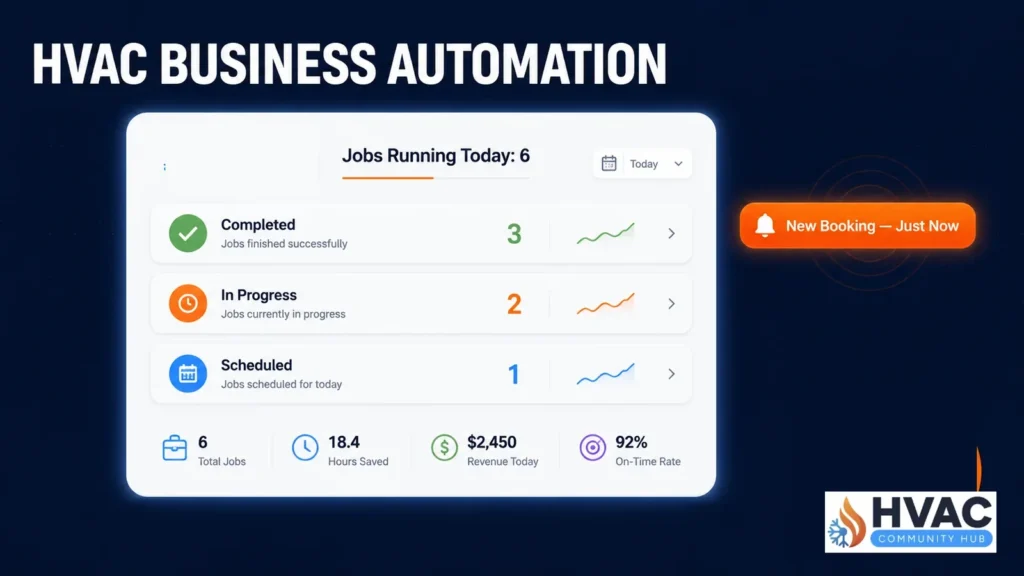
HVAC business automation means using software to handle repetitive tasks automatically — without you or your team having to do them manually every time. It is not about replacing your technicians or removing the human element from your service. It is about removing the admin burden that slows your business down.
Think about how many times a week your team manually sends a follow-up message, updates a job status, or reminds a customer about an upcoming appointment. Each task takes only a few minutes. But across a week, those minutes add up to hours. HVAC business automation handles all of it in the background while your team focuses on the work that actually generates revenue.
The businesses using automation today are not bigger or better resourced than yours. They simply made a decision to stop doing manually what software can do automatically. That decision is now available to every HVAC business owner regardless of company size.
Why HVAC Business Automation Matters More Than Ever in 2026
The HVAC industry grows more competitive every year. Customers now expect fast responses, instant booking confirmation, and professional follow-up after every job. Meeting those expectations manually — across dozens of jobs a week — is almost impossible without a large admin team.
HVAC business automation levels the playing field. A two-truck operation with good automation can respond faster, follow up more consistently, and look more professional than a ten-truck company still relying on manual admin. Speed and consistency win jobs. Automation delivers both.
Furthermore, labour costs continue to rise. Adding admin staff to handle follow-ups, reminders, and scheduling is expensive. HVAC business automation handles all of that at a fraction of the cost — freeing your existing team to focus on higher-value work.
The Biggest Time Wasters in an HVAC Business
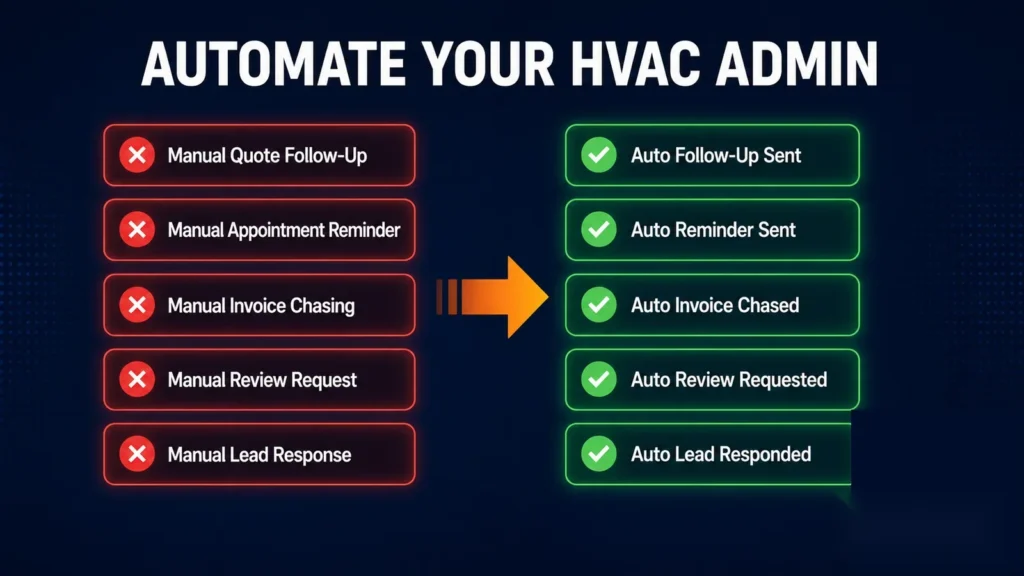
Before setting up automation, it helps to understand exactly where your time goes. These are the most common time-wasting tasks in HVAC businesses that automation eliminates completely.
Manual Quote Follow-Ups
Sending a quote and then manually following up two days later is one of the biggest time drains in any HVAC business. Most owners either forget to follow up entirely or spend time chasing quotes that were never going to close. HVAC business automation sends a follow-up message automatically at the right time — without anyone on your team having to remember or act.
Appointment Reminders
No-shows and last-minute cancellations cost HVAC businesses significant revenue every week. Calling or texting customers the day before an appointment takes time and relies on someone remembering to do it. An automated reminder system sends the message at the right time, every time, without any manual effort from your team.
Invoice Chasing
Following up on unpaid invoices is uncomfortable and time-consuming. Many HVAC owners avoid it and end up waiting weeks for payment. HVAC business automation sends payment reminders automatically at set intervals after an invoice goes out — politely, professionally, and consistently — without any awkward manual chasing.
H3: Review Requests
Online reviews directly affect how many new customers find and choose your business. However, asking every customer for a review manually after every job almost never happens consistently. An automated review request goes out at the right moment after job completion — when the customer is most satisfied and most likely to leave a positive response.
H3: New Lead Response
Speed matters more than almost anything else when a new lead comes in. Research consistently shows that responding to a new enquiry within five minutes dramatically increases the chance of winning the job. Manual response at that speed is impossible across a busy week. HVAC business automation sends an instant response the moment a new enquiry arrives — letting the customer know you received their message and will be in touch shortly.
The Core Tools Behind HVAC Business Automation
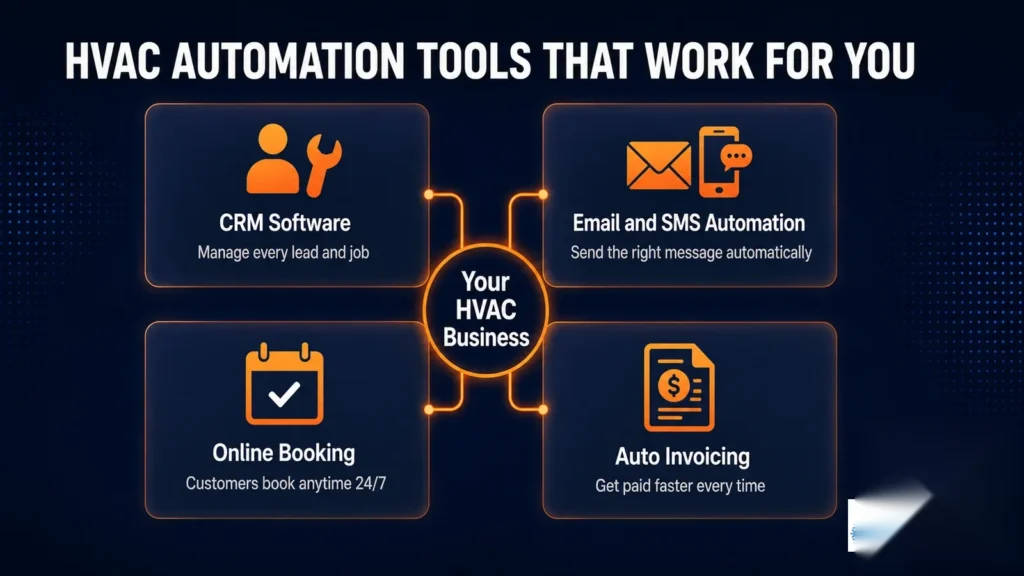
HVAC business automation does not require expensive enterprise software or a technical team to set up. Most of the tools available today are affordable, cloud-based, and designed specifically for trade businesses. Here are the core tools that power effective HVAC business automation.
CRM Software
A CRM — Customer Relationship Management system — is the foundation of HVAC business automation. It stores all your customer information in one place and triggers automated actions based on where each customer sits in your pipeline. When a new lead comes in, the CRM logs it, sends an instant response, and reminds your team to follow up. When a quote goes out, the CRM schedules automatic follow-ups. When a job completes, it triggers a review request and schedules the next service reminder. Everything connects through one central system.
Email and SMS Automation
Email and SMS automation lets you send the right message to the right customer at exactly the right time — automatically. Appointment reminders, invoice follow-ups, seasonal service prompts, and review requests all run on autopilot once you set them up. Customers receive professional, timely communication every time without your team lifting a finger.
Online Booking Systems
An online booking system lets customers schedule appointments directly through your website — at any time of day or night — without calling your office. The booking automatically updates your team’s schedule, sends a confirmation to the customer, and triggers a reminder before the appointment. Fewer phone calls, fewer scheduling mistakes, and more bookings coming in outside business hours.
Automated Invoicing and Payment
Automated invoicing sends a professional invoice the moment a job is marked complete. Payment reminders go out automatically if the invoice remains unpaid after a set number of days. Some systems also allow customers to pay online instantly through a link in the invoice — reducing payment delays and eliminating most of the manual chasing that drains your time every week.
How to Start With HVAC Business Automation
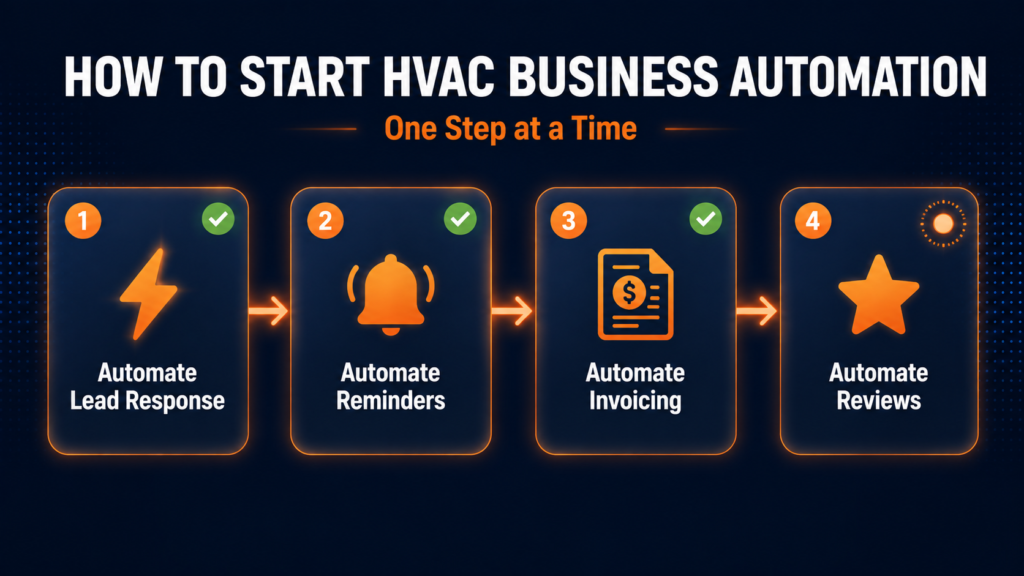
Starting with automation does not mean changing everything at once. The most effective approach is to automate one area at a time, starting with the task that costs you the most time or money every week.
Start With Lead Response
If you currently respond to new enquiries manually and sometimes take hours or even a day to reply, start here. An instant automated response to every new enquiry costs you almost nothing to set up and immediately improves your chances of winning the job. Customers who receive a fast, professional response are far more likely to book with you than those who wait.
Then Automate Appointment Reminders
Once lead response runs automatically, set up appointment reminders next. A simple SMS the day before every appointment reduces no-shows and last-minute cancellations significantly. This single automation can recover hours of lost time and revenue every single week.
Add Invoice and Payment Automation
After reminders are running, connect your invoicing. Set up automatic invoice delivery the moment a job completes and schedule payment reminders at three days, seven days, and fourteen days after the invoice goes out. Most businesses see faster payment within the first month of implementing this step.
Build Out the Full System Over Time
Once the core automations run smoothly, expand into review requests, seasonal service reminders, and re-engagement campaigns for customers who have not booked in over twelve months. Each new automation adds another layer of consistent, professional communication that your competitors are unlikely to match if they are still doing everything manually.
How Much Time Does HVAC Business Automation Actually Save?
The time saved through HVAC business automation depends on the number of manual tasks, team size, and quality of your existing processes. Rather than assuming an industry-wide savings figure, measure how long your team currently spends on tasks such as reminders, follow-ups, scheduling, and invoicing. Automate suitable steps, then compare the time required before and after.
For example, saving five hours a week would free up about 260 hours over a year — time you could use for customer service, training, or improving operations. That is an illustration, not a promised result. Compare your actual time savings and service improvements against the cost of the software and setup.
Furthermore, the consistency automation delivers is something manual processes can never match. Every customer gets the same fast response, the same professional reminder, and the same timely follow-up — regardless of how busy your week gets or how many jobs are running at the same time.
Common Mistakes HVAC Businesses Make With Automation
HVAC business automation delivers excellent results when it is set up correctly. However, a few common mistakes can reduce its effectiveness or create a poor customer experience.
The first mistake is automating too much too fast. Trying to set up ten different automations at once leads to errors, missed steps, and a system nobody on your team understands. Start with one automation, run it for two to four weeks, then add the next.
The second mistake is making automated messages feel robotic. A message that reads like it came from a machine damages trust rather than building it. Every automated message should sound warm, professional, and personal — as if a real person from your team wrote it specifically for that customer.
The third mistake is never reviewing the system after setup. Automation needs occasional checking. Forms change, software updates, and customer behaviour shifts. Review your automations every three months to confirm everything still runs correctly and the messages still feel relevant and professional
Frequently Asked Questions About HVAC Business Automation
How much does HVAC business automation cost?
Costs vary depending on the tools you choose and the size of your business. Basic automation through a CRM and email platform starts at a very manageable monthly cost. More comprehensive systems with SMS, online booking, and automated invoicing sit at a higher price point but typically pay for themselves within the first few months through time savings and faster payment collection.
Do I need technical skills to set up HVAC business automation?
Most modern automation tools are designed for business owners, not developers. They use simple drag-and-drop interfaces and pre-built templates that require no coding or technical background. A provider who specialises in HVAC businesses can also set the entire system up for you so you simply turn it on and let it run.
Will automation make my business feel less personal?
Only if it is set up poorly. Well-written automated messages feel warm, relevant, and professional. Most customers never know a message was automated — they simply notice that your business responds faster and communicates more consistently than your competitors.
What is the first automation every HVAC business should set up?
Instant lead response. Responding to a new enquiry within five minutes dramatically increases your chances of winning the job. This is the single automation that delivers the fastest and most measurable return for most HVAC businesses.
HVAC Business Automation Is Not the Future — It Is Now
The HVAC businesses winning the most jobs in 2026 are not necessarily the ones with the best technicians or the lowest prices. They are the ones that respond fastest, follow up most consistently, and communicate most professionally at every stage of the customer journey. HVAC business automation makes all of that possible without adding a single person to your payroll.
Every week you spend doing manually what software can do automatically is a week your competitors with better systems pull further ahead. The gap between businesses that automate and those that do not grows wider every month.
Automation works best when business processes are clear. Read more about HVAC business structure, SOP compliance, and growth without reliable systems.
Take the Next Step
First, write down the three admin tasks that cost you the most time every week. Second, identify which one you could eliminate first with a simple automated system. Third, test one automation this week — even a basic email auto-response to new enquiries — and measure the difference it makes.
If you want a complete HVAC business automation system set up and running without the technical headache, HVAC Hub builds and manages automation systems specifically for HVAC businesses.
Visit hvachub.co to find out how we help HVAC businesses save time, win more jobs, and grow faster with the right automation in place. You can also read our HVAC website maintenance guide to see how a well-maintained website and smart automation work together to grow your business in 2026. For a broader look at how automation fits into modern business operations, the Harvard Business Review’s guide to business automation offers useful context on why businesses that automate consistently outperform those that do not.
Responses