HVAC Advertising: Get More Calls Without Wasting Money

Smart HVAC advertising is not about spending more. It is about spending in the right places at the right time. Most businesses rely on one or two channels and wonder why growth stalls. In fact, combining SEO with paid search produces four times more leads than single-channel efforts. Furthermore, businesses with 100 or more Google photos get 520% more calls than those with fewer than 10. The difference between growing businesses and struggling ones is not budget size. It is channel mix, timing, and consistency. This guide shows you exactly which HVAC advertising channels work best in 2026 and how to stop wasting your budget.
Why Most HVAC Advertising Budgets Get Wasted
The HVAC industry generates around $31 billion in annual revenue. Competition in every local market is growing fast. More businesses are advertising, which means the cost of getting it wrong is higher than ever.
The Tracking Problem Most Owners Miss
Many HVAC owners spend money on ads without tracking where their calls come from. As a result, they keep paying for channels that produce nothing. They also cut channels that were actually working. The fix is simple. Every channel needs a trackable phone number. Without this, every ad decision is a guess.
Two Types of HVAC Advertising
All HVAC advertising falls into two groups. The first is demand capture. This reaches people already searching for help right now. Google Ads and Local Services Ads do this well. The second is demand creation. This reaches homeowners before they have a problem. Facebook and Instagram ads do this well. Both types are useful. However, they serve different goals and work best at different times of year.
How Much to Spend on Advertising
Your budget should match your revenue. A $1 million business should spend $8,300 to $16,700 per month. A $500,000 business should spend $4,200 to $8,300 per month. A $250,000 business should spend $2,100 to $4,200 per month. Advertising is not an expense. It is an investment. One loyal HVAC customer is worth $15,000 to $25,000 over their lifetime. Spend accordingly.

The 6 Most Effective HVAC Advertising Channels in 2026
Here is exactly which channels produce the best results for HVAC businesses in 2026 — and how to use each one without wasting money.
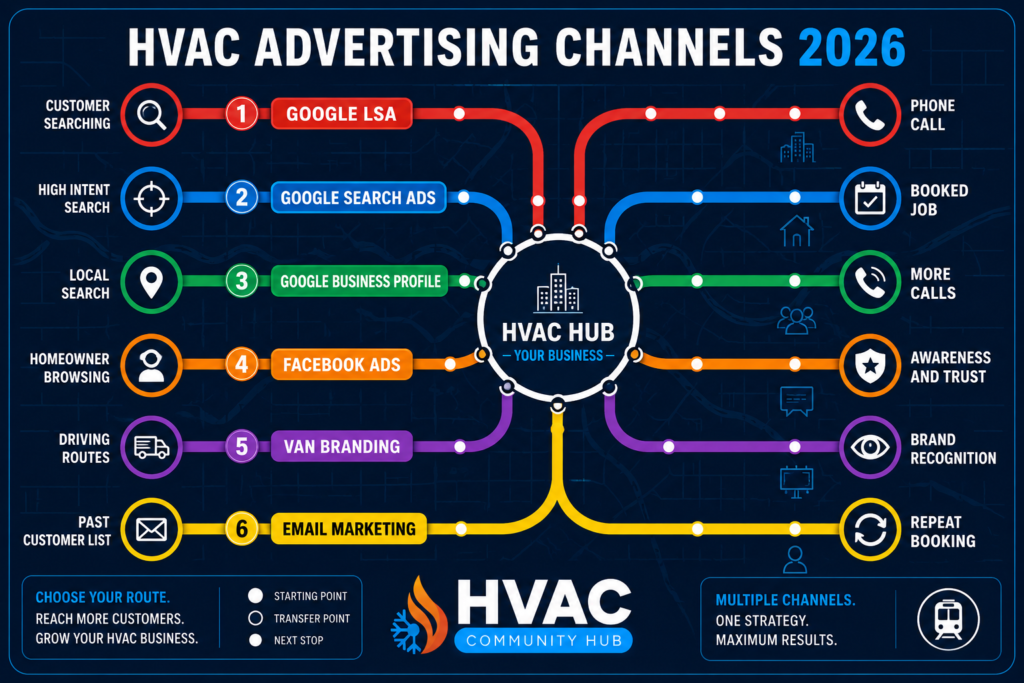
1. Google Local Services Ads — Your Highest Priority Paid Channel
Google Local Services Ads appear at the very top of search results — above regular Google Ads, above the map pack, above everything. When a homeowner searches for AC repair, your Local Services Ad is the first thing they see, complete with your Google rating, years in business, and a green Google Guaranteed badge.
You pay per lead, not per click — meaning you only pay when someone actually calls or messages you. Furthermore, you can dispute invalid leads and request credits for spam calls. For most HVAC businesses, Google Local Services Ads produce the best cost per booked job of any paid advertising channel available. If you can only run one paid channel, make it this one.
2. Google Search Ads — Fast Leads for Competitive Markets
Google Search Ads appear below Local Services Ads and above organic results. They work best for high-intent searches like “emergency AC repair” or “HVAC installation near me” where the customer is ready to act immediately. Google Ads for home services average $7 to $8 per click — meaning your targeting and landing page need to convert well to produce a positive return.
The biggest mistake HVAC businesses make with Google Search Ads is sending all traffic to their homepage. Instead, send each ad to a specific landing page matching the exact search term. An ad for “furnace repair” should go to a furnace repair page — not a general homepage. This simple change can double your conversion rate overnight.
3. Google Business Profile — The Best Free Advertising in Existence
Your Google Business Profile is the most cost-effective advertising tool available to any HVAC business. HVAC companies with complete and active Google Business Profiles get twice as many calls on average compared to those with incomplete profiles. Furthermore, local SEO accounts for 70% of all HVAC organic traffic.
Complete every field in your profile — services, hours, photos, service areas, and business description. Add new photos every week. Respond to every review within 24 hours. Post weekly updates about seasonal offers, completed jobs, and helpful tips. Each of these actions sends positive signals to Google that your business is active and relevant — and your ranking in the local map pack improves as a result. You can read our full Google Maps ranking guide for a detailed breakdown — HVAC GOOGLE MAPS
4. Facebook and Instagram Ads — Building Awareness Before the Breakdown
Facebook and Instagram advertising lets you reach homeowners in your specific service area before they need HVAC help. This is demand creation — building brand awareness and trust so your business is the first name they think of when something goes wrong.
Facebook’s targeting options are powerful for local home services. You can target by zip code, homeowner status, household income, and age group. A well-targeted Facebook ad for a seasonal maintenance offer — “Book your summer AC tune-up before the rush — limited slots available” — can produce booked maintenance jobs at very low cost during shoulder season when paid search volume is low and your competitors have gone quiet.
5. Yard Signs and Vehicle Branding — Local Advertising That Never Stops
Every job your business completes is an advertising opportunity. A yard sign placed at a completed job site turns every neighbour who walks or drives past into a potential customer. Your branded van driving through the neighbourhood does the same thing — 24 hours a day, every day it is on the road.
Vehicle branding is one of the highest-return advertising investments any HVAC business can make. A professional van wrap typically costs $2,000 to $4,000 and can generate thousands of impressions per day in the suburbs where most HVAC work happens. Furthermore, a branded van communicates professionalism and scale — two things that build customer confidence before they ever make a call.
6. Email Marketing — Your Highest ROI Channel for Existing Customers
Your existing customer base is a goldmine that most HVAC businesses ignore. 60% of HVAC emergency calls come from mobile search — but a significant proportion of those callers already have a preferred HVAC company they just forgot to call first. Email marketing keeps you in front of past customers so your business is the first call they make when something goes wrong.
A simple pre-summer email reminding past customers to book an AC tune-up, sent to your full customer list in late April, can produce $10,000 to $20,000 in booked maintenance jobs within a week — at near-zero cost. Furthermore, unlike paid advertising, your email list is an asset you own permanently — no algorithm can take it away from you. You can read more about growing your customer base in our referral guide — HVAC REFERRAL PROGRAM
How to Measure Whether Your HVAC Advertising Is Actually Working
The most common advertising mistake HVAC businesses make is not tracking results. Without tracking, you cannot tell which channels are producing booked jobs and which ones are producing nothing. Here is exactly how to measure your advertising performance.
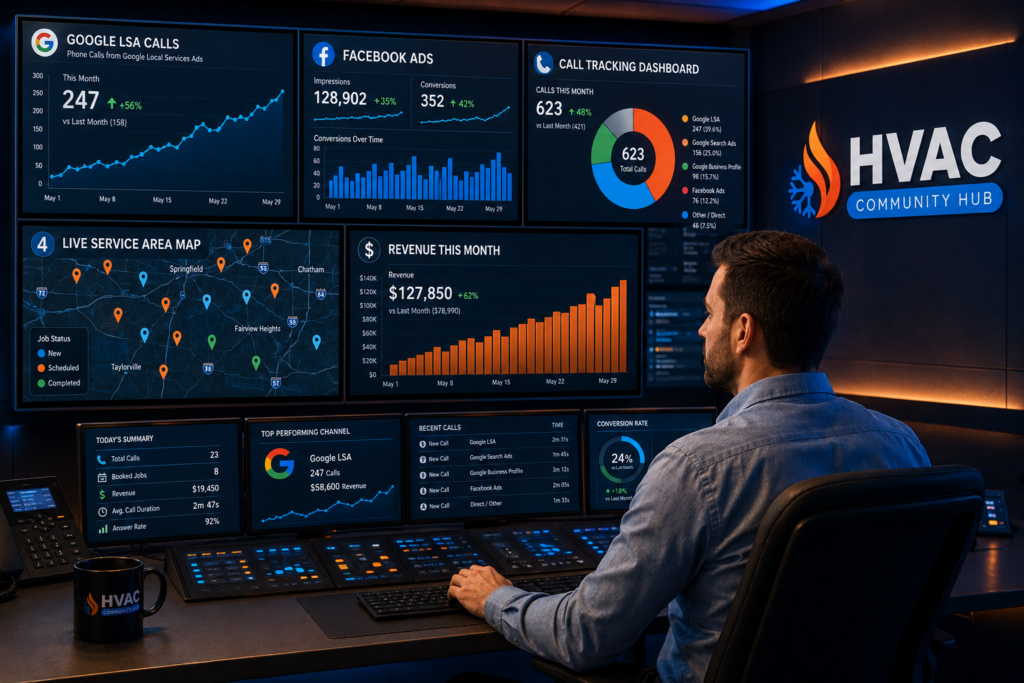
Use Call Tracking Numbers for Every Channel
Assign a unique phone number to each advertising channel. One number for your Google Ads, one for your yard signs, one for your Facebook ads, one for your email campaigns. When a customer calls, the tracking system tells you exactly which channel they came from.
This single step transforms your advertising from guesswork to data. Within 90 days of using call tracking, most HVAC businesses discover that one or two channels are producing 80% of their calls — and the rest are producing almost nothing. As a result, you can confidently shift budget from poor-performing channels to high-performing ones and watch your cost per booked job drop.
Track Cost Per Booked Job — Not Just Cost Per Lead
Many HVAC advertising platforms show you cost per click or cost per lead. However, the number that actually matters is cost per booked job — how much did you spend in advertising to produce one completed, paid job.
Calculate this monthly for every channel. Divide your total spend on each channel by the number of jobs it produced. A channel producing booked jobs at $80 each is far more valuable than one producing leads at $30 each if those cheaper leads rarely convert to booked work.
Review Your Advertising Performance Every Month
Set aside one hour every month to review your advertising numbers. Which channels produced the most calls? Which produced the most booked jobs? Which had the lowest cost per booked job? What was your total advertising spend as a percentage of revenue?
Use these numbers to make decisions — not gut feelings. Increase spend on channels producing strong returns. Reduce or pause channels that are not converting. Test one new channel or message every 90 days. Over time, this disciplined approach produces a consistently improving advertising system that gets more efficient every month. You can read more about building your full marketing system in our marketing guide — HVAC MARKETING
HVAC Advertising Through the Seasons — What to Run and When
One of the biggest advertising mistakes HVAC businesses make is running the same strategy all year round. The right advertising mix changes with the season — and the businesses that match their spend to seasonal demand produce the best return.
Peak Season — Summer and Winter
During peak season — summer for cooling and winter for heating — demand is high and your phone is already ringing. This is the time to maximise Google Local Services Ads and Google Search Ads to capture every high-intent search in your service area. Budgets can be increased during these periods because the conversion rate is at its highest and every captured lead is likely to become a booked job quickly.
Furthermore, peak season is also the best time to ask for Google reviews, run referral programme reminders, and send email campaigns to past customers who have not booked recently. Every touchpoint during peak season builds the customer base that sustains your business through slower periods.
Shoulder Season — Spring and Autumn
Shoulder season — spring and autumn — is when the real advertising strategy gets made. Demand is lower, which means cost per click drops and competition decreases. Smart HVAC businesses use shoulder season to run maintenance offer campaigns on Facebook and Instagram, send seasonal email reminders to their customer list, and focus on SEO content that will rank in time for the next peak season.
Furthermore, shoulder season is the best time to build brand awareness in your local area at a lower cost. Facebook and Instagram ads reaching homeowners before they need urgent help are far cheaper and more effective during shoulder season than during peak demand when everyone is already searching and costs are elevated.
Off-Season — Invest in Organic Channels
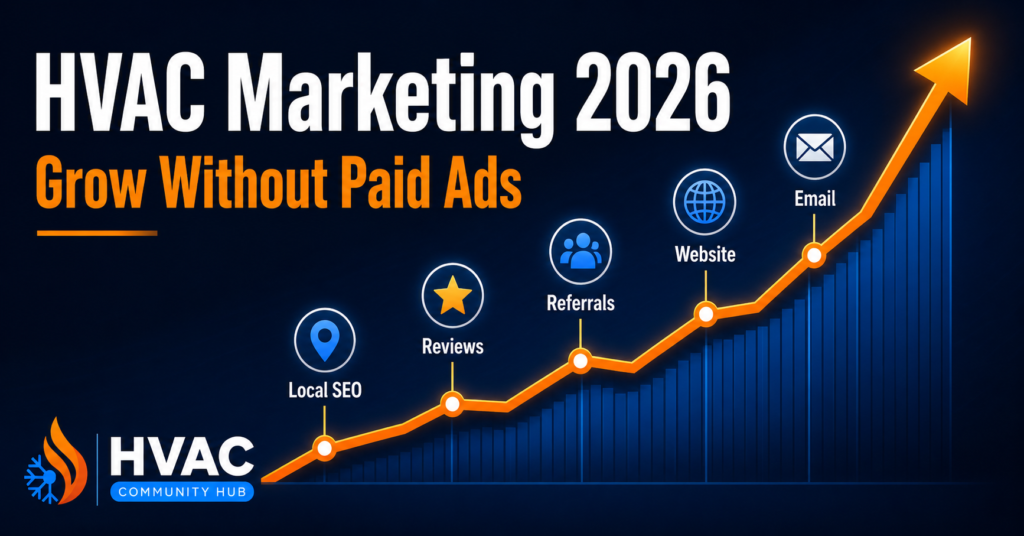
During the true off-season, smart HVAC businesses shift spending from paid advertising toward organic channels — website improvements, blog content, Google Business Profile optimisation, and review gathering. These investments compound over time and produce free leads during every future peak season.
An HVAC business that publishes two blog posts per week during off-season, improves its website speed, and builds 30 new Google reviews in three months will start the next peak season with significantly more organic traffic and calls — at zero ongoing cost.
Frequently Asked Questions About HVAC Advertising
What is the best HVAC advertising channel in 2026?
Google Local Services Ads produce the best cost per booked job for most HVAC businesses. They appear at the top of search results, charge per lead rather than per click, and come with Google’s trust badge. Furthermore, combining Local Services Ads with a strong Google Business Profile and local SEO produces the highest overall lead volume at the lowest cost.
How much does Google advertising cost for HVAC businesses?
Google Search Ads average $7 to $8 per click for home services keywords. Google Local Services Ads charge per lead — typically $20 to $80 per lead depending on your market and service type. Your total monthly budget depends on your revenue target and your conversion rate from lead to booked job.
Do Facebook ads work for HVAC businesses?
es — but for a different purpose than Google. Facebook ads work best for building brand awareness, running seasonal maintenance offers, and reaching homeowners before they have an urgent problem. They are most effective and most cost-efficient during shoulder season when Google search volume is low and your competitors have reduced their spend.
How do I stop wasting money on HVAC advertising?
Start by tracking every channel with a unique phone number. Calculate your cost per booked job for each channel monthly. Stop spending on channels that are not producing booked jobs. Double down on channels that are producing strong returns. Review your numbers every month and adjust based on data — not assumptions.
Should small HVAC businesses advertise on Google?
Yes — specifically through Google Local Services Ads and by optimising their Google Business Profile. Both options are accessible for small businesses with limited budgets. Google Local Services Ads can be started with as little as $200 to $300 per month in some markets, while Google Business Profile optimisation costs nothing but time.
Build an HVAC Advertising System That Gets Smarter Every Month\
The best HVAC advertising is not a one-time campaign. It is a system that tracks results, shifts budget to what works, and gets more efficient every month. When you combine Google Local Services Ads for immediate demand with Facebook ads for awareness, email for repeat business, and organic SEO for long-term free leads — your business generates calls from multiple directions simultaneously.
Start With One Channel This Week
First, check whether your Google Business Profile is complete and active — this is your most important free advertising tool. Second, if you are not running Google Local Services Ads, set up an account this week and start with a small daily budget. Third, set up call tracking so you know exactly which channel your next 20 calls came from.
Furthermore, if you want support building your advertising and marketing system — including website setup, local SEO, CRM integration, and a community of HVAC owners sharing what works — HVAC Hub is exactly where to start.
Visit hvachub.co to join free and start building the advertising system that gets your phone ringing consistently in 2026. You can also read our HVAC website design guide to see how a strong website makes every advertising channel work harder —HVAC WEBSITE DESIGN
Responses