
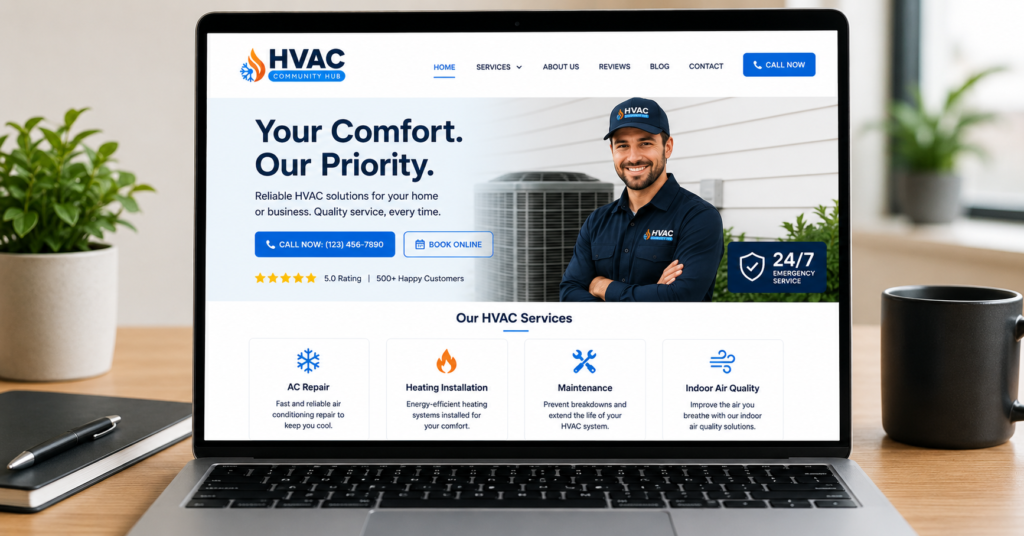
HVAC Website Design: Win More Customers Online in 2026

Your HVAC website design is costing you jobs every single day — and most owners do not even know it. Right now, a homeowner in your area is searching for HVAC help on their phone. They click on a website. It loads slowly. The phone number is hard to find. The site looks old. So they go back and click the next result. That next result is your competitor.
The good news is that fixing this does not have to be complicated or expensive. In this guide, you will find out exactly what your HVAC website must have in 2026 to turn visitors into paying customers. Furthermore, whether you need a brand new website or want to improve an existing one, every step here is clear, simple, and practical.
Why Your HVAC Website Design Decides If You Get the Call
Your HVAC website design is the first thing most customers see before they call you. Google research shows that visitors form an impression of your website in less than 50 milliseconds. That is faster than a blink of an eye.
Here is the problem. Around 27% of HVAC businesses have no website at all. Among those that do, the average speed score is just 42 out of 100. So most HVAC websites are slow, old, and losing leads every single day.
This guide covers exactly what your HVAC website must have in 2026. Whether you need a brand new site or want to fix an existing one, every step here is clear and simple.
What Your Website Is Really Doing for Your Business
Most HVAC owners think of their website as a digital business card. However, that way of thinking is costing businesses thousands of dollars every month.
Your website is your top sales tool. It works 24 hours a day, 7 days a week. It is often the first place a customer checks before calling you. Furthermore, it is almost always where they go after seeing you on Google Maps or social media.
So your website design is not just about looking good. It is about making your phone ring.
What Happens When Your Website Is Weak
A weak HVAC website design sends customers straight to your competitor. For example, a homeowner searches for HVAC help at 10pm. They find your website. It loads slowly. There is no phone number at the top. It looks outdated. As a result, they go back and click the next result.
In contrast, a business with a fast, clear, and professional website gets that call. The difference is that simple.
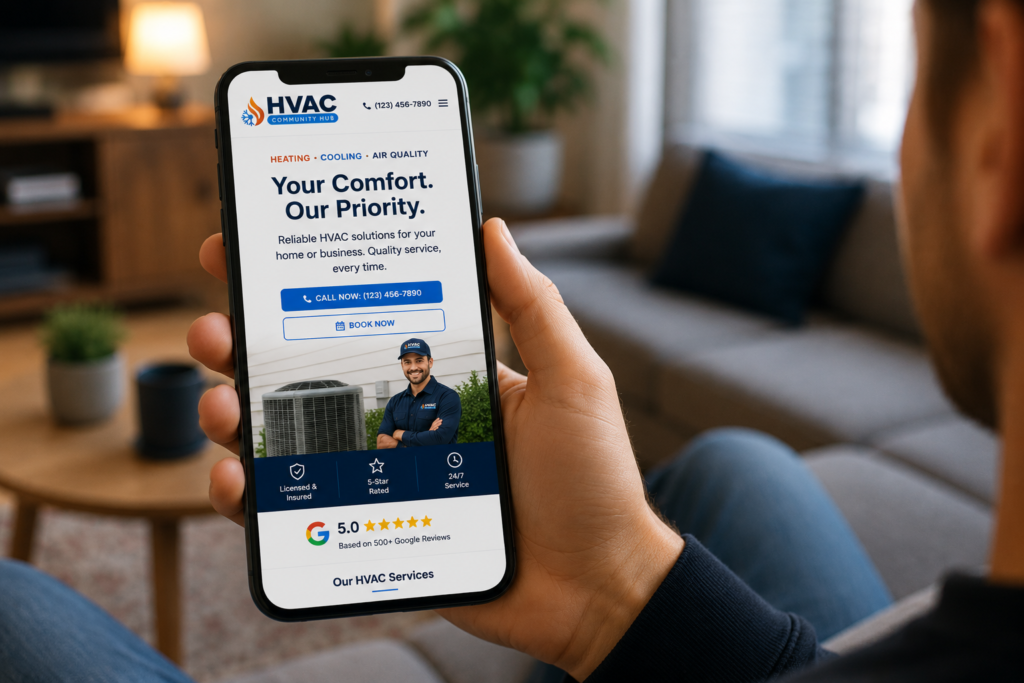
Key Stat: 75% of HVAC searches happen on mobile devices. Moreover, more than half of mobile users leave a website that takes more than 3 seconds to load. Therefore, speed and mobile design are not optional in 2026.
The 7 Must-Have Elements of a Strong HVAC Website Design
Here is exactly what your HVAC website needs. These are not opinions. They are the elements that separate websites that get calls from those that produce nothing.
1. A Click-to-Call Button at the Top of Every Page
Your phone number must be visible without scrolling — on every device. On mobile, it should be a tap-to-call button that dials your number in one touch.
When a homeowner’s AC breaks in summer, they are not browsing. They are looking for the fastest way to get help. So if your number is hidden at the bottom of the page, they will simply call someone else.
The best approach is a sticky header. This is a bar that stays at the top of the screen as the visitor scrolls. In addition, add a floating call button at the bottom of every mobile page. This one change can increase calls by 30% or more.
2. A Fast and Mobile-First Design
Your website must load in under 3 seconds on a phone. According to Google’s Core Web Vitals standard, the main content must load in under 2.5 seconds to receive a good score. Furthermore, this score directly affects how high you rank on Google.
To achieve this, avoid heavy page builders that slow your site down. Also compress all images before uploading them. Choose a fast and reliable hosting plan. As a result, a well-built site not only wins more customers but also ranks higher and brings in more organic traffic.
3. A Separate Page for Every Service You Offer
Every service your business offers needs its own page. For example, AC repair, heating setup, duct cleaning, and maintenance should each have a dedicated page. Do not list everything on one general services page.
This helps Google understand what you do. It also helps customers quickly find the exact help they need. Each service page should have a clear call to action, your phone number, and a short description of how the service works.
You can read more about how local SEO connects to your service pages in our guide .
4. A Location Page for Every Area You Serve
Your website also needs location pages. One for each city or suburb you work in. If you serve three cities, you need three separate location pages. Each one should be written specifically for that area.
These pages are one of the strongest tools for ranking on Google Maps. Moreover, they show customers that you are a local business — and that builds trust straight away. For a deeper look at Google Maps rankings, check out our full guide.
5. A Google Reviews Section on Your Homepage
Social proof is one of the most powerful tools on any website. When a new customer lands on your homepage and sees 150 five-star reviews, their trust level rises instantly.
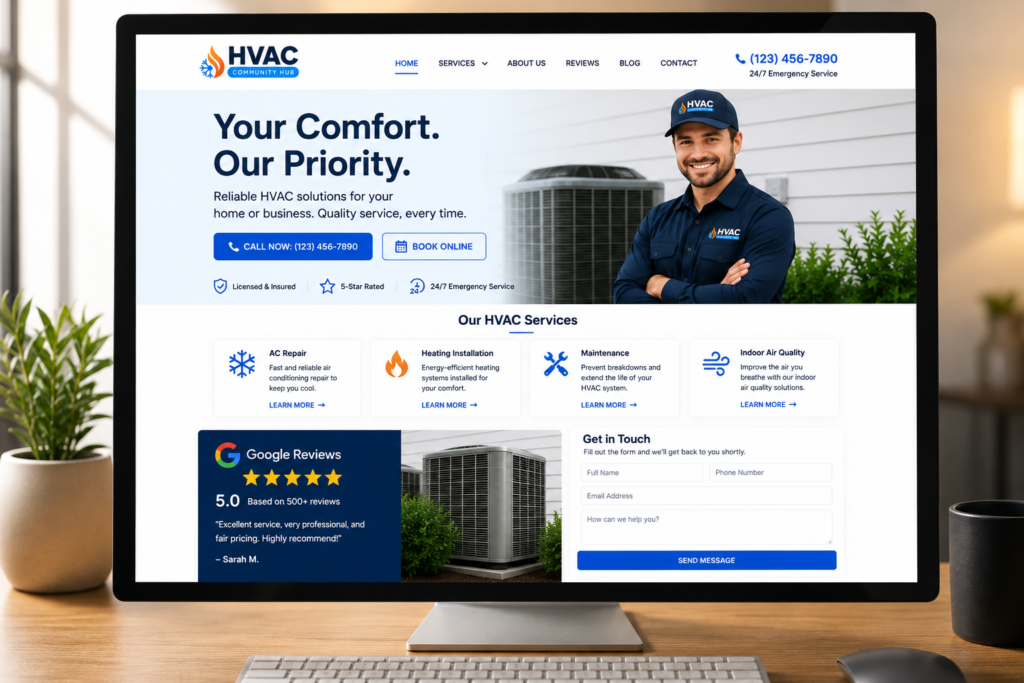
Therefore, add a Google reviews section near the top of your homepage. Include the star rating, the number of reviews, and two or three short quotes from real customers. As a result, visitors who were about to leave will stay and call instead. how to build your reviews system in our full guide
6. A Short and Simple Contact Form
Not every customer wants to call. Some prefer to send a message, especially outside business hours. As a result, a short contact form can capture leads that would otherwise be lost.
Keep the form simple. Ask for name, phone number, and what they need. Nothing more. Every extra field you add reduces the number of people who complete it. Also make sure form replies go straight to your phone so no lead goes unanswered.
7. An About Us Page That Builds Trust
People hire people, not just businesses. An About Us page with a real photo of you and your team creates a personal connection. Include your years of experience and a short story about why you started the business.
Also add your licence number, insurance details, and any industry certifications on this page. Customers who are comparing you to two other businesses will often choose you simply because they feel they know you better.
How Your HVAC Website Design Affects Your Google Rankings
Many HVAC owners think of their website and their Google ranking as two separate things. However, they are deeply connected. In fact, your website is one of the strongest signals Google uses to decide where to rank your business.
What Google Looks for in Your Website
People hire people, not just businesses. An About Us page with a real photo of you and your team creates a personal connection. Include your years of experience and a short story about why you started the business.
Also add your licence number, insurance details, and any industry certifications on this page. Customers who are comparing you to two other businesses will often choose you simply because they feel they know you better.
Why Speed Is So Important in 2026
Website speed is now one of the most important ranking factors. The average HVAC website scores just 42 out of 100 on Google PageSpeed Insights. In contrast, a well-built website scores 90 or above. Simply having a fast website puts you ahead of most competitors without doing anything else.
HVAC Hub Tip: HVAC Hub builds and looks after websites made for HVAC businesses. Every site is built for speed, mobile use, local SEO, and lead conversion. Our team handles all the technical work so you can focus on running your business. Visit hvachub.co to learn more about our website creation and maintenance services.
Should You Build Your Own HVAC Website or Hire Someone?
This is one of the most common questions HVAC owners ask. In short, the answer depends on your budget, your time, and your goals.
Building It Yourself
Website builders like Wix and WordPress make it possible for anyone to build a basic site without coding. However, a self-built website often lacks the speed and SEO setup needed to rank on Google. As a result, many HVAC owners spend weeks building a site that produces very few leads.
Hiring a Professional
A professionally built HVAC website is designed from the start to rank, load fast, and turn visitors into calls. Furthermore, a good HVAC web designer knows what pages you need and builds a site that works as a sales tool — not just a digital brochure.
Once your site is live, it also needs regular care. Security updates, speed checks, and content updates are all needed regularly. Without this care, even a great website will slow down and lose rankings over time.
HVAC Hub Tip: HVAC Hub offers both website creation and monthly website care for HVAC businesses. You get a fast, professional, and fully optimised site — built and looked after by people who understand the HVAC industry. Visit hvachub.co to find out more.
Frequently Asked Questions About HVAC Website Design
How much does an HVAC website design cost in 2026?
A basic template website costs between $1,500 and $3,000. Furthermore, a custom-built WordPress site with full SEO setup typically costs between $5,000 and $12,000. However, for HVAC businesses that want a professional result without a large upfront cost, HVAC Hub offers a more affordable and industry-specific option.
How long does it take to build an HVAC website?
A basic site can be built in one to two weeks. However, a fully optimised site with service pages and location pages takes three to six weeks. Therefore, it is always better to plan ahead rather than rushing the process.
Does my HVAC website need to be mobile friendly?
Yes — without question. More than 75% of HVAC searches happen on mobile devices. Furthermore, Google now uses your mobile site as the main version it ranks. As a result, a site that does not work on mobile will rank lower and convert fewer visitors, regardless of how it looks on a desktop.
What is the most important page on an HVAC website?
Your homepage is the most visited page. However, your individual service pages are the most important for ranking on Google and converting searches into calls. In addition, location pages are critical for any HVAC business that serves more than one area.
How often does an HVAC website need to be updated?
At a minimum, check and update your website every month. Furthermore, security updates, speed checks, and content refreshes should all happen regularly. As a result, many HVAC businesses use a monthly care service to keep their site running well without managing it themselves.
Your HVAC Website Design Is Either Winning or Losing Jobs Right Now
Every day your website is slow or missing key elements, it is losing jobs to competitors whose sites work better. In fact, the difference between a full schedule and a quiet phone is often nothing more than a faster, clearer, better-built website.
What to Do Right Now
First, check your website on a mobile phone. Does it load in under 3 seconds? Is your phone number visible straight away? Do you have a separate page for each service you offer?
If the answer to any of these is no — your website is costing you money right now. Furthermore, the longer you leave it, the more jobs you lose to competitors who have already fixed these problems.
HVAC Hub builds and looks after websites made specifically for HVAC businesses. Every site is built to rank, convert, and grow. Visit Hvac Community Hub to find out how we can help your business get the calls it deserves.
A good HVAC website also needs maintenance and search visibility. Explore ongoing HVAC website maintenance and local SEO for HVAC businesses.



Responses