
HVAC Website Maintenance: Stop Losing Customers in 2026

HVAC website maintenance is one of the most overlooked parts of running a successful HVAC business. A neglected website drives away potential customers every single day. Most HVAC owners assume that once a website goes live, it runs itself. That is rarely true. Slow load times, broken contact forms, outdated content, and poor mobile performance all push visitors away before they pick up the phone. This guide explains what goes wrong when HVAC website maintenance is ignored, the warning signs to watch for, and what a proper plan actually includes.
Why HVAC Website Maintenance Matters More Than Most Owners Realize
Your website is your most important salesperson. Unlike a technician, it works around the clock, seven days a week, without a day off. It answers questions, builds trust, and generates enquiries even when your team is on the job. However, just like your HVAC equipment, a website needs regular servicing to perform properly.
When a potential customer searches for an HVAC company in your area, Google decides which businesses appear at the top. One key factor Google checks is website health — how fast the site loads, how well it works on mobile, and how recently you updated the content. Poor HVAC website maintenance pushes your site down the rankings. That means fewer people find you, fewer people call you, and fewer jobs come through the door.
Even customers who find your website can leave quickly. A site that loads slowly, looks outdated, or has broken links sends one clear message: this business does not pay attention to detail. For an industry built on trust, that first impression costs you the job before you answer the phone.
Customers compare your website to competitors in the same moment they decide who to call. A well-maintained website makes that decision easy. A neglected one hands the job to someone else.
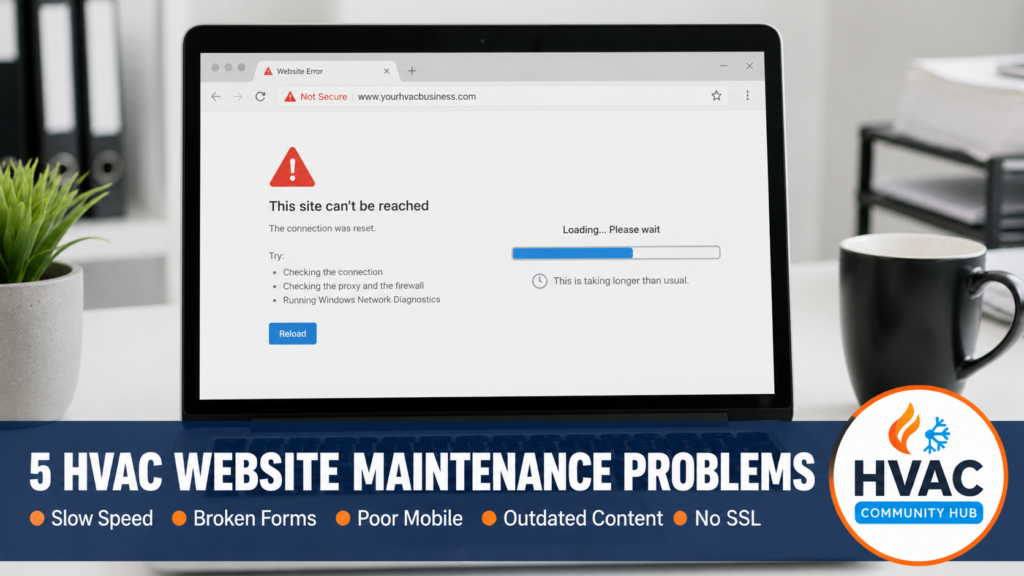
The Most Common HVAC Website Maintenance Problems
Most HVAC websites share the same handful of problems. Knowing what they are helps you fix them before they cost you customers.
Slow Page Load Speed
If your website takes more than three seconds to load, most visitors leave before it finishes. Page speed directly affects how long visitors stay and whether they convert into enquiries. Images that are too large, outdated plugins, and cheap hosting are the most common causes of slow load times on HVAC websites.
Google also uses page speed as a direct ranking factor through its Core Web Vitals system. A slow website therefore hurts both user experience and your search ranking at the same time, creating a double penalty that compounds over time if left unaddressed.
Broken Forms and Dead Links
A broken contact form is one of the worst HVAC website maintenance failures. A customer fills in your enquiry form, you never receive it, and that lead disappears forever. Broken links to old pages or removed services cause the same problem. The visitor gets frustrated and calls your competitor instead. Regular testing catches these issues before they cost you jobs.
Poor Mobile Performance
More than 60% of all website visits now happen on a phone. If your HVAC website has tiny text, hard-to-tap buttons, or a layout that does not resize properly, you lose most visitors before they read a single paragraph. Google ranks mobile-friendly websites higher in search results. Poor mobile performance damages both usability and rankings at the same time.
Outdated Content and Service Information
An HVAC website with old pricing, services you no longer offer, or photos of outdated equipment confuses potential customers. Google rewards websites where owners update content regularly. Fresh, accurate content tells both visitors and search engines that your business is current and worth ranking higher.
Expired SSL Certificate and Security Gaps
An SSL certificate puts the padlock icon in your browser’s address bar. When it expires, browsers warn visitors that your site is “not secure.” Most customers close the tab immediately and go elsewhere. Outdated software and plugins expose your business and customer data to real risk. Fix this before it becomes a crisis.
How HVAC Website Maintenance Affects Your Google Rankings
Many HVAC business owners treat Google rankings and website maintenance as two separate things. They are not. Google checks the technical health of your website every time it crawls it — not just your keywords and content.
Slow load times, broken pages, and security warnings drag your Core Web Vitals scores down. Lower scores push your local search rankings down every month. Even great reviews cannot overcome a poorly maintained website. Good content alone will not save your rankings.
A fast, secure website gives your SEO strategy a stronger foundation. Maintenance makes that possible. HVAC website maintenance and Google rankings work together — not separately. To understand exactly what Google measures and why it matters, you can read ➡️ Google’s official Core Web Vitals documentation— it explains every metric in plain language.
Core Web Vitals and What They Mean for Your HVAC Business
Google’s Core Web Vitals measure three things. First, how fast your main content loads. Second, how quickly your page responds to a user’s first tap. Third, how stable your layout stays while it loads. Regular maintenance tasks directly improve all three scores. These include image compression, plugin updates, and code cleanup. Weak scores push your website below competitors in local search results.
How Often Should HVAC Website Maintenance Happen
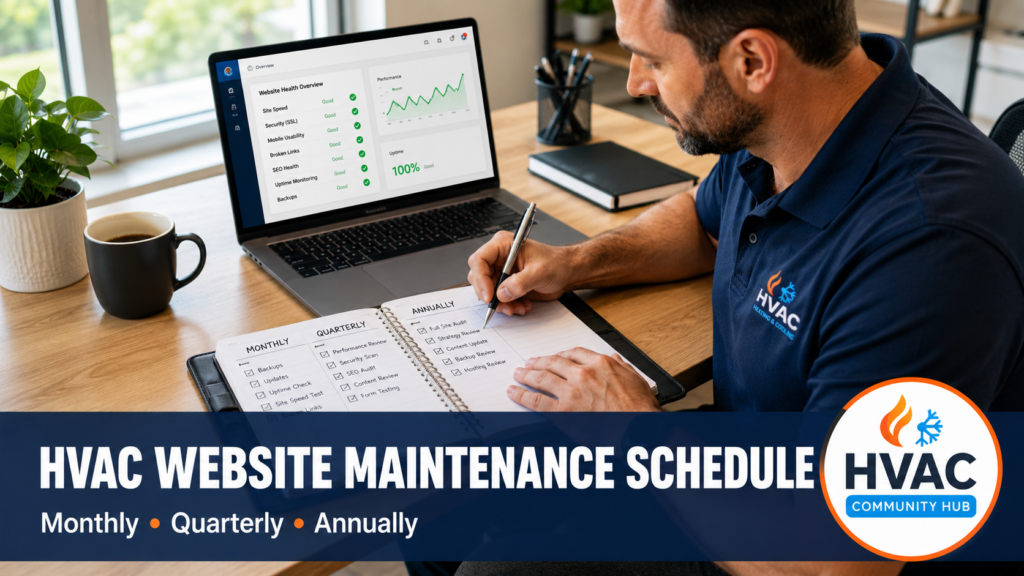
HVAC website maintenance works best as a consistent habit — not a large catch-up every few months. Think of it like a service agreement for your equipment. Here is a simple breakdown of what to do and when.
Monthly HVAC Website Maintenance Tasks
Submit a test enquiry through your contact form and confirm you receive it. Check Google Search Console for crawl errors or flagged pages. Update all plugins, themes, and platform software. Back up the entire website every month without fail.
Quarterly HVAC Website Maintenance Tasks
Review all content for accuracy — services, pricing, and contact details. Test the website on both desktop and mobile. Run a page speed test and flag any pages that load slowly. Fix everything you find before it affects your rankings or enquiries.
Annual HVAC Website Maintenance Tasks
Review the overall design and ask whether it still reflects your business quality. Confirm your SSL certificate is current and not approaching expiry. Run a full link audit and fix anything broken or outdated across the entire site.
Warning Signs Your HVAC Website Maintenance Is Overdue
A few clear warning signs tell you that your HVAC website maintenance is already overdue and actively costing you leads right now.
1) Your website takes more than three seconds to load on a mobile phone
2) Your contact form has not generated an enquiry in weeks despite regular traffic
3) Visitors leave your website within a few seconds without clicking anything
4) Your website looks noticeably older or less professional than local competitors
5) Google Search Console shows a drop in impressions or click-through rate
6) Your website address shows “Not Secure” in the browser address bar
7) You have not updated your website content in over six months
If any of these apply, the problem is already affecting your lead flow. Check your current performance score right now using ➡️ Google’s free PageSpeed Insights tool — it gives you a clear score out of 100 and specific recommendations you can action immediately.

What to Look for in an HVAC Website Maintenance Provider
Not all website maintenance services deliver the same results. Check these three things before you commit to a provider.
First, find someone who understands HVAC specifically. A generic web agency knows websites but may not understand what HVAC customers search for. They may not know how seasonal demand affects your lead flow. An HVAC-focused provider builds maintenance plans around your business cycle.
Second, look for clear monthly reporting. A good provider sends you a summary each month. It shows what work happened, your speed scores, and any issues found and fixed. You should never wonder whether your website is being looked after.
Third, look for a provider who treats maintenance as part of a broader growth strategy rather than just a technical checklist. The best HVAC website maintenance plans connect directly to SEO, lead generation, and conversion rate improvement. To understand exactly how website health connects to your Google rankings, read our ➡️ complete HVAC SEO guide to your hvachub.co— it shows how a well-maintained website becomes your strongest lead generation tool.
What Good HVAC Website Maintenance Actually Includes
A solid HVAC website maintenance plan covers several areas working together. Speed optimisation keeps pages fast on every device. Security monitoring closes vulnerabilities before they become problems. Content updates keep service pages accurate and show Google the site is active. Form and link testing keeps every lead path working. Backup management means you restore everything quickly if something goes wrong.
HVAC website maintenance is not a cost. It is an investment in the reliability of your most important sales tool. Every month without it is a month your competitors pull ahead.
Frequently Asked Questions About HVAC Website Maintenance
How much does HVAC website maintenance cost?
Costs depend on your website size and the level of service you need. Basic monthly plans cover security updates, backups, and form testing. More complete HVAC website maintenance plans add speed optimisation, content updates, SEO monitoring, and monthly performance reports.
Can I do HVAC website maintenance myself?
You can manage some basic tasks in-house — checking forms, reviewing content accuracy, and updating contact details. Speed optimisation, security patching, and fixing SEO errors need a professional. Attempting these without experience often creates new problems while fixing old ones.
How do I know if my HVAC website is performing well?
Check your Core Web Vitals report inside Google Search Console. Aim for a score of 90 or above on PageSpeed Insights for both mobile and desktop. A score below 70 means your HVAC website maintenance is overdue. Google already ranks you lower because of it.
How do I know if my HVAC website is performing well?
Check your Core Web Vitals report inside Google Search Console. Aim for a score of 90 or above on PageSpeed Insights for both mobile and desktop. A score below 70 means your HVAC website maintenance is overdue. Google already ranks you lower because of it.
How long before I see results from better HVAC website maintenance?
Speed and security improvements show up in Google Search Console within four to six weeks. Ranking improvements from consistent HVAC website maintenance and content updates take three to six months to become clearly visible. However, the positive direction usually starts from the first month.
Keep Your HVAC Website Working as Hard as You Do
A properly maintained HVAC website generates consistent leads. It ranks higher in local search and builds trust with every visitor. A neglected one does the opposite — pushing customers away while you focus on the job in front of you. Regular HVAC website maintenance is not optional for a modern HVAC business. It is as essential as servicing the equipment you install.
Take the Next Step
First, test your website speed using Google’s free PageSpeed Insights tool and note your score. Second, submit a test enquiry through your contact form and confirm you receive it. Third, open your website on a phone and ask honestly whether a new customer would trust what they see.
HVAC Hub offers professional HVAC website maintenance, SEO, and digital growth services built specifically for HVAC businesses.
Visit hvachub.co to find out how we keep your website performing at its best every month.
You can also read our HVAC SEO guide to see exactly how HVAC website maintenance and search rankings grow your business together.

Responses