
HVAC Referral Program: Turn Every Customer Into a Lead Source

An HVAC referral program is the single most cost-effective growth strategy available to HVAC business owners today — and most owners either do not have one or have one that nobody uses. If you are serious about growing your business without spending money on paid ads, this guide covers everything you need to build a referral program that actually brings in consistent, high-quality jobs.
The idea is simple. Your happiest customers already talk about you. A referral program gives them a clear reason to do it on purpose — and gives you a predictable stream of warm leads who arrive already trusting your business.
By the end of this guide, you will know exactly what to offer, when to ask, how to track it, and how to avoid the mistakes that kill most referral programs before they gain momentum.
Why an HVAC Referral Program Is Your Most Powerful Growth Tool
Before building anything, it helps to understand why referrals outperform almost every other marketing channel for HVAC businesses specifically.
Trust is the core product in HVAC. You are asking customers to let a technician into their home, trust a diagnosis, and often spend thousands of dollars on a system they cannot fully evaluate themselves. That level of trust is hard to earn through an ad — but it transfers instantly through a personal recommendation.
The numbers back this up. According to a Nielsen survey, 92% of consumers trust recommendations from friends and family over any form of advertising. And research from Forbes found that referral programs produce a lower cost-per-lead than any other acquisition channel for 54% of businesses surveyed.
For HVAC specifically, the average cost to acquire a new customer through digital and offline channels runs between $296 and $350. A referral, by contrast, costs only the reward you offer — typically $25 to $100 — and the lead arrives pre-sold.
💡 HVAC Hub Insight: HVAC business owners in our community consistently report that referred customers close faster, spend more, and generate more referrals themselves. The problem is never a shortage of happy customers — it is a shortage of a system to activate them.
Referred customers also behave differently after signing on. They complain less, they are more likely to leave positive reviews, and they are significantly more likely to become referrers themselves — creating a compounding growth loop that no paid ad can replicate.
What a High-Performing HVAC Referral Program Looks Like
Most referral programs fail not because the idea is wrong but because the execution is too vague. A strong HVAC referral program has three non-negotiable components: a compelling reward, a frictionless process, and a tracking system.
1. A Reward That Actually Motivates
Your reward needs to be meaningful enough that a customer thinks of you the moment a neighbour mentions their HVAC problem. The most effective rewards for HVAC businesses are:
- Cash reward or account credit — $50 to $100 works well for most residential HVAC businesses
- A free service visit or discounted maintenance for the referring customer
- A gift card to a popular retailer (Amazon, Visa, local restaurant)
- A discount on a future repair or maintenance agreement
One important rule: reward both sides. The person doing the referring and the new customer who was referred should both receive something. When both parties benefit, referrals feel generous rather than transactional — and the program spreads faster.
2. A Process With Zero Friction
The biggest reason referral programs fail is friction. If your customer has to fill out a form, remember a code, or go to a website to refer someone, most of them will not bother — even if they genuinely want to.
The most effective delivery methods are:
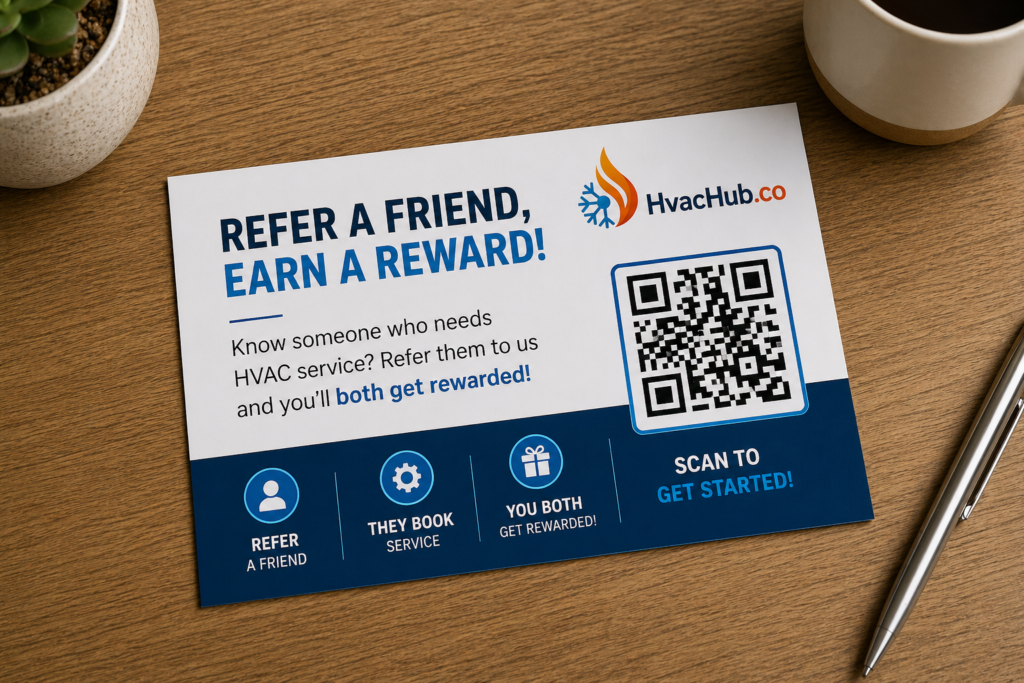
- A printed card left at the end of every job — simple, physical, and visible on a fridge or desk
- A follow-up text or email sent within 24 hours of job completion, with a personal referral link
- A QR code on the back of your business card that leads to a simple referral landing page
- A verbal ask from your technician — the most powerful method of all
The verbal ask works because it happens at the perfect moment: right after a good job, when the customer is at peak satisfaction. Train your technicians to say something simple:
🗣️ “If you know anyone who needs HVAC work done, we would love to help them — and we will take care of you with a $50 credit for the introduction. No forms, just send them our number and tell them to mention your name.”
That is it. No pressure, no script to memorize, no awkwardness. Just a genuine ask at the right moment.
3. A Tracking System That Follows Through
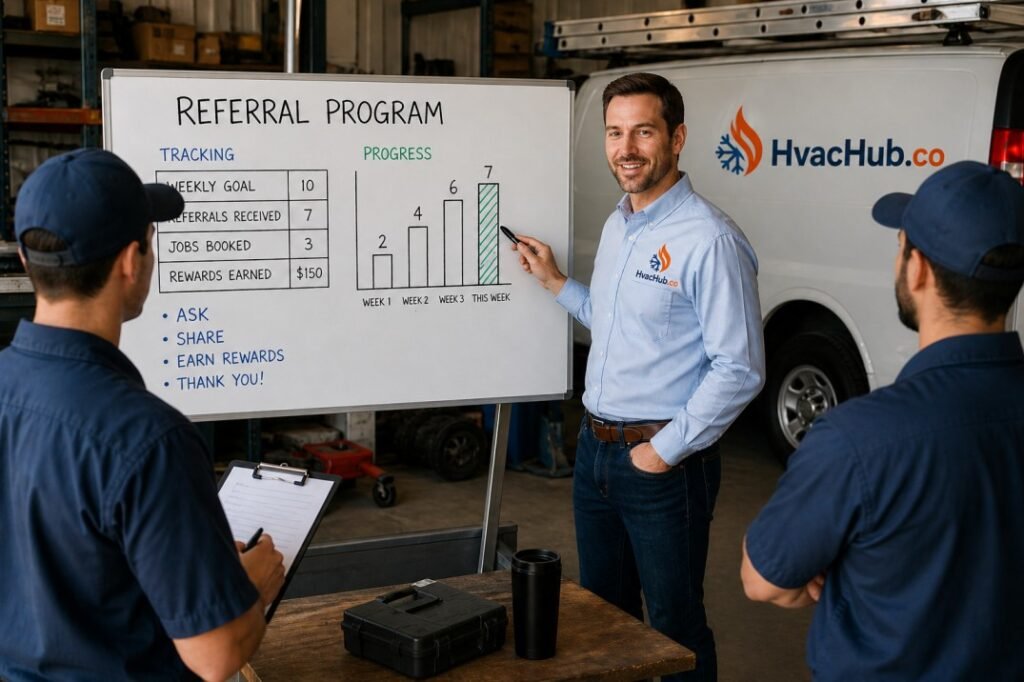
Every referral must be tracked. When a new customer mentions who referred them, that name gets recorded immediately — ideally in your CRM so nothing falls through the cracks. The reward gets delivered within 48 hours of the referred job being completed.
This last part is critical. Slow follow-through is the number one reason referral programs lose momentum. When a customer refers someone and does not hear back for three weeks, they stop referring. When they receive a thank-you and their reward within two days, they refer again.
Set a firm company rule: all referral rewards are processed within 48 hours of the referred job being marked complete.
How to Launch Your HVAC Referral Program in 30 Days
You do not need software, a marketing agency, or a big budget to launch. Here is a straightforward 30-day plan:
- Week 1 — Decide on your reward structure and print 50 referral cards. Even a simple A6 card works.
- Week 2 — Brief every technician on the verbal ask. Role-play it once so it feels natural.
- Week 3 — Add a referral mention to your post-job follow-up text or email. One sentence is enough.
- Week 4 — Review how many referrals came in, reward those customers within 48 hours, and adjust if needed.
Start simple. You can add automation, tracking software, and loyalty tiers once the basics are working. Most HVAC owners never launch because they are waiting for the perfect system. The imperfect system you launch today beats the perfect one you are still planning in six months.
Partner Referrals: The Underused Growth Channel Most HVAC Owners Ignore
Customer referrals are powerful. But there is another referral source that most HVAC owners completely ignore: trade partners.
Electricians, plumbers, builders, real estate agents, and property managers all regularly encounter customers who need HVAC services. A simple agreement — you send them work, they send you work — can produce a steady stream of referrals every single month, at zero cost.
How to start:
- Make a list of five tradespeople in your area whose work complements HVAC
- Reach out personally — a phone call or coffee meeting works better than an email
- Propose a simple mutual referral arrangement, no formal contract needed
- Follow up with a referred customer within 24 hours so your partner looks good for recommending you
Real estate agents deserve a special mention. Every time a home is sold, the new owner often needs HVAC work — inspection, servicing, or a full replacement. One relationship with a busy agent can produce 10 to 20 qualified leads per year.
💡 HVAC Hub members share their exact partner outreach scripts and track record of results inside the community. If you want proven templates instead of starting from scratch, this is where to find them.
The 5 Most Common HVAC Referral Program Mistakes
Even well-intentioned programs fail when these mistakes are present:
- Launching the program and never mentioning it — a referral program cannot sell itself. Every technician must mention it on every job.
- Offering a reward too small to feel meaningful — a $5 discount rarely motivates anyone to pick up the phone and recommend you to a friend.
- Forgetting to deliver the reward — this destroys trust and guarantees the customer never refers again.
- Only tracking referrals manually — spreadsheets work at low volume but break down fast. Connect referral tracking to your CRM as early as possible.
- Giving up after one month — referral programs compound over time. Month one might bring two referrals. Month six, with consistency, brings twelve.
Consistency is the entire game. The HVAC businesses with the strongest referral pipelines are not the ones with the cleverest programs — they are the ones who ask on every job, reward promptly, and never let it slip.
Connecting Your Referral Program to Reviews, CRM and Email
An HVAC referral program delivers its best results when it is connected to the rest of your business systems — not running as a standalone tactic.
Here is how the best-performing HVAC businesses integrate referrals into their full growth system:
- CRM tracks every referral source so you always know which customers and partners are sending you work
- Post-job email sequence requests a review first, then mentions the referral program — in that order
- Customers who leave a five-star review are immediately followed up with a referral ask, since they are at peak satisfaction
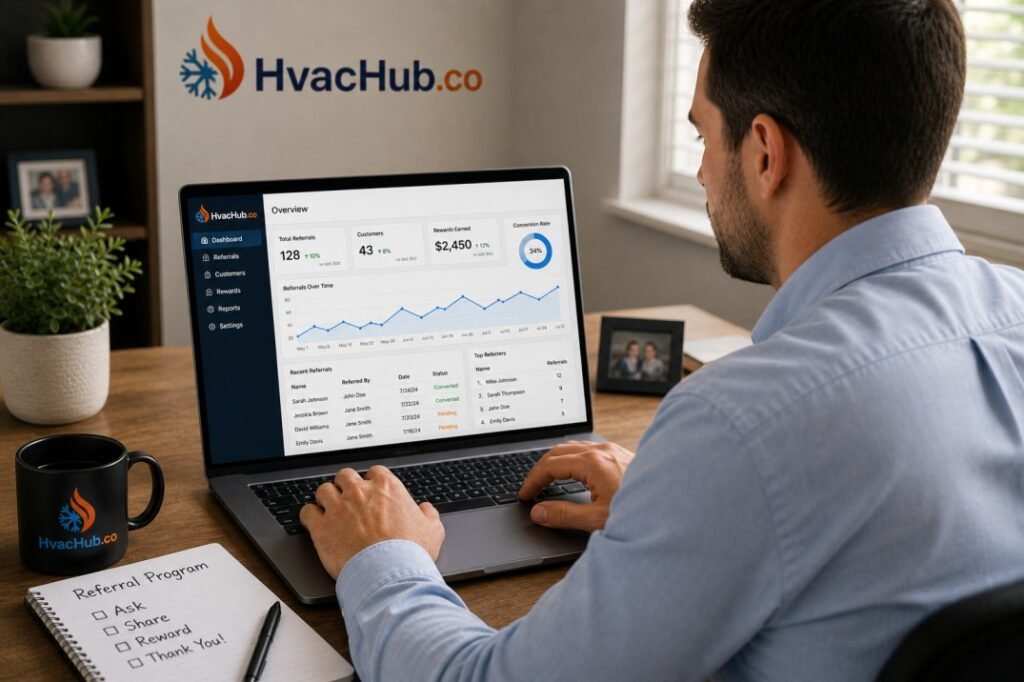
- Monthly reporting shows referral volume, conversion rate, and reward costs so you can measure ROI and coach your team
When reviews, referrals, and follow-up automation work together, every satisfied customer becomes a multi-purpose growth asset — not just a one-time job.
This connected approach is what separates HVAC businesses that grow steadily from those that are constantly starting over with cold marketing.
Frequently Asked Questions About HVAC Referral Programs
How much should I offer as a referral reward?
For residential HVAC, $50 to $100 works well for most markets. The key is that the reward feels meaningful to the customer. If your average job value is $500 or more, a $50 reward is a reasonable investment for a pre-sold lead. Always reward both the referring customer and the new customer.
Do referral programs work for small HVAC businesses?
Yes — and they often work even better for small businesses because customer relationships are more personal. A small owner-operated HVAC business with 200 past customers and a consistent referral ask can generate 15 to 25 referrals per month without spending anything on ads.
What is the best way to track HVAC referrals?
Start with a simple question on every new customer intake: “How did you hear about us?” Record the answer in your CRM immediately. As volume grows, add a referral tracking field and automate reward notifications so nothing falls through the cracks.
When is the best time to ask for a referral?
The best time is at the end of a job, while the customer is still present and satisfaction is highest. The second-best time is in your post-job follow-up text or email, sent within 24 hours of completion.
How long before a referral program starts producing results?
Most HVAC businesses see their first referrals within two to four weeks of consistently asking. Meaningful volume — where referrals become a reliable lead channel — typically builds over three to six months of consistent execution.
Build the System, Not Just the Tactic
An HVAC referral program is not a one-time campaign. It is a system you build once and run consistently — and the returns compound the longer you keep it running.
The HVAC business owners who generate the most referrals are not necessarily the best at sales. They are the ones who deliver great service, ask at the right moment, follow through on every reward, and connect referrals to the rest of their business systems.
If you want to build that system with the support of business owners who have already done it — including the CRM workflows, technician scripts, partner outreach templates, and email sequences — that is exactly what HVAC Hub is built for.
Join free at hvachub.co and connect with HVAC business owners who are building businesses that grow without depending on the next ad spend.
Responses