
HVAC Invoicing: How to Get Paid Faster on Every Job

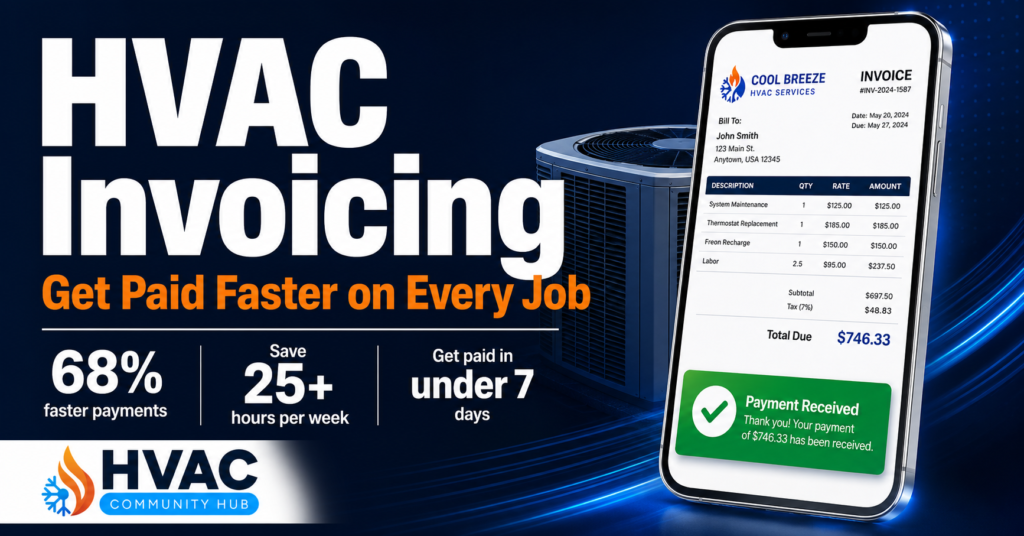
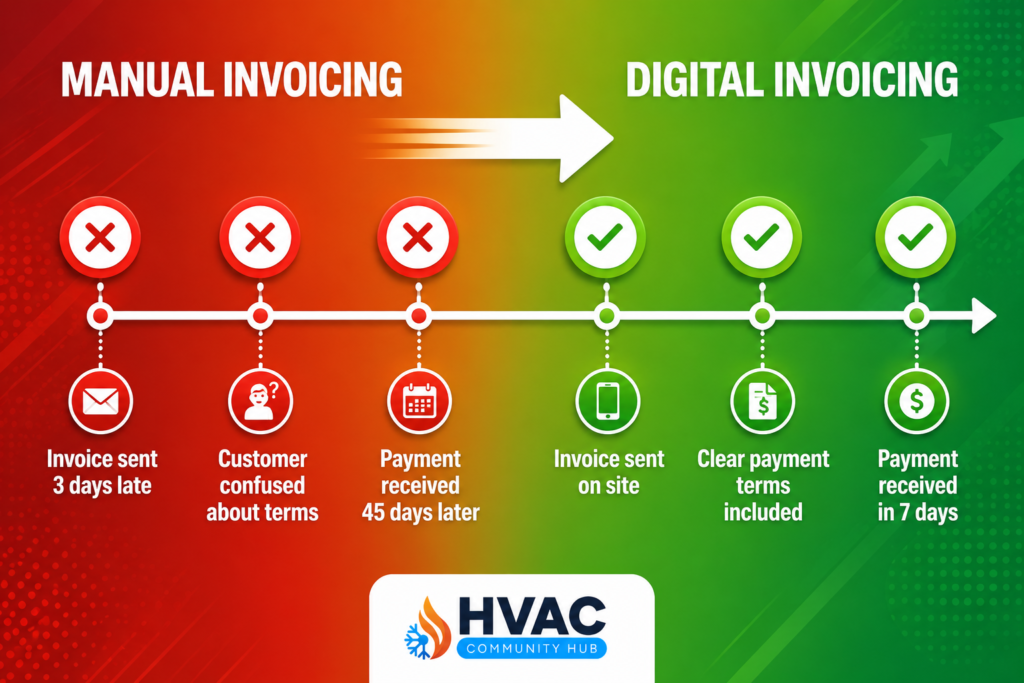
Slow and messy HVAC invoicing is one of the biggest hidden problems in the HVAC industry. In fact, research shows that HVAC businesses using manual invoicing wait an average of 30 to 45 days to get paid — while those using modern invoicing systems get paid in under 7 days. Furthermore, 68% of HVAC businesses that switched to proper invoicing software reported a significant improvement in cash flow within the first month. This guide shows you exactly how to fix your HVAC invoicing process, get paid faster on every job, and stop chasing late payments for good.
Why HVAC Invoicing Is Costing You More Than You Think
Most HVAC business owners think of invoicing as an admin task. However, how and when you invoice directly affects how much money sits in your bank account at any given time. HVAC billing software can save business owners over 25 hours of manual work per week — time that could be spent on more jobs or growing the business.
Furthermore, late payments create a damaging cycle. When customers pay late, you struggle to pay your suppliers on time. When suppliers are not paid on time, you cannot order parts quickly. As a result, jobs get delayed, customers get frustrated, and your reputation suffers — all because of a broken invoicing process.
The Real Numbers Behind Late HVAC Payments
The numbers tell a clear story. Customers pay faster when they understand exactly when payment is due, what payment methods are accepted, whether a deposit is required, and what the late payment policy is. Yet most HVAC businesses send invoices days after job completion with unclear payment terms and no follow-up system.
Consider this — if your average job value is $1,500 and you have 20 unpaid invoices sitting at any given time, that is $30,000 of your own money sitting in other people’s bank accounts. Fixing your invoicing process does not just improve your cash flow. It puts money back in your pocket that is already yours.
What Slow Invoicing Actually Costs Your Business
Every day an invoice goes unsent is a day you are giving your customer an interest-free loan. Every week a payment sits overdue is a week your business is funding someone else’s cash flow instead of its own.
Furthermore, the admin time spent chasing late payments is time taken away from running and growing your business. Most HVAC owners who calculate the true cost of their invoicing problems are shocked by the number. The fix is not complicated. It simply requires a proper system.
What Every Professional HVAC Invoice Must Include
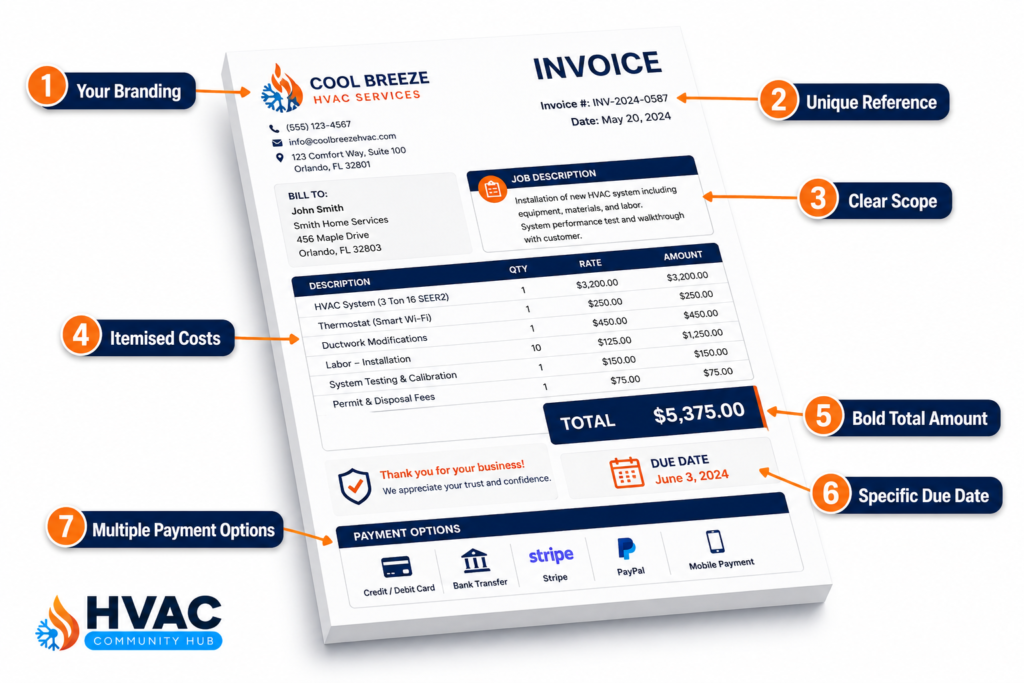
A professional HVAC invoice is not just a request for payment. It is a document that builds trust, prevents disputes, and makes it easy for customers to pay quickly. Here is exactly what every invoice must contain.
1.Your Business Details and Branding
Every invoice starts with your logo, business name, phone number, email address, and website. This makes the invoice look professional and gives the customer everything they need to contact you if they have a question.
Furthermore, a branded invoice reinforces your professionalism every time a customer opens their email. It is a small but powerful detail that separates organised HVAC businesses from those that look amateur.
2. A Unique Invoice Number and Date
Every invoice needs a unique reference number and the date it was issued. This makes follow-up conversations simple and professional. Furthermore, invoice numbers help you track which invoices are paid and which are outstanding — essential for managing your cash flow accurately.
3. A Clear Description of Work Completed
Describe the work done in clear and simple language. Include the date the job was completed, what was installed or repaired, the equipment make and model where relevant, and any warranty details.
Clear breakdowns prevent disputes and build trust. Include coverage details if applicable. This reassures clients about the quality of work provided. A customer who can see exactly what was done is far less likely to dispute the invoice or delay payment.
4. An Itemised Cost Breakdown
Never send an invoice with just a single total amount. Always break it down into line items — labour, parts, equipment, call-out fee, and any additional charges. Be transparent by itemizing equipment, parts, and labor. Clear breakdowns prevent disputes and build trust.
Customers who can see exactly what they are paying for pay faster and dispute less. Furthermore, an itemised invoice protects you legally if a customer later questions the charges.
5. A Bold and Clear Total Amount Due
Make the total amount impossible to miss. Use a larger font size. Put it in a coloured box. Bold it. Whatever you do — make sure the customer sees the total amount immediately without having to search for it.
Bold the amount due section to make it stand out. This sounds simple but many HVAC invoices bury the total at the bottom of a long document. Making it visible reduces confusion and speeds up payment.
6. A Clear Payment Due Date
Never use vague terms like “payment due upon receipt.” Always state a specific date. For example — “Payment due by 15 June 2026.” A specific date creates a clear deadline that customers respect far more than a vague instruction.
Furthermore, stating the due date prominently gives you a clear basis for follow-up. When the due date passes without payment, you have a specific date to reference in your reminder message.
7. Multiple Payment Options
Offering choices like credit cards, ACH transfers, or mobile payments simplifies the process and removes common barriers to timely payments. The more ways a customer can pay, the faster they will pay.
At minimum, accept credit and debit card payments. In addition, offer bank transfer, online payment links, and where possible, tap-to-pay on site at job completion. Every payment barrier you remove is a day off your average payment time.
8. Your Late Payment Policy
Include a clear and polite statement of your late payment policy on every invoice. For example — “Invoices unpaid after 14 days will incur a 2% late payment fee.” This does not need to be aggressive. It simply sets clear expectations from the start.
Customers pay faster when they understand exactly when payment is due and what the late payment policy is. Most customers who see a late payment policy will prioritise your invoice to avoid the fee — even if they pay other invoices late.
How to Get Paid Faster — The 5 Most Effective Strategies
Knowing what to include in an invoice is only part of the solution. How and when you send it matters just as much.
Strategy 1 — Send the Invoice on Site the Moment the Job Is Done
The single most effective thing you can do to get paid faster is to send the invoice before you leave the job. Same-day invoicing means the job is done and the invoice goes out immediately. On-site payment means the customer pays while the technician is still there.
When you hand a customer their invoice on the spot — or send it to their phone as you pack up your tools — they are still in the mindset of the job being fresh. The longer you wait to send the invoice, the more the urgency fades and the more likely they are to set it aside.
Strategy 2 — Collect Deposits Before Starting Large Jobs
For any job over $1,000, always collect a deposit before starting work. Deposits give HVAC businesses financial stability, reduce risk, help cover equipment costs upfront, and ensure customer commitment before major work begins.
A 30 to 50% deposit is standard practice for large installations. Furthermore, collecting a deposit upfront separates serious customers from those who might try to avoid payment. Any customer who refuses to pay a reasonable deposit on a large job is a red flag worth taking seriously.
Strategy 3 — Automate Your Payment Reminders
Chasing late payments manually is one of the most time-consuming and uncomfortable tasks in running an HVAC business. Instead of chasing late payments manually, HVAC invoicing software can send friendly reminders automatically. You choose the timing, tone, and frequency.
Set up automatic reminders at three points — 3 days before the due date, on the due date itself, and 3 days after the due date if unpaid. These gentle nudges keep your invoice at the top of the customer’s mind without you having to pick up the phone or write a single message.
Strategy 4 — Offer a Small Early Payment Discount
A 2 to 3% discount for payment within 48 hours is a small cost that often produces a big result. Customers who were planning to pay in two weeks will often pay the same day if there is a small saving involved.
Furthermore, the discount pays for itself many times over in improved cash flow. Having money in your account two weeks earlier is worth far more than the 2% you give away.
Strategy 5 — Use Invoicing Software That Connects to Your CRM
Manual invoicing and CRM systems that do not talk to each other create gaps. Jobs get invoiced late. Payment status does not update. Follow-ups get missed. As a result, money stays outstanding longer than it should.
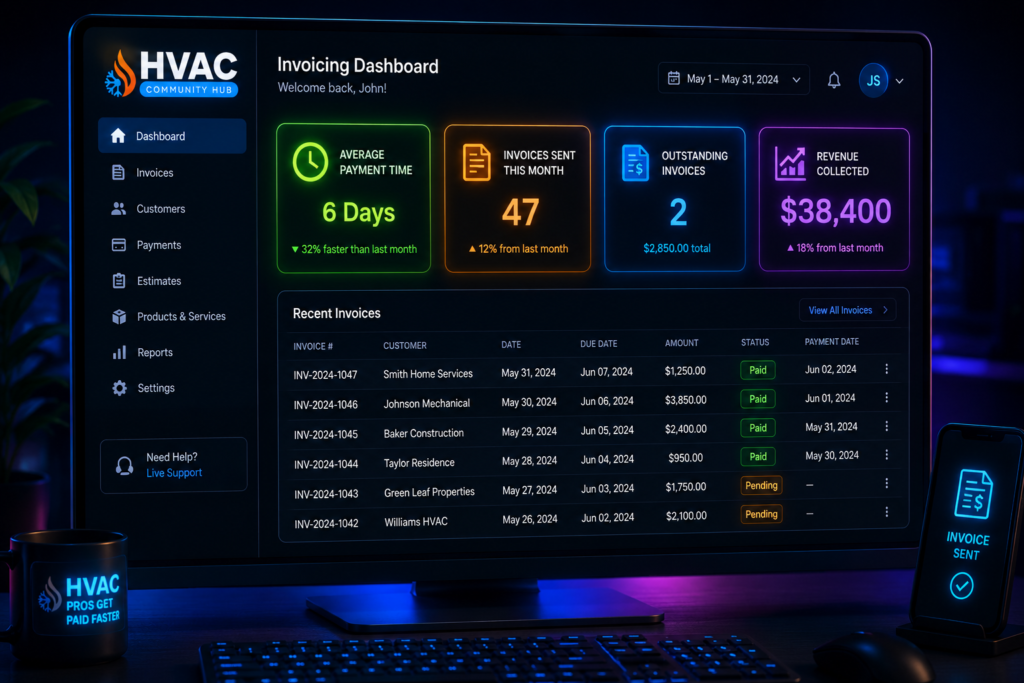
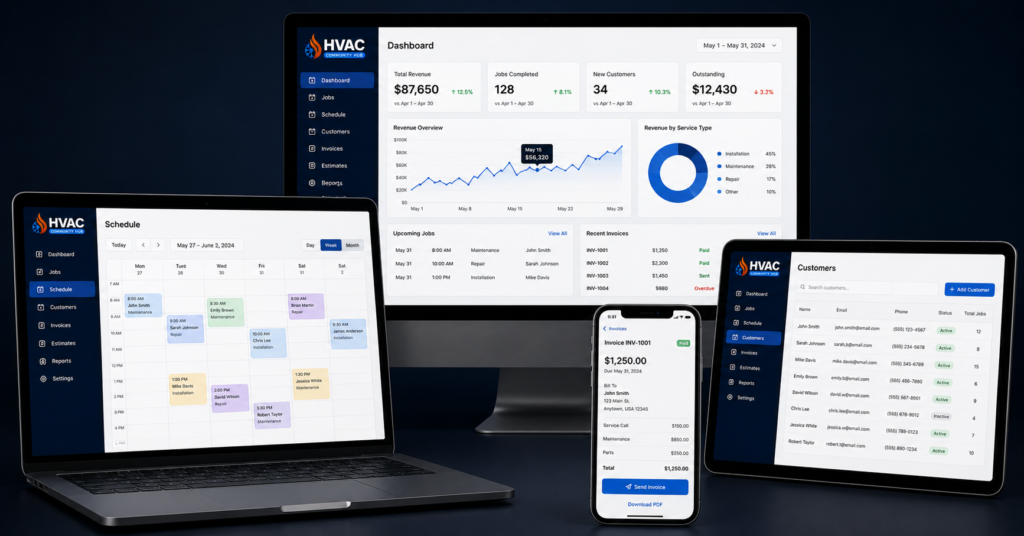
The best HVAC invoicing systems connect directly to your CRM so that when a job is marked complete, the invoice is generated automatically. Payment status updates in real time. Reminders fire automatically. And you can see exactly which invoices are paid and which need attention from a single dashboard. You can learn more about how CRM connects to your invoicing process in our full guide — HVAC CRM PLAYBOOK
Common HVAC Invoicing Mistakes That Delay Payments
Even experienced HVAC businesses make these invoicing mistakes regularly. Recognising them is the first step to fixing them.
Sending Invoices Days After the Job
Every day between job completion and invoice delivery gives the customer more time to forget, deprioritise, or dispute the charge. Send invoices the same day — ideally on site.
Using Vague Payment Terms
“Payment due upon receipt” means nothing to most customers. Specify the exact due date on every invoice. Furthermore, state your accepted payment methods clearly so customers have no reason to delay.
Not Following Up on Overdue Invoices
Many HVAC owners feel uncomfortable chasing payments. However, following up on overdue invoices is not aggressive — it is professional. A polite automated reminder is all most customers need to pay promptly. Without it, invoices get buried and forgotten.
Accepting Only Bank Transfer or Cheque
Limiting payment options slows everything down. Customers who would happily pay by card today may procrastinate for a week before getting around to a bank transfer. Accept as many payment methods as possible. Make paying you the easiest thing on their to-do list.
Frequently Asked Questions About HVAC Invoicing
When should I send an HVAC invoice?
Send the invoice on site the moment the job is complete. If that is not possible, send it within 2 hours of leaving the job. The sooner the invoice arrives, the faster you get paid.
What payment terms should I use on HVAC invoices?
For residential jobs, net 7 or net 14 terms work well — meaning payment is due within 7 or 14 days. For commercial jobs, net 30 is more standard. Always state the specific due date rather than a number of days to avoid confusion.
Should I charge a late payment fee?
Yes — and state it clearly on every invoice. A late payment fee of 1.5 to 2% per month is standard in the trades industry. Most customers will pay on time simply to avoid the fee. For repeat late payers, enforce it consistently.
What is the best HVAC invoicing software in 2026?
Popular options include Jobber, Housecall Pro, and ServiceTitan for larger businesses. For smaller HVAC businesses, simpler tools like Invoice2go or Xero work well. The best software is the one your team will actually use consistently on every job.
How do I reduce disputes on HVAC invoices?
Include a detailed description of work completed, an itemised cost breakdown, and any warranty details on every invoice. Clear and transparent invoices eliminate most disputes before they start. Furthermore, getting a customer signature on the completed job sheet before leaving creates a written record of acceptance.
Fix Your HVAC Invoicing and Watch Your Cash Flow Transform
Your HVAC invoicing process is either working for your business or against it. Every late invoice, every unclear payment term, and every missing follow-up is money that should be in your account sitting somewhere else instead.
Start With One Change Today
First, commit to sending every invoice on the same day the job is completed. This single change alone will reduce your average payment time significantly. Then add clear payment terms and a specific due date to every invoice. Finally, set up at least one automated payment reminder for overdue invoices.
Furthermore, if you want support building a professional invoicing and payment system — including CRM integration, automated reminders, and a community of HVAC owners sharing what works — HVAC Hub is exactly where to start.
Visit hvachub.co to join free and start getting paid faster on every job in 2026. You can also read our HVAC quotes guide to see how great quoting connects to faster invoicing — HVAC QUOTES

Responses