
AI in HVAC Troubleshooting: Transforming Diagnostics 2025

The HVAC industry is evolving faster than ever, and AI in HVAC troubleshooting is leading that transformation. As systems become more advanced and customer expectations rise, technicians need tools that help them diagnose issues quickly, accurately, and confidently. Artificial intelligence is delivering exactly that. In 2025, AI-powered diagnostics, predictive maintenance, and smart sensors are becoming essential tools for HVAC professionals who want to stay competitive and efficient.
In this post, we’ll explore how AI is reshaping HVAC troubleshooting, why it matters, and how technicians and business owners can benefit from these powerful new technologies.
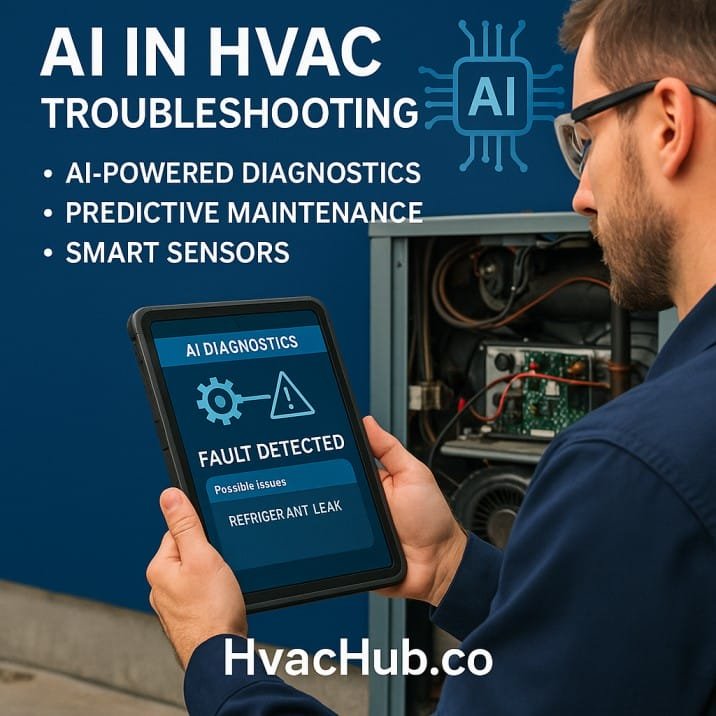
1. AI Makes Diagnostics Faster and More Accurate
Traditional HVAC troubleshooting relies heavily on experience, intuition, and trial-and-error testing. However, AI now analyzes system behavior in real time. These tools collect data from sensors, thermostats, and equipment components and instantly identify patterns that indicate potential issues.
Instead of spending time guessing or checking every part manually, technicians receive immediate diagnostic insights. For example, AI systems can detect refrigerant leaks, airflow imbalances, motor failures, and coil blockages long before they become severe.
As a result, HVAC techs can solve complex problems in minutes instead of hours, increasing productivity and improving customer satisfaction.
2. Predictive Maintenance Prevents Breakdowns Before They Happen: AI in HVAC Troubleshooting
One of the most powerful uses of AI in HVAC troubleshooting is predictive maintenance. AI doesn’t just find existing issues-it predicts future ones. It tracks trends in temperature, pressure, amperage, airflow, and vibration. When data falls outside normal ranges, AI sends warnings.
This means:
- Units get serviced before failure
- Expensive breakdowns become less common
- Customers avoid emergency repair costs
- Businesses reduce stress and workload during peak seasons
Predictive maintenance creates a smoother, more proactive service experience for everyone involved.
3. AI Helps New Technicians Perform Like Experienced Pros
The HVAC labor shortage continues, and many companies rely on newer technicians with limited field experience. AI is closing that skill gap.
AI-powered diagnostic apps and smart tools provide:
- Step-by-step repair recommendations
- Real-time insights
- Error explanations
- Component testing guidance
Because of this support, new technicians no longer need years of experience to troubleshoot confidently. They can follow AI-driven instructions, complete accurate repairs, and learn faster on the job. This improves service quality across the entire team.
4. Smart HVAC Systems Learn Customer Behavior: AI in HVAC Troubleshooting
Modern HVAC systems and thermostats are now equipped with built-in AI technology. They learn household patterns, temperature preferences, and energy usage habits.
These systems adjust automatically to optimize comfort and efficiency. That means fewer service calls caused by “user error,” lower energy bills for customers, and a more connected experience between homeowners and their HVAC systems.
5. AI Improves Customer Transparency and Trust
AI improves communication between technicians and customers. Diagnostic apps can generate simple, easy-to-understand reports showing what went wrong and how it was fixed.
Customers appreciate:
- Visual explanations
- Data-based recommendations
- Faster repair decisions
- Clear cost breakdowns
When clients understand the issue clearly, they trust the technician more. This builds long-term loyalty, increases repeat service, and boosts referrals.
6. HVAC Businesses Gain a Competitive Edge: AI in HVAC Troubleshooting
Companies adopting AI in 2025 are outperforming those using traditional troubleshooting methods. AI helps HVAC businesses:
- Reduce callbacks
- Decrease diagnostic time
- Improve technician efficiency
- Increase customer satisfaction
- Lower operational costs
Because AI works 24/7, businesses gain insights that would take humans weeks to discover.
Final Thoughts
AI in HVAC troubleshooting isn’t replacing technicians-it’s empowering them. With faster diagnostics, predictive maintenance, and intelligent guidance, AI helps HVAC professionals deliver better results with less stress. As technology continues to advance in 2025, HVAC businesses that embrace AI will stand out, grow faster, and serve customers with unmatched accuracy and reliability.
Ready to stay ahead of the HVAC industry’s future? Join the HVAC Community Hub today and grow with a network of forward-thinking professionals.

Responses