
HVAC Business Structure: When Organized Companies Lack Systems

HVAC business structure can appear strong on the surface while major operational gaps still exist underneath.
Many HVAC companies look organized. The office runs daily schedules, technicians complete jobs, and customers continue calling for service. From the outside, everything seems to be working smoothly.
However, appearance and structure are not the same thing.
In many cases, businesses that look organized are actually operating without clear systems behind their daily activities.
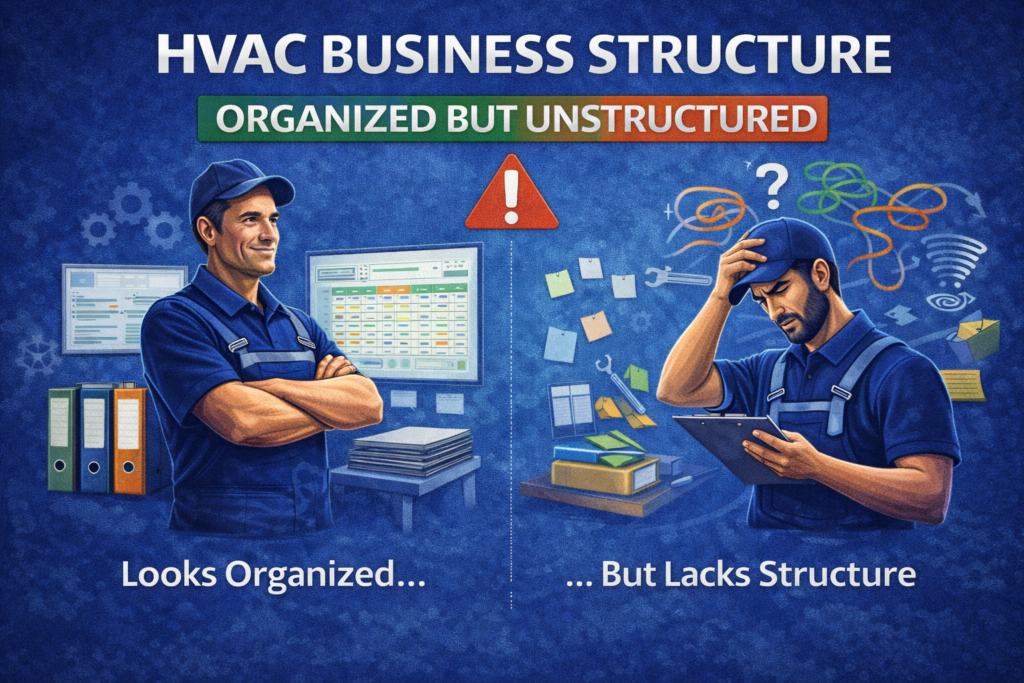
Why Organization Can Be Misleading
Organization often means tasks are getting done. Phones are answered, jobs are scheduled, and technicians arrive at customer homes.
Because work continues moving, owners assume the business structure is solid.
Yet true HVAC business structure goes beyond daily activity. Structure means processes are defined, responsibilities are clear, and systems guide how work moves through the company.
Without those systems, teams often rely on habit instead of structure.
Signs a Company Looks Organized but Isn’t Structured
The difference between activity and structure usually becomes visible during stressful situations.
For example, when demand increases or a key employee is absent, problems quickly appear.
Common signs include:
• Dispatch depends on one experienced person
• Technicians follow different service procedures
• Job documentation varies between team members
• Install standards are not clearly defined
• Managers solve problems differently each time
Although work still gets completed, the company depends heavily on individual effort instead of reliable systems.
When Structure Is Missing, Leaders Carry the Weight
In businesses without strong structure, owners often become the central problem-solvers.
Employees ask questions constantly.
Supervisors wait for direction.
Important decisions require leadership approval.
Over time, this creates a hidden leadership burden.
Instead of focusing on growth and improvement, leaders spend their time correcting operational confusion.
This is one of the biggest risks when HVAC business structure is weak.
Systems Create Stability
Healthy companies reduce this pressure by building structured processes.
Clear systems help teams understand how work should happen without constant supervision.
For example, structured companies often create:
• Defined service documentation standards
• Installation checklists and quality controls
• Clear dispatch procedures
• Consistent communication protocols
• Defined leadership responsibilities
Because processes guide decisions, teams operate with greater consistency.
Structure Supports Sustainable Growth
Growth always exposes operational weaknesses.
When HVAC companies expand without strengthening structure, complexity increases quickly. More technicians, more customers, and more jobs create additional pressure on the organization.
Without systems supporting that growth, confusion multiplies.
However, companies with strong HVAC business structure scale more smoothly because their systems guide daily operations.
Final Thought
Looking organized is not the same as being structured.
Many HVAC companies operate efficiently for years before realizing their processes depend too heavily on individual effort. Eventually, those hidden gaps create operational stress.
Strong companies focus on building structure behind their daily activity. Clear systems, documented procedures, and defined roles create stability that supports long-term growth.
Join the HVAC Community Hub
If you want practical insights on building stronger systems, improving leadership structure, and creating more stable HVAC operations, join now HVAC Community Hub.
Inside the community, HVAC professionals share real strategies designed to help businesses grow with clarity, consistency, and stronger operational foundations.
Responses