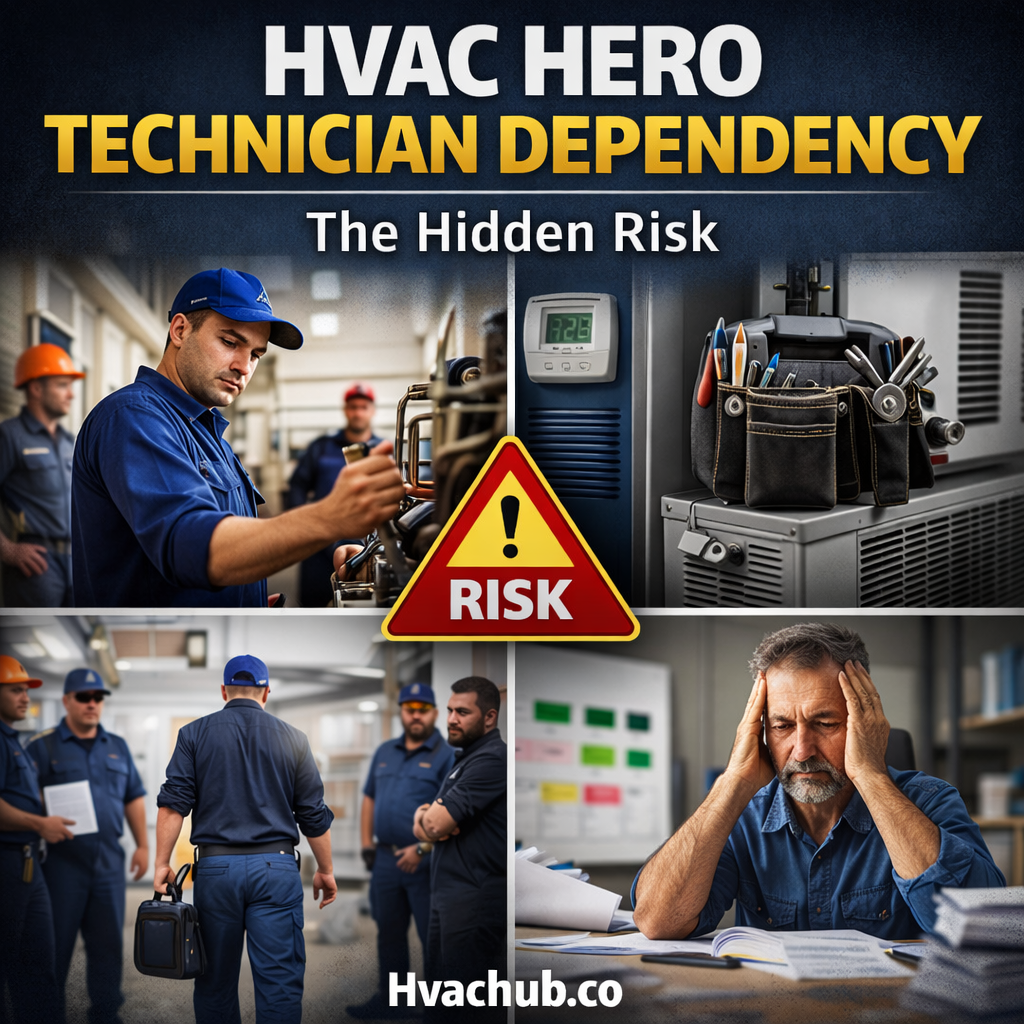
HVAC Hero Technician Dependency: The Hidden Risk

HVAC hero technician dependency creates serious risk inside growing companies.
At first, it looks like strength.
One technician handles the toughest jobs.
That person solves complex problems.
Customers ask for them by name.
However, over time, the business begins to rely too heavily on that one individual.
That is where instability begins.
Why Hero Technicians Seem Like an Asset
Every company values strong performers.
A hero technician often:
- Fixes jobs others struggle with
- Works faster than the team average
- Handles difficult customers calmly
- Requires little supervision
Because of this, owners give them more responsibility. They assign high-value installs. They trust them with urgent calls.
As a result, revenue depends on one person’s performance.
When Strength Turns Into Structural Risk
HVAC hero technician dependency becomes dangerous when knowledge and responsibility concentrate in one place.
For example:
- Only one technician knows certain system setups
- Complex installs get assigned to the same person repeatedly
- Other technicians stop developing similar skills
Gradually, skill distribution weakens.
If that technician calls in sick, takes vacation, or leaves unexpectedly, operations slow down immediately.
The business does not lack talent.
It lacks redundancy.
Signs You Have a Hero Dependency Problem
You may notice warning signs such as:
- Schedules built around one technician’s availability
- Supervisors escalating advanced jobs to the same person
- Customers requesting only one technician
- Other team members avoiding complex work
- Owners feeling anxious when that technician is unavailable
These signals point to HVAC hero technician dependency rather than simple high performance.
Why Growth Makes Dependency Worse
As job volume increases, pressure grows.
Instead of spreading responsibility, companies often double down on the hero. They assign even more complex work to the strongest technician.
Although this feels efficient in the short term, it increases long-term risk.
Eventually, burnout becomes likely. Meanwhile, other technicians remain underdeveloped.
Growth should build bench strength.
Hero dependency does the opposite.
The Cultural Impact of Hero Dependency
This issue does more than create operational risk.
It also shapes culture.
When one technician becomes the problem solver for everything, others may stop pushing themselves. Supervisors may avoid coaching. Training may lose urgency.
Over time, performance gaps widen.
Instead of building a strong team, the company builds a single point of failure.
How to Reduce HVAC Hero Technician Dependency
First, distribute complex work intentionally. Rotate advanced installs so more technicians build capability.
Next, document processes clearly. Capture knowledge from your strongest technician and turn it into training material.
Then, connect performance metrics to team development. Reward knowledge sharing, not just individual output.
When skill spreads across the team, stability increases.
Stability Comes From Depth, Not Heroes
Strong businesses do not rely on single performers.
They build systems where multiple technicians can handle complex work confidently.
HVAC hero technician dependency may feel like strength. In reality, it hides structural weakness.
A company should scale because of its structure — not because of one person’s ability.
Final Thought
Hero technicians deserve recognition.
However, a business that depends on one person eventually feels pressure.
Reduce HVAC hero technician dependency before it becomes a crisis.
Build depth. Build structure. Build resilience.
Join the HVAC Community Hub
If you want frameworks that strengthen team capability and reduce structural risk, join now HVAC Community Hub.
Inside, we focus on building HVAC businesses that scale through systems – not hero reliance.
Responses