
HVAC Leadership Structure: What Growth Reveals

HVAC leadership structure determines whether growth creates stability or chaos.
In the early stages, many companies operate with informal leadership. The owner makes most decisions. Supervisors handle issues as they arise. Communication flows directly through a few key people.
At a small scale, this works.
However, growth changes the pressure.
More trucks.
More technicians.
More customers.
More complexity.
That is when hidden weaknesses become visible.
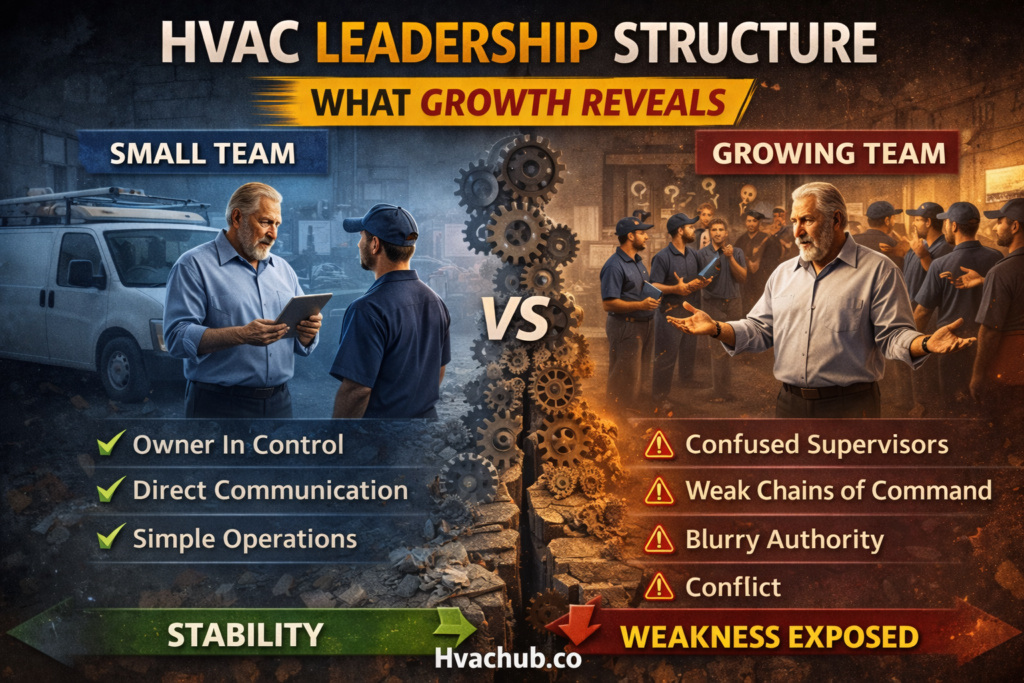
Why Small Teams Can Mask Structural Gaps
In a five-truck operation, the owner can personally oversee most decisions. If something goes wrong, they step in quickly. Because the team is small, alignment feels easier.
As a result, structural gaps remain invisible.
There may be no clear chain of command. Roles may overlap. Supervisors may lack defined authority.
Nevertheless, the business continues moving forward.
Growth, however, removes that cushion.
What Growth Actually Exposes
When job volume increases, informal leadership breaks down.
For example:
- Decisions get delayed because no one knows who owns them
- Supervisors hesitate because authority feels unclear
- Field and office conflict increases
- Accountability becomes inconsistent
These are not execution problems.
They are structural problems.
HVAC leadership structure must evolve as complexity increases. Otherwise, pressure builds faster than clarity.
Signs the Structure Is Weak
You may notice warning signals such as:
- Owners pulled into daily problem solving
- Supervisors unsure of decision rights
- Repeated escalation of small issues
- Confusion about performance ownership
- Growth creating stress instead of stability
When structure lacks definition, friction increases naturally.
In contrast, clear leadership layers create predictability.
Why More Revenue Doesn’t Fix Structure
Some owners assume revenue growth will solve internal strain. They believe adding more people or investing in systems will ease pressure.
However, without a defined HVAC leadership structure, additional resources increase complexity.
More managers without defined authority create overlap.
More technicians without clear reporting lines create confusion.
More revenue without structural clarity amplifies stress.
Therefore, growth becomes heavier instead of smoother.
Structure Creates Stability
Strong companies define:
- Clear reporting lines
- Specific decision rights
- Measurable ownership of outcomes
- Consistent escalation paths
When leadership roles are defined clearly, problems get solved at the right level.
Consequently, the owner regains strategic focus.
HVAC leadership structure is not about control. It is about clarity.
Growth Should Reduce Chaos
Healthy scaling reduces friction.
Supervisors gain authority. Managers own results. Owners shift toward strategy instead of daily firefighting.
If expansion increases tension, the structure likely needs attention.
Growth does not create weakness.
It reveals it.
Final Thought
Every HVAC company reaches a point where informal leadership stops working.
At that moment, structure determines stability.
If your growth feels heavier than it should, examine the layers of authority, ownership, and accountability.
HVAC leadership structure is the foundation that allows scale without collapse.
Join the HVAC Community Hub
If you want frameworks that strengthen leadership layers and create scalable clarity, join now HVAC Community Hub.
Inside, we focus on building HVAC businesses that grow through structure — not stress.
Responses