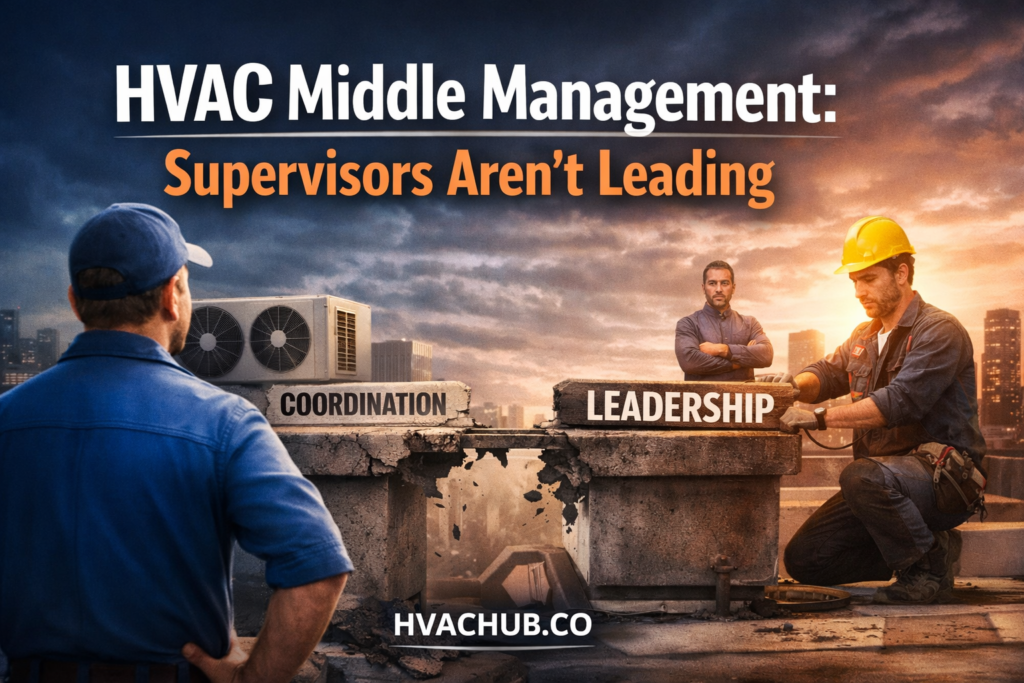
HVAC Middle Management: When Supervisors Aren’t Leading

In many growing companies, HVAC middle management looks stable from the outside.
Supervisors exist. Titles are assigned. Responsibilities appear clear.
However, leadership may still be missing.
That gap between coordination and real leadership quietly affects performance, accountability, and long-term growth.
The Difference Between Supervising and Leading
Supervising is reactive.
Leading is proactive.
A supervisor may answer technician questions, handle scheduling adjustments, and solve daily issues. While those tasks matter, they do not automatically create structure.
Leadership, on the other hand, requires:
- Enforcing standards consistently
- Correcting performance early
- Developing team members
- Preventing recurring problems
- Protecting systems under pressure
Without these elements, the middle layer becomes a communication channel rather than a stabilizing force.
Why the Leadership Gap Forms
Most companies promote their best technician into a supervisory role.
Technically, that makes sense. They know the field. They understand installs. The team trusts them.
Yet technical strength does not automatically translate into leadership ability.
For example, handling conflict, holding difficult conversations, and reinforcing accountability require completely different skills. When those skills aren’t developed, supervisors default to fixing issues themselves instead of building structure.
As a result, dependency increases.
Signs the Middle Layer Isn’t Holding Structure
The problem rarely announces itself loudly. Instead, it shows up in patterns:
- Technicians bypass supervisors and approach ownership
- Mistakes repeat across jobs
- Standards vary depending on oversight
- Meetings revolve around recurring issues
- Owners remain deeply involved in daily decisions
When this happens, coordination exists — but authority does not.
Growth Exposes the Weakness
During slow periods, this issue may remain hidden.
However, once the company grows, pressure increases.
More trucks create more moving parts. More installs raise quality risks. Revenue rises — and so do expectations.
If the middle layer cannot absorb that pressure, it shifts upward. Consequently, the owner becomes the stabilizer again.
Over time, this leads to fatigue and operational drift.
Where Accountability Really Stabilizes
Accountability does not start at the technician level. It stabilizes in the layer between ownership and the field.
If that layer does not:
- Reinforce expectations consistently
- Track measurable outcomes
- Address performance quickly
- Align daily work with company standards
Then accountability feels personal instead of structural.
Because of that, frustration spreads quietly across the organization.
Strengthening the Structure
Improving HVAC middle management begins with clarity.
First, define what leadership actually means inside your business. Make expectations measurable, not assumed.
Next, separate coordination from development time. Supervisors need space to coach, review, and improve systems — not just dispatch work.
Finally, tie authority to outcomes. Whether it’s callback reduction, quality control, or productivity targets, ownership must sit clearly within that middle layer.
When responsibility becomes measurable, leadership becomes visible.
The Stability Layer That Determines Scale
A company cannot scale on ownership and technicians alone.
There must be a stabilizing layer that absorbs pressure, protects standards, and builds future leaders.
When HVAC middle management operates effectively, growth feels controlled and predictable.
When it doesn’t, scaling feels chaotic — even if revenue is rising.
Final Thought
Titles do not create leadership.
Structure does.
If the layer between ownership and the field lacks clarity, authority, and accountability, it becomes a silent bottleneck.
And silent bottlenecks slow progress more than visible problems ever will.
Join the HVAC Community Hub
If you want to build stronger leadership systems, improve accountability, and create operational stability, join now HVAC Community Hub.
Inside the community, we focus on execution frameworks that help HVAC businesses scale with control not confusion.
Responses