
HVAC Peak Season Processes: Why Systems Break

HVAC peak season processes often break when demand suddenly rises.
Phones ring nonstop.
Install schedules fill quickly.
Service calls stack up.
At first, the busy period feels like success.
However, as pressure increases, the systems that normally keep operations organized begin to weaken. Small shortcuts appear, communication becomes rushed, and teams start prioritizing speed over structure.
That is when processes begin to slip.
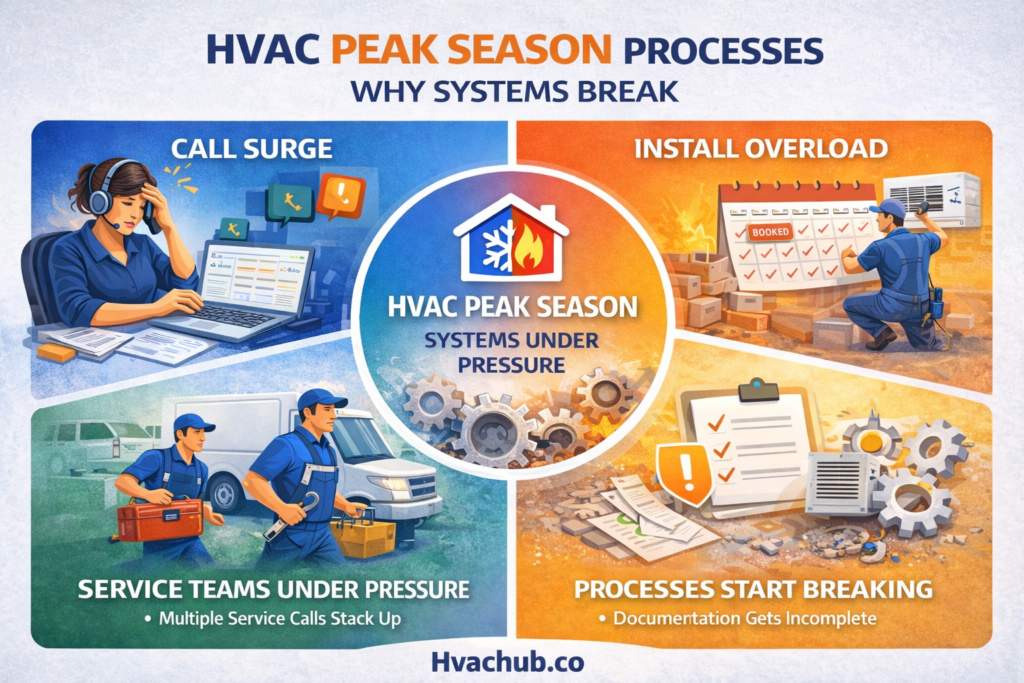
Why Busy Seasons Put Systems Under Pressure
Every HVAC business experiences periods when demand surges. During these months, leaders naturally focus on keeping up with customer requests.
To keep work moving, teams often start bending normal procedures.
Dispatchers may skip documentation steps.
Technicians rush through service notes.
Sales teams push jobs forward quickly.
Each shortcut saves time in the moment. However, repeated shortcuts gradually disrupt established routines.
When Temporary Shortcuts Become Permanent
During intense demand, many companies treat shortcuts as temporary solutions. They assume normal procedures will return once the busy season ends.
Unfortunately, that rarely happens.
Because teams adapt to faster habits, the original HVAC peak season processes are often forgotten. What started as a temporary adjustment becomes the new operating style.
Over time, this shift reduces consistency.
Signs Your Processes Never Recovered
Some HVAC companies notice the effects long after the busy period ends.
Common signals include:
- Job documentation becoming less detailed
- Scheduling conflicts increasing
- Customer communication becoming inconsistent
- Supervisors spending more time correcting mistakes
- Teams relying on memory instead of systems
Although these changes may seem small, they often trace back to procedures that broke during peak demand.
Why Systems Struggle to Return
Once habits change, returning to the original process requires effort. Teams become comfortable with faster routines, even if those routines create more mistakes.
At the same time, leaders may hesitate to slow the operation down again.
Because of this, HVAC peak season processes remain weakened even when workloads normalize.
The business continues operating, but efficiency slowly declines.
How Strong Companies Protect Their Systems
Healthy HVAC businesses expect busy seasons to challenge their structure. Instead of abandoning processes, they adjust them carefully.
For example, they may:
- Simplify documentation without removing it
- Assign supervisors to monitor quality more closely
- Create temporary workflows designed for high demand
- Review procedures once the season slows down
These adjustments allow teams to move quickly while still protecting operational discipline.
Stability Requires Consistent Systems
Busy periods will always test operations.
However, companies that maintain strong processes recover faster once demand stabilizes. Their systems continue guiding daily work instead of being replaced by rushed habits.
Reliable HVAC peak season processes protect quality, communication, and team coordination even during intense workloads.
Final Thought
Peak seasons bring opportunity, but they also test discipline.
If systems break during high demand and never return, the business slowly loses consistency.
Strong companies treat busy months as a stress test. They protect their processes while adapting to demand.
When structure survives the busiest season, the entire operation becomes stronger.
Join the HVAC Community Hub
If you want frameworks that help HVAC companies strengthen processes, maintain discipline during busy seasons, and scale with operational stability, join now HVAC Community Hub.
Inside, we focus on helping HVAC businesses grow with structure, clarity, and control.
Responses