

HVAC Quotes: How to Write Quotes That Win More Jobs

Most HVAC businesses lose jobs not because their price is too high but because their HVAC quotes are not professional enough to build trust. In fact, research shows that most homeowners gather quotes from at least three different HVAC contractors before making a decision. Furthermore, the contractor who wins is not always the cheapest — it is the one whose quote looks the most professional, feels the most transparent, and gives the customer the most confidence. This guide shows you exactly how to write HVAC quotes that win more jobs, close faster, and help your business grow in 2026.
Why Most HVAC Quotes Lose Jobs Before the Customer Even Reads Them
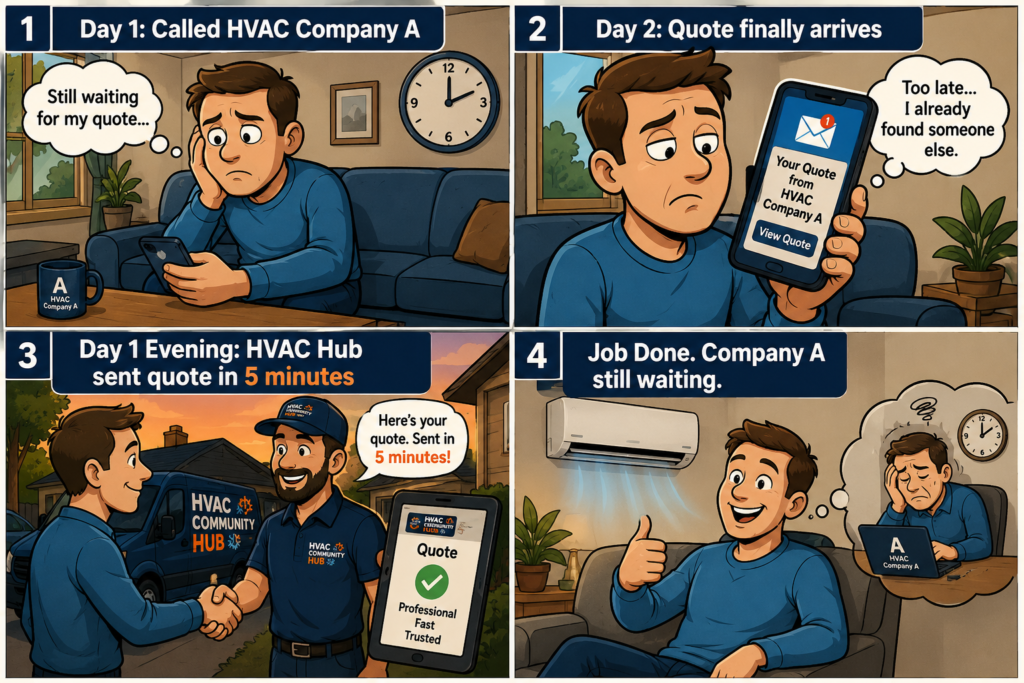
Speed is one of the biggest factors in winning HVAC jobs. Research from OnCall Air shows that contractors who send quotes within 5 minutes of a site visit close significantly more jobs than those who send them the next day. Furthermore, every hour you wait to send a quote is an hour the customer is reading a competitor’s quote instead.
The second biggest reason HVAC quotes fail is presentation. A quote typed on a plain document with no branding, no breakdown, and no clear terms does not inspire confidence. In contrast, a professional branded quote with itemised costs, clear scope of work, and payment terms tells the customer that your business is organised, trustworthy, and worth the investment.
What Customers Look for in an HVAC Quote
Before writing a single word, it helps to understand what customers actually want to see. Most homeowners are not HVAC experts. They cannot judge your quote on technical merit alone. Instead they judge it on clarity, transparency, and professionalism.
Customers want to know exactly what work will be done. They want to see a clear breakdown of costs so there are no surprises. They want to know the timeline. They want to understand the warranty. And they want to feel confident that the person they are hiring knows what they are doing. A quote that answers all of these questions wins jobs. A quote that leaves them guessing sends them to your competitor.
The Real Cost of a Slow or Unprofessional Quote
Every quote you send late or unprofessionally is a job you are giving away. Consider this — if your average job value is $2,500 and you lose just two jobs per month because of poor quoting, that is $5,000 in lost revenue every month. Over a year that is $60,000 in lost jobs from a fixable problem.
Furthermore, a poor quote damages your brand even with customers who do hire you. They remember the disorganised quote and they are less likely to refer you to friends and family. Fixing your quoting process is one of the highest-return improvements any HVAC business can make.
What Every Professional HVAC Quote Must Include
A winning HVAC quote is not just a price. It is a complete document that answers every question the customer has before they even think to ask it. Here is exactly what to include.
1.Your Business Branding at the Top
Every quote should start with your logo, business name, phone number, email, and website. This makes the quote look professional immediately and makes it easy for the customer to contact you. Furthermore, a branded quote signals that you run a real and organised business — not a one-man operation working from a notepad.
2.Customer Details and Quote Reference Number
Include the customer’s name, address, and contact details at the top of every quote. Add a unique quote reference number. This makes follow-up conversations easy — instead of saying “the quote I sent you”, you say “quote number 2026-047”. Furthermore, a reference number signals to the customer that your business handles volume and is organised enough to track its work.
3.A Clear Scope of Work
This is the most important part of any HVAC quote. Describe exactly what work will be done. Be specific. For example, do not write “install new AC unit.” Instead write “supply and install one Daikin 3.5kW split system air conditioner to the main living area, including all electrical connections, drainage, and commissioning.”
The more specific your scope of work, the more confident the customer feels. Furthermore, a detailed scope protects you legally — if a customer later claims you did not do something, your quote is the written record of exactly what was agreed.
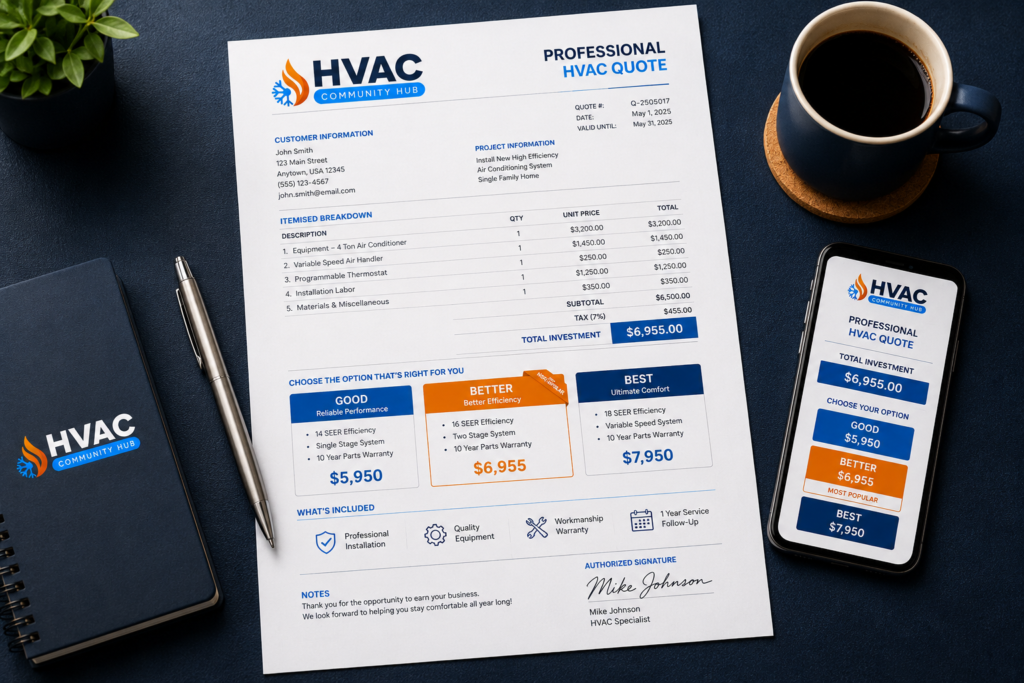
4.An Itemised Cost Breakdown
Never send a quote with just one total price. Always break down the cost into line items — labour, equipment, materials, and any additional charges. Transparent pricing is one of the strongest trust signals you can give a customer.
Research shows that contractors who use itemised quotes win 23% more jobs than those who send a single lump sum figure. Customers feel reassured when they can see exactly what they are paying for. They are less likely to question the price and more likely to say yes quickly.
5.The Good Better Best Options
One of the most powerful quoting strategies in 2026 is presenting three options — a Good option, a Better option, and a Best option. Each one offers more value at a higher price point.
For example, your Good option might cover the basic installation with a standard unit. Your Better option upgrades to a more energy-efficient unit with a longer warranty. Your Best option includes the premium unit, extended warranty, and a maintenance agreement for the first year. In 2026, contractors who respond with value-based options close 35 to 45% more jobs than those who simply send one price. Furthermore, presenting three options shifts the customer’s decision from whether to hire you to which option to choose.
6.Timeline and Start Date
Include a clear statement of when you can start the job and how long it will take to complete. Customers want certainty. Knowing that the job starts on Tuesday and takes two days removes uncertainty and speeds up the decision.
Furthermore, if you can offer a faster start date than competitors, say so clearly in your quote. Speed of service is a genuine selling point — especially during peak season when homeowners need urgent help.
7. Warranty and Guarantee Details
Every professional HVAC quote should clearly state the warranty on both parts and labour. This removes one of the most common customer objections before it is even raised.
Furthermore, if you offer any additional guarantees — a satisfaction guarantee, a no-call-back guarantee, or a price lock guarantee — include these in every quote. These small additions make a big difference in how much confidence the customer feels when deciding whether to hire you.
8. Clear Payment Terms
State exactly how and when you expect to be paid. For example, “50% deposit on acceptance, balance due on completion.” Clear payment terms set the right expectation from the start and reduce the risk of payment issues after the job is done.
You can learn more about how to handle payment terms and contracts in our full pricing guide — [ADD LINK TO HVAC PRICING POST HERE]
How to Send HVAC Quotes Faster and Win More Jobs
Writing a great quote is only half the battle. Sending it fast is equally important. Research from the HVAC industry consistently shows that the first professional quote a customer receives has the highest chance of winning the job.
Use Quoting Software to Send in Minutes
Manual quoting — typing up a new document for every job — is slow and inconsistent. Different technicians produce different quality quotes. Some forget to include warranty details. Others forget payment terms. As a result, your quote quality varies and your win rate suffers.
Quoting software solves this instantly. With a pre-built template, your technician can fill in the job details on their phone and send a professional branded quote within 5 minutes of finishing the site visit. Furthermore, the customer receives the quote while you are still fresh in their mind — before they have had a chance to call anyone else.
Follow Up on Every Quote You Send
Most HVAC businesses send a quote and wait. However, a simple follow-up call or message 24 to 48 hours after sending dramatically increases your win rate. The follow-up does not need to be pushy. A short message saying “Just checking you received our quote and whether you have any questions” is enough.
Furthermore, many customers have not hired a competitor — they simply got busy and forgot to respond. Your follow-up puts you back at the top of their mind at exactly the right moment. You can learn more about how to follow up effectively using a CRM in our full guide —HVAC CRM PLAYBOOK
Make It Easy for Customers to Accept Your Quote
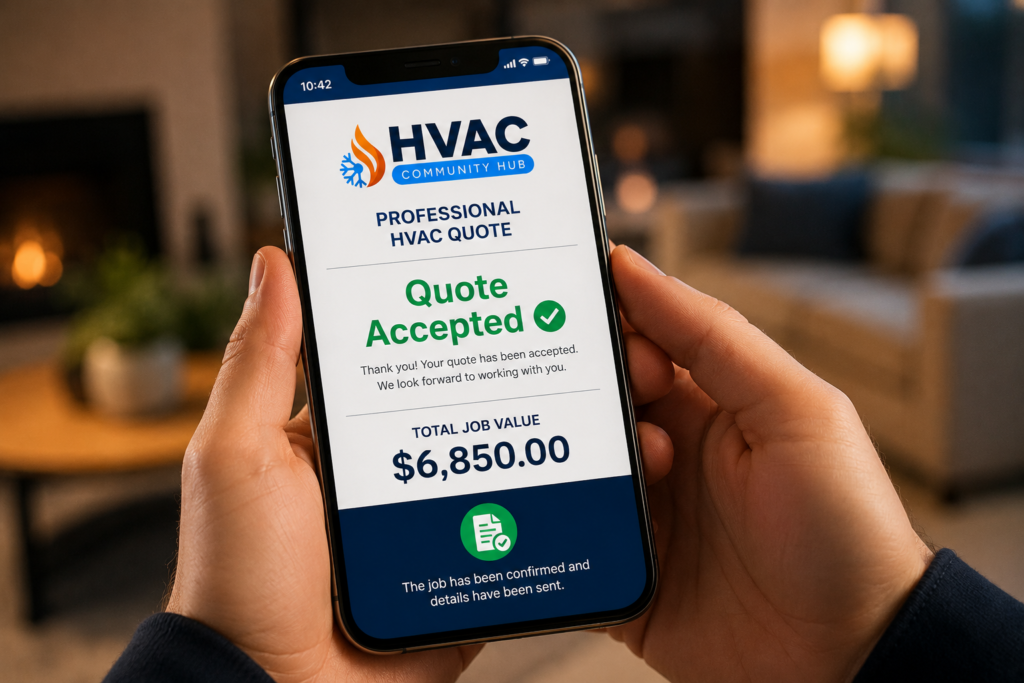
Every quote should include a clear and easy way for the customer to say yes. This means a digital signature option, a simple acceptance button in an email, or a phone number to call. The fewer steps between reading the quote and accepting it, the faster customers say yes.
Furthermore, offering digital acceptance means customers can approve your quote at 10pm from their sofa — without needing to wait for office hours. As a result, you wake up to accepted quotes and booked jobs without doing anything extra.
How to Handle the Most Common HVAC Quote Objections
Even the best quotes get questions. Knowing how to handle the most common objections confidently is what separates HVAC businesses that win the majority of their quotes from those that struggle to close.
Your Price Is Too High
This is the most common objection in HVAC quoting. However, it is rarely about the price itself. It is usually about perceived value. When a customer says your price is too high, they are really saying they are not yet convinced the price is worth it.
The right response is not to drop your price. Instead, walk them through the value. Explain your warranty, your experience, your response time if something goes wrong, and your reviews. Research shows that contractors who respond with value-based justifications close 35 to 45% more jobs than those who simply lower their price.
Another Company Quoted Less
When a customer tells you a competitor quoted less, ask a simple question — “Did their quote include the same warranty, the same equipment brand, and the same scope of work?” Most of the time the cheaper quote has excluded something important.
Furthermore, help the customer understand the risk of choosing based on price alone. A cheaper installation that fails in two years costs far more than paying a little extra for quality work that lasts. Your job is not to match the competitor’s price. Your job is to help the customer understand why your quote is the right investment.
Can I Think About It?
When a customer says they need to think about it, the worst thing you can do is say “of course, take your time.” Instead, ask what specific questions they still have. Often there is one thing holding them back that you can address immediately.
Furthermore, set a follow-up in your calendar for 48 hours later. A timely follow-up at the right moment converts more “I need to think about it” responses into accepted quotes than any other single action.
Frequently Asked Questions About HVAC Quotes
How quickly should I send an HVAC quote after a site visit?
Send your quote within 2 hours of the site visit whenever possible. Research shows that quotes sent within 5 minutes of a visit have the highest close rate. The longer you wait, the more likely the customer is to receive and accept a competitor’s quote first.
Should I offer Good Better Best options in every HVAC quote?
Yes — for any job over $500. Offering three options gives customers a choice rather than a yes or no decision. Furthermore, many customers will choose the middle or premium option when they can clearly see the additional value included.
How long should an HVAC quote be valid for?
Most HVAC businesses send a quote and wait. However, a simple follow-up call or message 24 to 48 hours after sending dramatically increases your win rate. The follow-up does not need to be pushy. A short message saying “Just checking you received our quote and whether you have any questions” is enough.
Furthermore, many customers have not hired a competitor — they simply got busy and forgot to respond. Your follow-up puts you back at the top of their mind at exactly the right moment. You can learn more about how to follow up effectively using a CRM in our full guide — HVAC CRM PLAYBOOK
Most HVAC businesses set quote validity between 14 and 30 days. This creates a gentle sense of urgency without pressuring the customer. Furthermore, stating a clear expiry date in the quote gives you a reason to follow up — “just checking in as your quote expires on Friday.”
Should I include photos in my HVAC quotes?
Yes — especially for larger jobs. Including a photo of the existing equipment, the installation location, or any issues you identified during the site visit makes your quote feel more personalised and professional. Furthermore, photos show the customer you paid close attention during the visit.
What is the best way to follow up on an HVAC quote?
Send a short and friendly message 24 to 48 hours after the quote. Ask if they have any questions and confirm they received it. If there is no response after a second follow-up, call directly. A personal call often closes jobs that would have been lost through message-only follow-ups.
Great HVAC Quotes Win Jobs Before the Competition Even Responds
The fastest and most professional HVAC quotes win the most jobs. Your HVAC quotes are often the first real impression a new customer gets of how your business operates. A slow, vague, or poorly formatted quote tells the customer your business is disorganised. In contrast, a fast, clear, and professional quote tells them they are in safe hands.
Start Improving Your Quotes Today
First, review your current quote template. Does it include all 8 elements covered in this guide? If not, add the missing ones this week. Then look at how quickly your team sends quotes after site visits and set a target of under 2 hours for every job.
Furthermore, if you want support building a professional quoting system — including templates, CRM integration, and a community of HVAC owners sharing what works — HVAC Hub is exactly where to start.
Accurate quotes depend on clear prices, payment options and a smooth sales process. Continue with profitable HVAC pricing, customer financing approval, and HVAC invoicing best practices.
Visit Hvachub.co to join free and start building the quoting system that wins more jobs in 2026. You can also explore our website design guide to see how a professional online presence supports your quotes — HVAC WEBSITE DESIGN POST

Responses