

HVAC Customer Complaints: Turn Frustration Into Loyalty

HVAC customer complaints are part of running a service business. Even companies with experienced technicians and strong processes will eventually deal with an unhappy customer. A delayed appointment, unexpected charge, repeat service call, communication problem, or poor experience can quickly create frustration.
However, a complaint does not always mean you have lost the customer. The way your team responds can make the difference between losing that customer and building stronger trust.
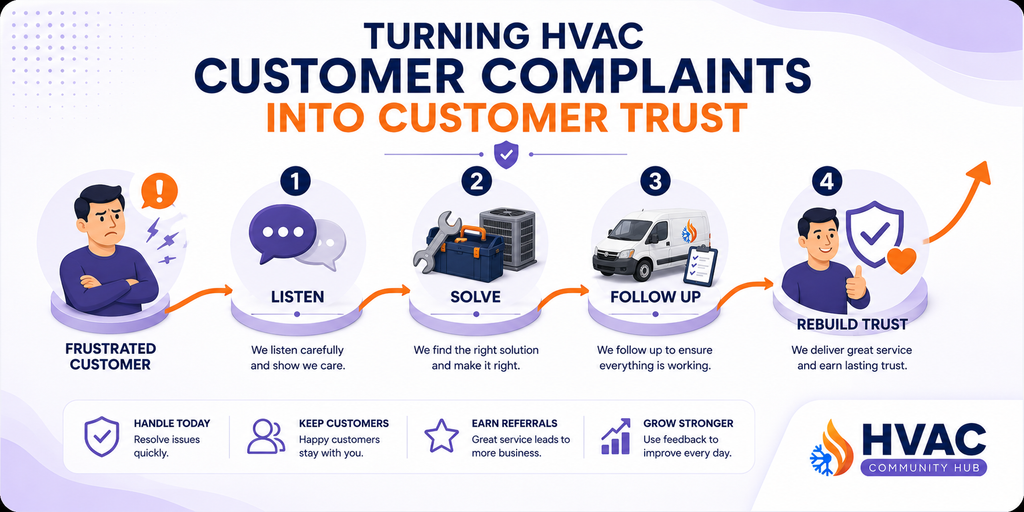
When your business listens, communicates clearly, takes responsibility, and resolves problems properly, a frustrated customer may leave with greater confidence in your company.
The goal is not to avoid every complaint. Instead, the goal is to handle HVAC customer complaints professionally and use them to improve the customer experience.
Why HVAC Customers Complain
Customers usually complain when their expectations do not match their actual experience.
A customer may expect a technician at a certain time, but the technician arrives much later. Another customer may expect a repair to solve the problem, only to experience another issue shortly afterward.
Sometimes the complaint is about the work itself. In other cases, the real problem is communication.
Customers may become frustrated when they do not understand why a repair costs more than expected, why a technician needs additional time, or why a replacement part is not immediately available.
That is why your team should not immediately assume that every complaint is about price or workmanship.
Listen to the entire situation first.
The customer may be looking for an explanation, a solution, an apology, or simply confirmation that someone is taking the problem seriously.
HVAC Customer Complaints Are Often About Communication
A small communication problem can quickly become a major customer complaint.
Imagine a customer waiting at home for a technician. The appointment runs behind, but nobody contacts the customer. By the time the technician arrives, the customer is already frustrated.
The technical work may be excellent.
The customer can still leave unhappy.
Clear communication can prevent many of these situations. If a technician is delayed, tell the customer. If a repair requires additional work, explain why. If a part needs to be ordered, set realistic expectations.
Customers are usually more understanding when they know what is happening.
Silence creates uncertainty.
Good communication creates trust.
How Your Team Should Respond to an Angry Customer
The first response matters.
When a customer is upset, your team should avoid becoming defensive. Arguing about who is right rarely solves the problem.
Instead, let the customer explain what happened.
Listen without interrupting.
Then confirm that you understand the concern.
A simple response such as, “I understand why that would be frustrating,” can help lower the tension.
After that, focus on the solution.
Ask what happened, review the job information, and explain what your company can do next.
The goal is not to win an argument.
The goal is to solve the customer’s problem while protecting the relationship.
Give Technicians a Clear Complaint-Handling Process
Technicians are often the first employees to hear a complaint.
That means they need to know what they can handle themselves and when they should involve the office.
A technician should not feel responsible for solving every billing, scheduling, or management issue on the spot.
Give your team clear guidelines.
Technicians can listen to the concern, explain the work they performed, and document the issue. More serious complaints can then move to the appropriate office employee or manager.
This keeps technicians focused on their role while making sure customers receive a consistent response.
What technicians should do:
- Listen carefully
- Stay calm and professional
- Avoid blaming the customer or another employee
- Explain the work clearly
- Document the concern
- Contact the office when the issue needs additional support
Respond Quickly When a Customer Complains
A complaint becomes harder to resolve when the customer feels ignored.
If someone calls about a problem, acknowledge it as soon as possible. Even when your team cannot solve the issue immediately, tell the customer that you are reviewing it.
A quick response shows that the complaint matters.
For example, you may need time to speak with the technician, review the invoice, or check the job history. Tell the customer what you are doing and when they can expect an update.
That small step can reduce frustration while your team works toward the actual solution.
Find the Real Problem Before Offering a Solution
Not every complaint has the same cause.
A customer may complain about the price when the real problem is that the final invoice was higher than expected.
Another customer may complain about a technician when the real issue is a scheduling delay.
Take time to understand the situation before deciding what to offer.
Review the appointment details, technician notes, photos, invoices, and previous communication when necessary.
Then explain what you found in simple language.
Customers do not need a complicated internal explanation.
They need a clear answer.
Know When to Apologize
An apology does not automatically mean your company accepts blame for everything.
Sometimes the customer is simply frustrated because the situation was inconvenient.
A sincere apology can still acknowledge that frustration.
For example, if a technician arrived later than expected and the customer was not informed, apologize for the communication failure.
If your team made an actual mistake, take responsibility and explain how you will correct it.
Customers often remember how a business handled a mistake more than the mistake itself.
Do Not Use Discounts as the Automatic Solution
Offering a discount can sometimes resolve a legitimate service problem.
However, it should not become your default response to every complaint.
A discount does not fix poor communication.
It does not correct bad workmanship.
It does not solve a scheduling problem.
First, understand the problem.
Then decide what resolution makes sense.
Depending on the situation, the right response could be a correction, follow-up visit, clearer explanation, refund, credit, or another appropriate solution.
The goal is to solve the underlying problem rather than simply paying the customer to stop complaining.
Turn Complaints Into Business Improvements
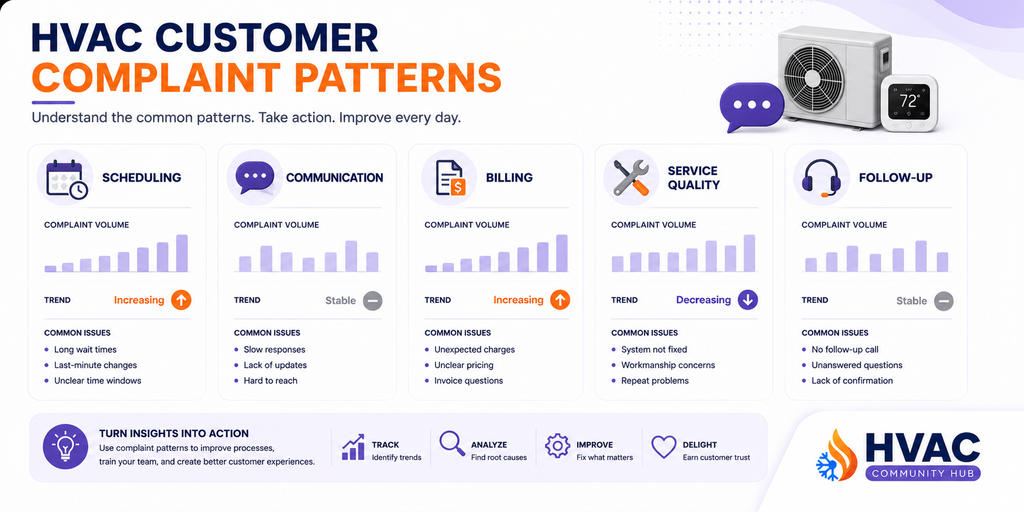
One of the biggest benefits of tracking HVAC customer complaints is that patterns become visible.
One complaint may be an isolated situation.
Ten similar complaints may reveal a business problem.
Perhaps customers repeatedly complain about appointment windows. Maybe invoices regularly surprise customers. Perhaps customers do not understand maintenance recommendations.
You may even discover that technicians receive incomplete information before arriving at a job.
These patterns give you useful information.
Instead of treating every complaint as a separate problem, look for the common cause.
If customers repeatedly complain about the same issue, fixing the process can prevent future complaints.
That is much more valuable than resolving the same complaint again and again.
Track Complaints So You Can See Patterns
Your complaint records do not need to be complicated.
Record the basic information:
- What the customer complained about
- Which job or service was involved
- When the complaint occurred
- How your team responded
- How the issue was resolved
- Whether the customer needed additional follow-up
Over time, this information can reveal recurring problems.
You may discover that most complaints involve a particular type of service, communication issue, or stage of the customer journey.
Once you know the pattern, you can work on the cause.
Follow Up After the Problem Is Resolved
Resolving the complaint is not always the final step.
A short follow-up can show the customer that your company cares about the outcome.
Ask whether the issue was resolved properly.
Make sure the customer understands what happened.
If your team promised another action, confirm that it happened.
This is especially important when the original complaint involved a service failure.
The customer may remember the problem.
A thoughtful follow-up gives your business another opportunity to demonstrate professionalism.
It also gives you another chance to learn.
The customer may tell you something that your team did not notice during the original complaint.
Protect Your Reputation by Fixing Problems at the Source
Online reviews often reflect customer experiences.
A frustrated customer may decide to leave a negative review if they believe the company ignored the problem.
That makes complaint handling an important part of reputation management.
However, asking customers to change a review should not be the main goal.
The better goal is to provide a good resolution.
When you consistently respond professionally, customers are more likely to see that your company takes responsibility and cares about service quality.
A strong reputation comes from the experience customers have with your business, especially when something goes wrong.
Create a Clear Escalation Process
Not every complaint should reach the owner.
If every unhappy customer immediately requires the owner’s attention, growth becomes difficult.
Create clear levels of escalation.
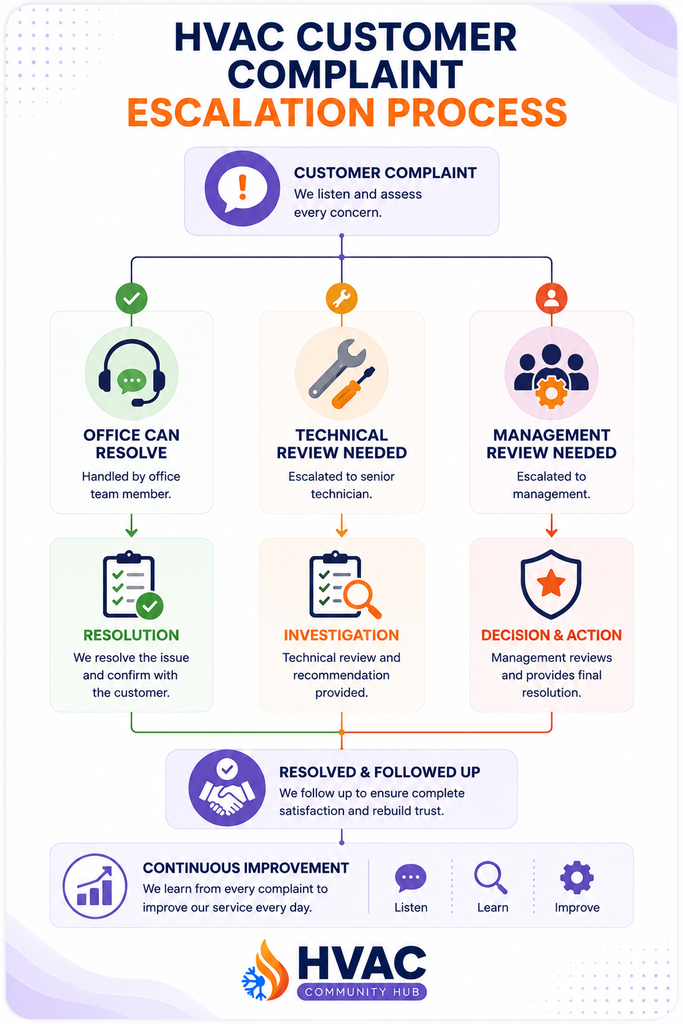
Simple concerns may be handled by the office team.
Technical concerns may require a senior technician or service manager.
Billing disputes may need someone with financial authority.
Serious complaints may require management involvement.
The exact structure depends on the size of your company.
The important thing is that employees know where to send a problem when they cannot resolve it themselves.
That keeps the process organized and prevents customers from being passed between employees without a clear owner.
Build a Culture Where Complaints Are Useful
Your employees should not feel that every complaint means someone is in trouble.
If your team becomes afraid to report problems, management may stop hearing about issues until they become much larger.
Instead, treat complaints as information.
Ask what happened.
Ask why it happened.
Ask what could prevent the same problem next time.
This does not mean ignoring mistakes.
It means using mistakes as opportunities to improve the business.
When employees know that management wants to solve problems rather than simply assign blame, they are more likely to share useful information.
Frequently Asked Questions About HVAC Customer Complaints
What is the best way to handle HVAC customer complaints?
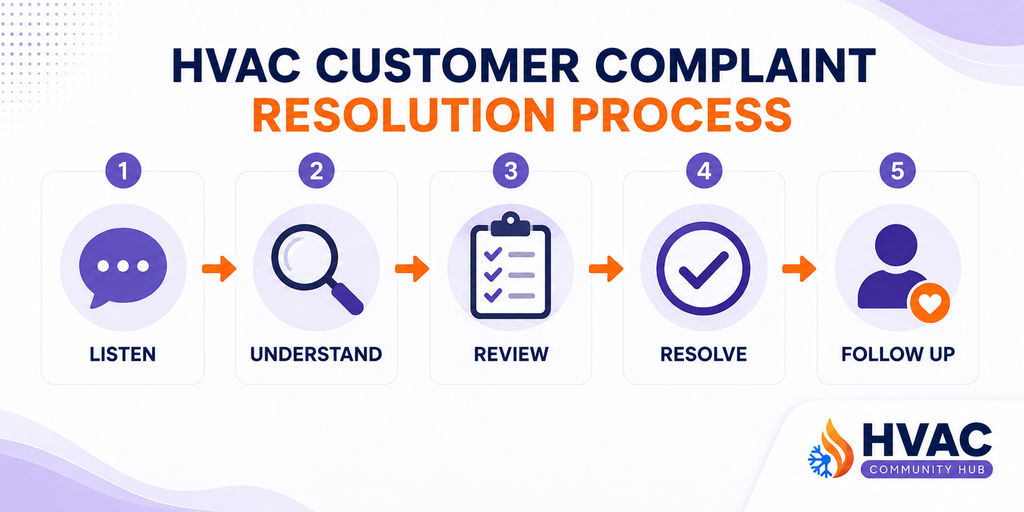
Listen carefully, understand the problem, review the relevant information, and provide a clear solution. A calm response can prevent a frustrated customer from becoming a lost customer.
Should HVAC technicians handle customer complaints themselves?
Technicians can handle simple concerns related to the work they performed. More serious complaints involving billing, scheduling, refunds, or management should move to the appropriate office or manager.
How quickly should an HVAC company respond to a complaint?
Respond as soon as reasonably possible. Even when the final solution takes time, acknowledging the complaint and explaining the next step helps customers feel heard.
Should I offer a discount when a customer complains?
Not automatically. First understand the problem. Depending on the situation, a correction, explanation, follow-up, refund, credit, or another solution may be more appropriate.
Can customer complaints help improve an HVAC business?
Yes. Repeated complaints can reveal problems with communication, scheduling, billing, workmanship, or internal processes. Tracking these patterns can help you fix the cause instead of repeatedly handling the same issue.
How can I prevent HVAC customer complaints?
Set clear expectations, communicate delays, provide accurate job information, explain pricing and recommended work clearly, and follow up when problems occur. Good communication can prevent many avoidable complaints.
HVAC Customer Complaints Can Become an Opportunity
Nobody wants an unhappy customer.
However, complaints are a normal part of operating a service business.
What matters is what your company does next.
Listen carefully.
Respond quickly.
Investigate the situation.
Take responsibility when your business makes a mistake.
Then fix the underlying problem.
A customer who sees your team handle a difficult situation professionally may develop more trust in your company, not less.
The real opportunity is to stop viewing every complaint as a threat.
Instead, use HVAC customer complaints as feedback that can help you improve communication, service processes, technician support, and the overall customer experience.
A strong HVAC company is not one that never receives complaints.
It is one that knows how to respond when they happen.
Take the Next Step
Start by reviewing your recent customer complaints.
Look for patterns.
Were customers frustrated about communication, scheduling, billing, service quality, or follow-up?
Choose the most common problem and identify what caused it.
Then make one process change that can prevent the same issue from happening again.
Small improvements can make a meaningful difference when they remove the problems customers experience repeatedly.
HVAC Hub provides resources for HVAC business owners who want to build stronger systems, improve customer experiences, and run more organized businesses.
Visit HVACHub.co to explore more HVAC business resources.
You can also review your existing HVAC Reputation Management and HVAC Customer Retention resources to connect complaint handling with the broader customer experience.




Responses