

HVAC No-Shows: How Missed Appointments Cost Your Business

A customer books an HVAC appointment, your team assigns a technician, and the schedule looks full. Then the technician arrives at the property and nobody answers the door.
This is an HVAC no-show, and it can cost your business more than the time spent waiting.
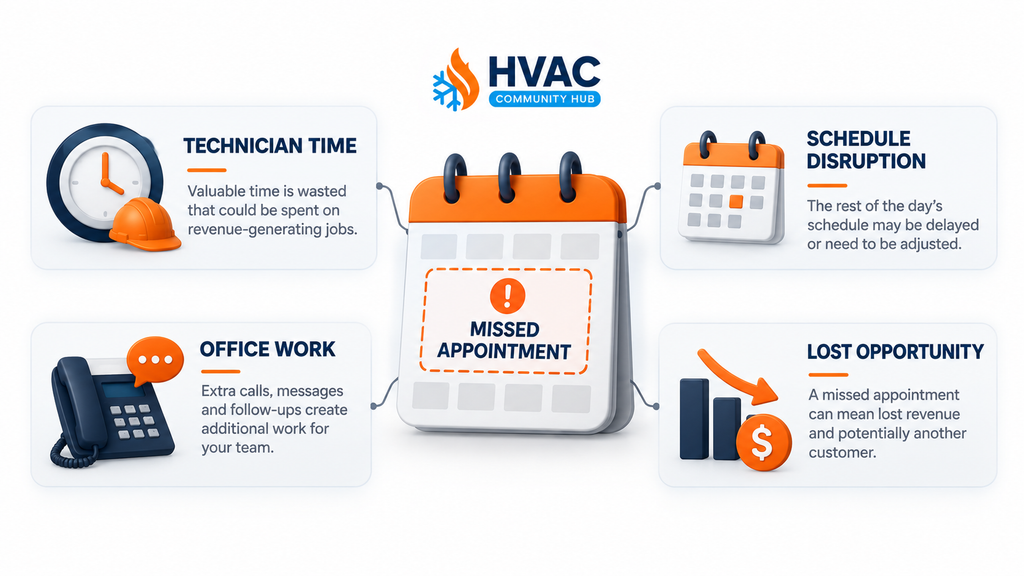
The technician loses productive time. Another customer may wait longer for service. The office may need to rearrange the schedule. Meanwhile, the business has already spent time preparing for an appointment that did not happen.
One missed appointment may not seem serious. However, repeated no-shows can create a pattern that affects your team’s time, daily schedule, and revenue.
The solution is not simply to blame customers. Instead, HVAC companies need a clear process that reduces missed appointments, confirms customer availability, and handles no-shows consistently.
Why HVAC No-Shows Create Bigger Problems Than Empty Time
A no-show does not only remove one appointment from the calendar.
It can affect everything around that appointment.
A technician may spend time driving to the property, parking, locating the address, and waiting for the customer. That time could have gone toward another service call.
The office team also has work to do. Someone may need to call the customer, update the technician, adjust the schedule, and find another appointment to fill the gap.
Then comes the lost opportunity.
If your technician could have completed another paid service during that time, the no-show has a direct effect on potential revenue.
That is why HVAC businesses should look at missed appointments as an operational issue rather than an occasional inconvenience.
Common Reasons Customers Miss HVAC Appointments
Customers do not always miss appointments because they do not care.
People forget. Plans change. Work schedules move. A family member may not be home when the technician arrives.
Sometimes, the customer may also misunderstand the appointment window.
For example, a customer might think the technician will arrive at a specific time when your company actually provided a two-hour window.
Another customer may book an appointment several days ahead and simply forget about it.
Communication can also break down when customers receive too many messages from different channels.
Understanding these reasons can help your business create a better process.
The goal is not to eliminate every no-show. That is unrealistic.
Instead, reduce avoidable missed appointments before they affect the technician’s day.
Confirm the Appointment Before the Technician Leaves
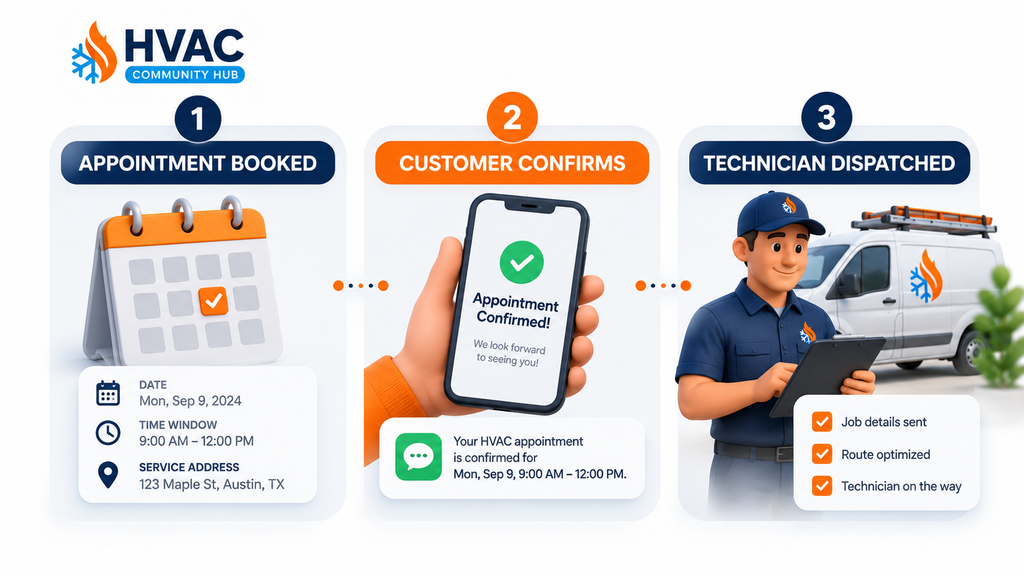
One of the simplest ways to reduce no-shows is to confirm the appointment.
The timing can depend on your service model. A confirmation the day before can remind the customer about the appointment and give them a chance to reschedule.
Your message should be simple.
Include the appointment date, expected time window, service address, and a clear way to contact your office if the customer needs to make a change.
Avoid sending a long message filled with information the customer does not need.
A short reminder is easier to read and easier to act on.
Your office can also use the confirmation as an opportunity to identify problems before the technician starts driving.
If the customer says they cannot make the appointment, you can adjust the schedule instead of sending a technician to an empty property.
Make It Easy for Customers to Reschedule
Sometimes a customer cannot keep the appointment.
That does not automatically need to become a no-show.
Give customers a simple way to tell your office that they need another time.
For example, your confirmation message can say:
“Need to change your appointment? Please contact us before your scheduled visit.”
That small option can make a difference.
A customer who knows how to reschedule may contact your office instead of simply missing the appointment.
Your team can then move the appointment to another available slot.
This approach also gives the office better visibility into the schedule.
Instead of discovering a problem when the technician arrives, your team can respond before the appointment becomes a wasted trip.
Set Clear Expectations About Appointment Windows
Appointment windows can create confusion when customers expect an exact arrival time.
If your company provides a two-hour window, explain that clearly when the appointment is booked.
For example:
“Your technician will arrive between 10:00 a.m. and 12:00 p.m.”
That message gives the customer a clear expectation.
Your confirmation should repeat the same information.
Technicians should also follow the agreed process when they arrive. If the customer is not available, the technician can contact the office rather than making assumptions.
Clear expectations help both sides prepare for the visit.
They can also reduce frustration when the technician cannot arrive at the exact minute the customer expected.
Create a Simple Process for HVAC No-Shows
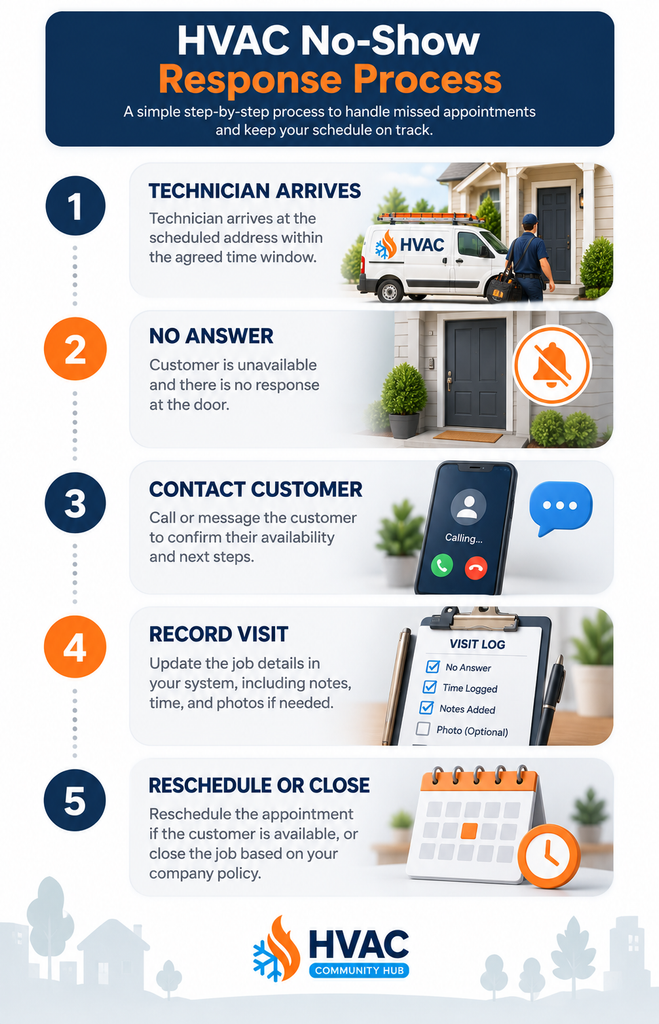
Your team needs to know what happens when a customer does not answer.
Without a process, each employee may handle the situation differently.
One technician may wait ten minutes. Another may leave immediately. Someone else may call the customer several times.
That inconsistency can create problems.
Create a basic no-show procedure that everyone can follow.
For example:
- Confirm that the technician reached the correct address.
- Contact the customer using the approved method.
- Wait according to your company policy.
- Record the missed appointment.
- Inform the office.
- Decide whether to reschedule or close the appointment.
The exact process should fit your business and customer agreements.
The important part is consistency.
When technicians and office staff follow the same process, your company can handle missed appointments without unnecessary confusion.
Know When a No-Show Needs a Different Response
Not every missed appointment should receive the same response.
A first-time no-show may have a simple explanation.
Perhaps the customer forgot the appointment or had an unexpected problem. Your office can contact the customer and offer another appointment.
Repeated no-shows are different.
If the same customer repeatedly misses appointments, your business may need a different policy.
Your company could require confirmation before scheduling another visit. Depending on your business model and customer agreements, you may also consider a deposit or other policy for repeated missed appointments.
Whatever approach you choose, communicate it clearly.
Customers should understand the policy before another appointment is booked.
Track HVAC No-Shows to Find Patterns
You cannot improve what you never track.
Keep a record of missed appointments and look for patterns over time.
You might discover that no-shows happen more often during certain appointment windows. Another pattern may involve a specific customer group, service type, location, or booking method.
The data does not need to be complicated.
Track the appointment date, customer type, service type, appointment window, whether the customer confirmed, and what happened afterward.
After several weeks or months, review the information.
A pattern may point to a simple change that could reduce missed appointments.
For example, your company might discover that customers are more likely to miss appointments when they book too far in advance. That insight could help your team adjust its confirmation process.
Do Not Let No-Shows Become a Technician Problem
Technicians should not have to decide how to handle every missed appointment on their own.
They need a clear company process.
The office should define how long a technician waits, when the technician should call, how the visit gets recorded, and who decides whether to reschedule.
That structure protects technician time.
It also prevents technicians from spending too much time trying to reach customers.
Your technicians are there to perform HVAC work. A clear office process allows them to return to productive work when an appointment does not happen.
Use Empty Time Wisely When a Customer Does Not Show
Even with a strong process, some no-shows will still happen.
When one occurs, your team can look for productive ways to use the unexpected gap.
The office may have another customer who needs an earlier appointment. A technician could complete paperwork, restock the vehicle, review the next job, or handle another approved task.
The best option depends on your schedule and business model.
The important thing is to avoid treating the entire time block as automatically lost.
Good dispatch communication can help your team respond quickly when the schedule changes.
That flexibility becomes especially useful during busy periods when customers are waiting for service.
Improve Your Booking Process With No-Show Data
No-show data can help you improve the booking process itself.
Look beyond the number of missed appointments.
Ask why customers miss them.
Do customers understand the appointment window? Are reminders reaching them? Can they easily contact your office? Does your booking team explain what the customer needs to do before the technician arrives?
These questions can reveal weaknesses in the customer experience.
Small improvements can make the booking process clearer.
For example, your team might change the timing of reminders or make the rescheduling instructions easier to find.
Over time, these changes can reduce avoidable no-shows and create a smoother experience for customers and technicians.
Make Missed Appointments Part of Your Operating Review
HVAC no-shows should not disappear from your business records after the technician leaves.
Review them with other operating numbers.
Look at how many appointments were missed, how much technician time was affected, and how often customers rescheduled.
Then compare the results over time.
A rising no-show rate may point to a problem in your booking or confirmation process.
A falling rate may show that your changes are working.
You do not need a complicated report.
A simple monthly review can give your team useful information and help you make better decisions.
Frequently Asked Questions About HVAC No-Shows
What is an HVAC no-show?
An HVAC no-show happens when a customer does not attend or provide access for a scheduled service appointment without canceling or rescheduling beforehand.
Why do HVAC customers miss appointments?
Customers may forget, have schedule changes, misunderstand the appointment window, or face unexpected problems. Clear reminders and easy rescheduling options can help reduce avoidable no-shows.
How do HVAC no-shows affect a business?
They can waste technician time, disrupt the day’s schedule, create extra office work, and reduce opportunities to complete other paid jobs.
How can HVAC companies reduce no-shows?
Use appointment confirmations, clear time windows, reminders, and simple rescheduling options. A consistent process can help your team handle missed appointments more effectively.
Should HVAC companies charge for no-shows?
That depends on the company’s service model, customer agreements, and local requirements. If you use a no-show policy or fee, explain it clearly before the appointment.
Should HVAC businesses track no-shows?
Yes. Tracking missed appointments can help identify patterns and show where changes to booking, confirmation, or scheduling processes may help.
Take the Next Step
HVAC no-shows may seem like a small scheduling problem, but repeated missed appointments can create a real cost for your business.
Technician time gets wasted. Office staff spend time fixing the schedule. Customers who need service may wait longer. Meanwhile, another job could have filled the empty appointment slot.
Start with a simple process.
Confirm appointments before the scheduled visit. Make the appointment window clear. Give customers an easy way to reschedule. Then create a consistent process for technicians when nobody is available.
Next, track the results.
Record missed appointments and review the patterns each month. Look for common causes and decide which changes could reduce avoidable no-shows.
Most importantly, do not make technicians solve the problem alone.
Give your field and office teams clear responsibilities. When everyone knows what to do, a missed appointment becomes easier to manage.
A perfect no-show rate is not realistic. A better process is.
When your HVAC business handles missed appointments with clear communication and consistent systems, you can protect technician time, reduce schedule disruption, and create a better experience for customers.
Please join HVAC Community Hub.



Responses