

Your HVAC Company Is Fully Booked. So Why Is There Still No Money Left?

The calendar is full. Vans leave the yard before sunrise. Technicians are working overtime, dispatch is fielding calls, and the company has never sent more invoices. Yet at the end of the month, the owner checks the bank account and wonders where the money went.
A busy HVAC business is not necessarily a profitable HVAC business. Revenue measures what customers pay for work. Profit depends on what remains after the direct costs of delivering that work and the overhead required to keep the company operating. A company can increase sales while weakening its margins.
This guide examines how HVAC owners can separate activity from profitability, find margin leaks, and decide which jobs deserve more capacity. The financial examples are illustrative, not industry benchmarks or recommendations for a specific company’s pricing.
Why a Fully Booked HVAC Company Can Still Struggle
An appointment calendar tracks demand, not the financial return on that demand. A maintenance visit, a complicated diagnostic, a warranty callback, and a system replacement may occupy similar blocks on the schedule but contribute very different amounts toward payroll and overhead.
The problem becomes harder to see when owners measure success primarily through calls booked, trucks dispatched, or total monthly revenue. Those numbers are useful operational indicators, but they cannot tell whether a particular job covered its costs.
There is also a capacity tradeoff. When technicians are booked solid with low-margin work, the business may have to turn away higher-value opportunities or push them into another week. Being busy can conceal the cost of the work that never gets scheduled.
Where Does the Money Go on an HVAC Service Job?
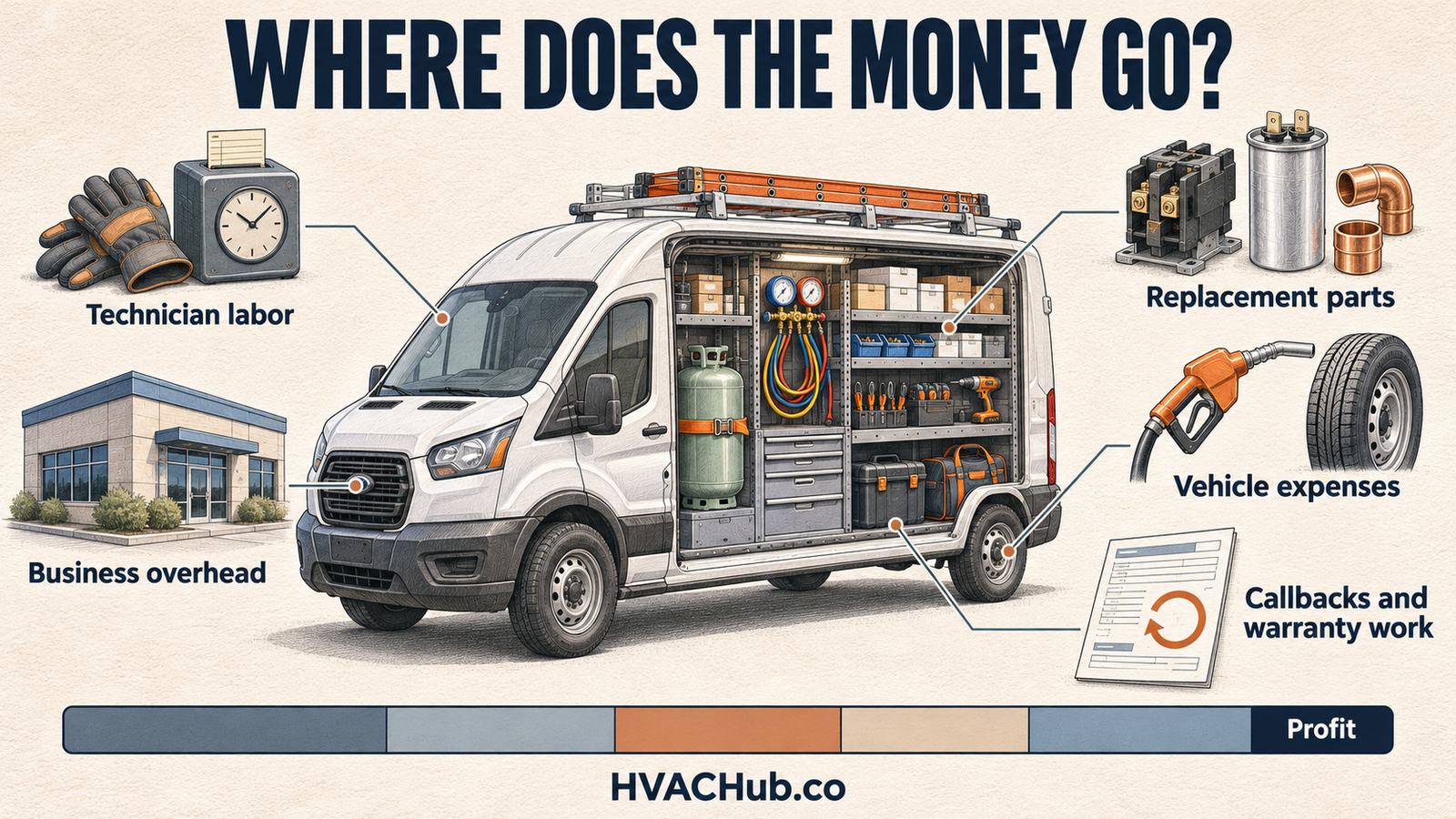
Start with the direct costs associated with completing a job: technician wages and related payroll burden, parts and materials, subcontracted work, equipment rental, and other costs that can reasonably be traced to that job. Businesses classify costs differently, so choose a consistent accounting approach and review it with a qualified bookkeeper or accountant.
Some costs are less obvious. A technician might spend 45 minutes driving, 30 minutes collecting parts, 90 minutes on site, and another 20 minutes completing documentation. If a price is based only on the time inside the customer’s home, the job may appear more profitable than it really is.
Callbacks can compound the issue. A return visit may generate no new invoice but still consume wages, vehicle time, replacement materials, and dispatch capacity. Not every callback is preventable or the contractor’s responsibility; nevertheless, its cost should be visible.
A simple illustrative job calculation
Suppose an HVAC service job brings in $600. The business assigns $210 in technician labor and payroll burden, $125 in parts and consumables, and $45 in other job-related costs. Direct costs total $380, leaving $220 in gross profit. The gross margin is $220 divided by $600, or approximately 36.7%.
That $220 is not take-home profit. It still needs to contribute toward office staff, insurance, software, facilities, advertising, administration, financing expenses, and other operating costs. The example does not establish a target margin; actual figures vary by market, service type, and accounting method.
Revenue Is Not Profit: Know the Three Numbers
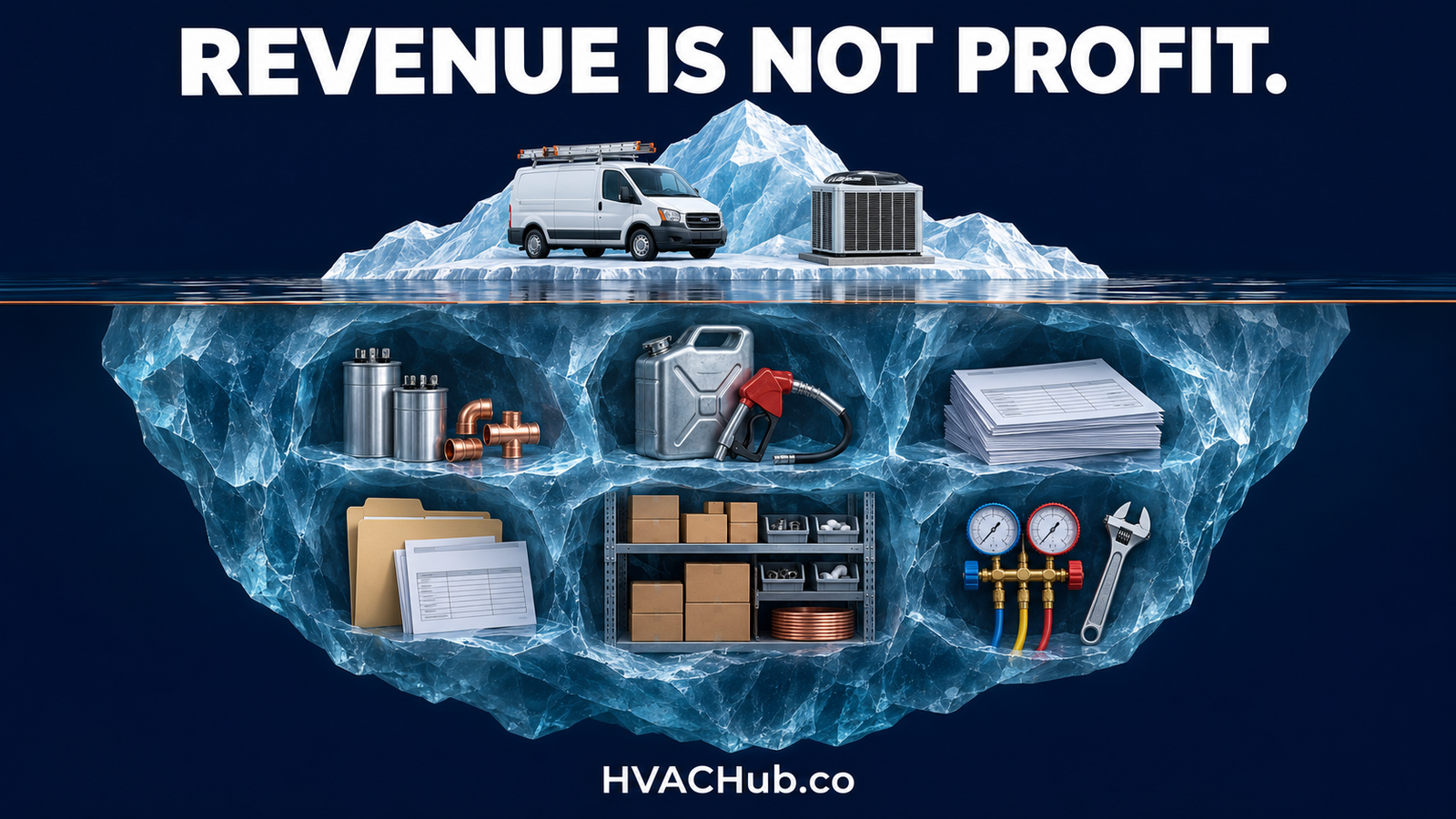
Revenue
Revenue is the amount earned from providing services and selling equipment, according to the company’s accounting method. A strong revenue month may simply reflect more jobs, larger invoices, or a different mix of installations and service work.
Gross profit and gross margin
Gross profit is revenue minus the direct costs of delivering the work. Gross margin expresses that amount as a percentage of revenue: (revenue − direct costs) ÷ revenue × 100. It helps compare jobs of different sizes when costs are recorded consistently.
Operating profit and net profit
Operating profit reflects what remains after operating expenses, while net profit also reflects applicable nonoperating items and taxes under the accounting presentation used. Owners should work with their accountant to define these measures consistently rather than mixing cash balances with income-statement profit.
Cash flow is a separate issue. A profitable company can experience cash pressure if customers pay slowly, inventory is purchased ahead of jobs, or loan payments are due. Conversely, a healthy bank balance after collecting deposits does not prove the work has earned a profit.
The Five Hidden Reasons HVAC Margins Shrink
1. Labor hours that never reach the invoice
Travel, supply-house trips, equipment loading, paperwork, meetings, and training all consume paid time. Some of that time is essential to a well-run company. The issue is whether pricing and staffing plans acknowledge it.
2. Underestimated installation complexity
A quoted replacement may involve electrical corrections, access challenges, duct modifications, permits, or unexpected materials. A standardized estimate that ignores site conditions can erode the margin before the crew finishes the first day.
3. Discounting without measuring contribution
A discount reduces revenue immediately, while many job costs remain unchanged. An owner may approve a price reduction to fill an empty slot, but repeating that decision across a full calendar can leave the business busy and underfunded.
4. Untracked callbacks and warranty work
Callbacks require clear classification. Some result from workmanship issues, some from unrelated failures, and others from customer expectations that were not set correctly. Tracking the reason and cost helps improve quality without unfairly blaming technicians.
5. Overhead that grows faster than useful capacity
Additional vans, office staff, subscriptions, storage, and advertising can support growth. But if those commitments increase faster than the contribution generated by jobs, revenue growth may not translate into operating profit.
What’s Draining Your Profit? Follow the Leaks

A practical review starts with a small number of job categories: maintenance, diagnostic and repair, replacement, light commercial, and warranty or callback work. The right categories depend on the company’s actual service mix. Calculate revenue and consistently defined direct costs for each category over a meaningful period.
Then examine patterns. Which jobs frequently exceed estimated labor hours? Which require second visits? Which use costly parts that were not included in the quote? Which generate significant gross profit but consume scarce crew capacity? Avoid drawing conclusions from a handful of unusual jobs.
Consider contribution per constrained resource, such as technician hour or installation crew day, alongside gross margin. A job with a lower percentage margin may still make an important contribution if it produces substantial gross profit efficiently. Likewise, a high-margin small ticket may not cover travel and dispatch costs.
A Practical Monthly HVAC Profitability Review
- Reconcile completed jobs and invoiced revenue to the accounting records.
- Review direct job costs using a consistent definition across months.
- Separate service, maintenance, installation, and callback activity where possible.
- Compare estimated versus actual technician and crew hours.
- Track return visits and identify their documented causes.
- Review overhead, debt obligations, accounts receivable, and upcoming cash needs separately.
- Investigate outliers before changing pricing or technician incentives.
- Select one or two measurable improvements and review the results next month.
This review does not require a complex dashboard on day one. A dependable spreadsheet and accurate job records can reveal more than an elaborate report built from incomplete data.
Should You Raise Prices or Fix Operations First?
There is no universal answer. If a company consistently prices below the cost of delivering quality work, a pricing review may be necessary. If estimates are reasonable but crews repeatedly exceed planned hours, scheduling, training, job preparation, or scope control may deserve attention first.
Owners should also consider market positioning and customer value. Cutting corners to improve a margin number can create callbacks, safety problems, and reputational damage. The goal is not simply to make every job cheaper; it is to deliver reliable service at a sustainable price.
Before making changes, model the effects. What happens if labor hours fall by 10% on a recurring job type? What if parts prices rise? How many profitable technician hours are available after training, leave, and unavoidable nonbillable work? Scenario planning is more useful than assuming a busier calendar will solve the problem.
When Growth Makes the Problem Worse
Growth can magnify weak processes. A second truck creates more opportunities, but also adds vehicle costs, insurance, tools, hiring, supervision, and potentially more office workload. If the first truck’s jobs were priced poorly, replicating the model can replicate the losses.
A useful expansion question is not merely “Can we book another technician?” It is “Can the additional work reliably contribute enough to cover the new costs and the risks of expansion?” That requires realistic utilization assumptions and an understanding of cash needs during the ramp-up period.
How to Calculate Profitability Per Technician Hour
To understand what each technician contributes, start with the hours available for customer work and compare them with the hours actually spent on completed jobs. Paid hours, billable hours, and productive hours are not necessarily the same. Travel, preparation, training, and paperwork are part of operating a legitimate service company, even when they cannot be billed as separate line items.
For example, imagine a technician is paid for 40 hours in a week but spends 25 hours completing work that is directly assigned to customer jobs. If those jobs generate $4,500 in revenue and $2,900 in direct costs, they produce $1,600 in gross profit, or $64 per assigned job hour. That number is not the technician’s wage or the company’s net profit; it is one way to evaluate how effectively limited service capacity contributes toward overhead.
Use this measure carefully. Emergency diagnostics, rural travel, apprenticeship, and complex commercial work may naturally require different time commitments. Comparing technicians without accounting for job difficulty, territory, and support resources can create unfair incentives and reduce service quality.
The Difference Between a Profitable Job and a Profitable Month
A company can complete many individually profitable jobs and still finish the month with disappointing results. Fixed expenses continue whether the calendar is full or empty: rent, insurance, management salaries, technology subscriptions, and other recurring commitments. A job’s gross profit contributes toward those costs; it does not automatically become money the owner can withdraw.
Consider a hypothetical month with $100,000 in revenue and $62,000 in direct job costs. Gross profit is $38,000. If operating expenses for the period are $35,000, operating profit is only $3,000 before considering any additional nonoperating items and taxes. A 38% gross margin in this illustration produces a 3% operating margin. The point is not that those percentages are normal, but that a large sales number can coexist with a thin bottom line.
Owners should also watch timing. Equipment deposits, customer receivables, supplier payment terms, and loan principal payments affect cash availability differently from reported profit. Reviewing a profit-and-loss statement alongside a cash-flow forecast gives a clearer picture than checking the bank balance alone.
Which HVAC Jobs Should Fill the Calendar First?
Not all available work is equally valuable, and the answer is not simply to chase the highest ticket. A profitable maintenance visit may support customer retention and uncover legitimate future needs. A large installation may generate substantial gross profit but tie up a crew for several days. A diagnostic call may be valuable because it solves a customer’s immediate problem and builds trust.
Evaluate job categories using gross profit, labor hours, scheduling flexibility, callback history, payment reliability, and strategic value. For instance, a service call that produces $180 in gross profit in two assigned hours contributes $90 per assigned hour. An installation producing $1,500 in gross profit across 24 crew hours contributes $62.50 per crew hour. Ticket size alone is a poor scheduling guide.
A sound dispatch strategy also respects customer urgency and safety. No financial metric should encourage delaying critical service, overstating repairs, or pushing unnecessary replacements. The objective is to use capacity intelligently while maintaining professional standards.
How to Spot Pricing Problems Without Guessing
When margins fall, some owners immediately raise prices across the board. Others try to book more calls. Both approaches can miss the underlying cause. Begin by comparing estimates with actual results for a representative sample of jobs. Identify whether the gap came from labor hours, unquoted materials, supplier increases, discounts, scope changes, or repeat visits.
Separate estimating errors from execution problems. If a replacement was priced for one crew day but required two because of difficult access visible during the initial survey, the estimating process may need improvement. If the estimate was realistic but parts were missing on installation day, purchasing and job preparation may be the issue. If costs increased because the customer approved additional work, confirm that the change was documented and invoiced appropriately.
Review pricing in the context of local market conditions, customer expectations, warranty obligations, and the quality of service delivered. A sustainable price should support competent workmanship, fair wages, and a financially stable operation—not simply match the cheapest competitor.
A 30-Day Profit Improvement Experiment
Rather than attempting a complete business overhaul, select one recurring problem and measure it for a month. A company might focus on reducing unplanned supply-house runs, improving replacement estimates, recording callback causes, or ensuring technicians close out job notes promptly. Choose a metric that reflects the problem without rewarding shortcuts.
Record a baseline from recent jobs, define the change, and assign responsibility. At the end of 30 days, compare job hours, direct costs, return visits, and customer outcomes with the baseline. Consider seasonal demand and unusual jobs before concluding the experiment worked.
For example, if crews repeatedly lose time because materials are missing, test a pre-departure parts checklist for installations. Measure whether emergency supply trips decline and whether completion times improve. The result is more actionable than a general instruction to “work faster.”
Frequently Asked Questions
Why is my HVAC business busy but not profitable?
Common possibilities include underestimated labor, weak pricing, high parts costs, callbacks, excessive overhead, poor job mix, and incomplete cost tracking. Reviewing actual job economics and financial statements helps identify which factors apply.
What is gross margin for an HVAC job?
Gross margin is the percentage of revenue remaining after consistently defined direct job costs. Calculate it as (job revenue − direct job costs) ÷ job revenue × 100. It is not the same as net profit.
Does more HVAC revenue always mean more profit?
No. Revenue can grow while direct costs or overhead grow even faster. Job mix, pricing, productivity, and operating expenses determine whether additional sales create additional profit.
How can HVAC contractors track job profitability?
Record job revenue, parts, labor hours and burden, relevant subcontracting and other direct costs, then compare actual results with estimates. Use consistent categories and review results with the company’s accounting professional.
The Discussion: Are You Growing or Just Getting Busier?
A packed calendar is an achievement, but it is not a financial verdict. Sustainable HVAC businesses need enough profitable work, dependable systems, and visibility into what each job contributes. The right question is not only how many calls the company completed, but what remained after delivering them properly.
Have you ever had your busiest HVAC month turn out to be one of your least profitable? What was eating the margin—labor, parts, callbacks, overhead, or something else? Share what you learned with other contractors at HVAC Community Hub.


Responses