
HVAC Hard Conversations: The Cost of Avoidance

HVAC hard conversations often get delayed longer than they should.
Most owners know when something needs to be addressed. A technician underperforms. A supervisor avoids accountability. A team member resists standards.
However, instead of addressing it directly, many leaders wait.
They hope the issue improves on its own.
They assume the person will self-correct.
They convince themselves timing is not right.
Over time, avoidance becomes expensive.
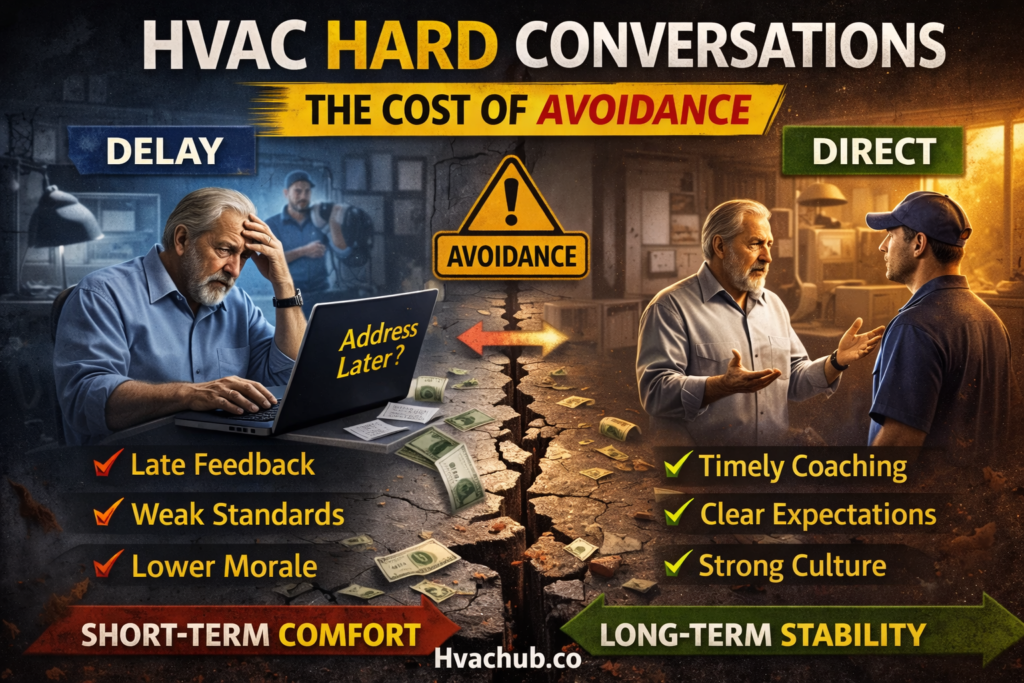
Why Owners Delay Difficult Conversations
Avoidance rarely comes from weakness.
In fact, it often comes from empathy.
Many HVAC owners built their businesses from the field. They understand pressure. They know how hard the job can be. Therefore, they hesitate to confront someone who is already stressed.
Additionally, some owners fear conflict will damage morale. Others worry about losing a skilled technician.
As a result, small performance gaps remain unaddressed.
The Hidden Cost of HVAC Hard Conversations Delayed
When leaders postpone direct feedback, standards shift quietly.
For example:
- Deadlines stretch without consequence
- Quality dips without correction
- Attitude issues spread to others
- Accountability feels selective
Because no one addresses the behavior clearly, the team adjusts its expectations.
Consequently, the tolerated standard becomes the new standard.
The cost does not appear immediately. Instead, it compounds through repetition.
Avoidance Sends a Signal
Silence communicates more than most leaders realize.
If one technician ignores procedures without correction, others notice. If a supervisor avoids a performance review, the team interprets it.
Over time, HVAC hard conversations become rare.
When correction disappears, clarity disappears as well.
That weakens culture.
Why Firing Is Not the Core Issue
This topic is not about termination.
Most businesses do not fail because they hesitate to fire someone. Instead, they struggle because they hesitate to coach early.
Clear feedback prevents larger problems.
When leaders address issues quickly, they often avoid escalation entirely.
Therefore, the real problem is not firing too late.
It is confronting too late.
The Psychology Behind Avoidance
Avoidance feels comfortable in the short term.
Conflict creates discomfort. Direct conversations require emotional control. Clear expectations may upset someone temporarily.
However, discomfort avoided today becomes instability tomorrow.
Strong leadership accepts short-term tension to protect long-term stability.
How to Approach Hard Conversations Effectively
First, address issues early. The longer a behavior continues, the harder it becomes to correct.
Next, focus on behavior rather than personality. Describe specific actions and measurable expectations.
Then, connect feedback to standards. Make it clear that correction protects the team, not just authority.
When handled calmly and directly, HVAC hard conversations strengthen respect instead of weakening it.
Stability Requires Directness
Healthy companies do not avoid tension.
They manage it.
Clear expectations create confidence. Direct feedback builds trust. Consistent correction protects standards.
HVAC hard conversations are not signs of dysfunction.
They are signs of leadership.
Final Thought
If a conversation feels uncomfortable, it may already be overdue.
Avoidance feels easier today.
However, clarity builds stability tomorrow.
Address small issues before they become cultural problems.
Join the HVAC Community Hub
If you want frameworks that strengthen leadership discipline and protect team standards, join now HVAC Community Hub.
Inside, we focus on building HVAC businesses that scale through clarity — not avoidance.



Responses