
Your HVAC Business Is Getting Calls. Why Are So Few Turning Into Booked Jobs?

The phone rings. A homeowner asks whether someone can inspect an air conditioner that stopped cooling. Another person submits a website form about a noisy heat pump. A property manager requests an appointment for a rooftop unit. By Friday, the HVAC company has handled dozens of inquiries—but the schedule contains far fewer confirmed jobs than expected.
For contractors, that gap is worth investigating. Generating inquiries is only the beginning. Customers still need to reach the business, understand the next step, find an acceptable appointment, and agree to book. When any part of that journey breaks down, marketing activity may look healthy while technicians have open capacity.
This guide explains how to calculate an HVAC lead conversion rate, identify booking barriers, improve call handling without pressuring customers, and measure changes responsibly. The numerical examples are illustrative rather than industry benchmarks.
What Is an HVAC Lead Conversion Rate?
An HVAC lead conversion rate describes the share of a defined group of inquiries or qualified leads that reach a chosen outcome. For this article, the primary outcome is a confirmed service appointment—not an estimate sent, a technician dispatched, or a job completed. Those later outcomes deserve separate measures.
The basic calculation is: confirmed bookings divided by eligible inquiries, multiplied by 100. If a business receives 40 eligible inquiries and confirms 12 appointments, its inquiry-to-booking rate is 30%. Those other 28 inquiries do not necessarily represent lost sales. Some may be duplicates, price questions, out-of-area requests, or jobs the company cannot handle.
That distinction matters. Counting every phone ring can mislead you if the total includes spam, suppliers, appointment changes, or wrong numbers. Decide what counts as an inquiry and a qualified lead before comparing weeks, teams, or marketing channels.
Three conversion measures worth separating
- Inquiry-to-contact rate: the proportion of legitimate inquiries where a meaningful two-way conversation occurs.
- Qualified-lead-to-booking rate: the proportion of serviceable, relevant prospects who confirm an appointment.
- Booking-to-completed-job rate: the proportion of confirmed appointments that result in completed visits, accounting for cancellations and reschedules.
Each measure answers a different operational question. Low inquiry-to-contact numbers may point to poor phone coverage. If staff reach nearly everyone but book few visits, examine scheduling, communication, service fit, and pricing clarity.
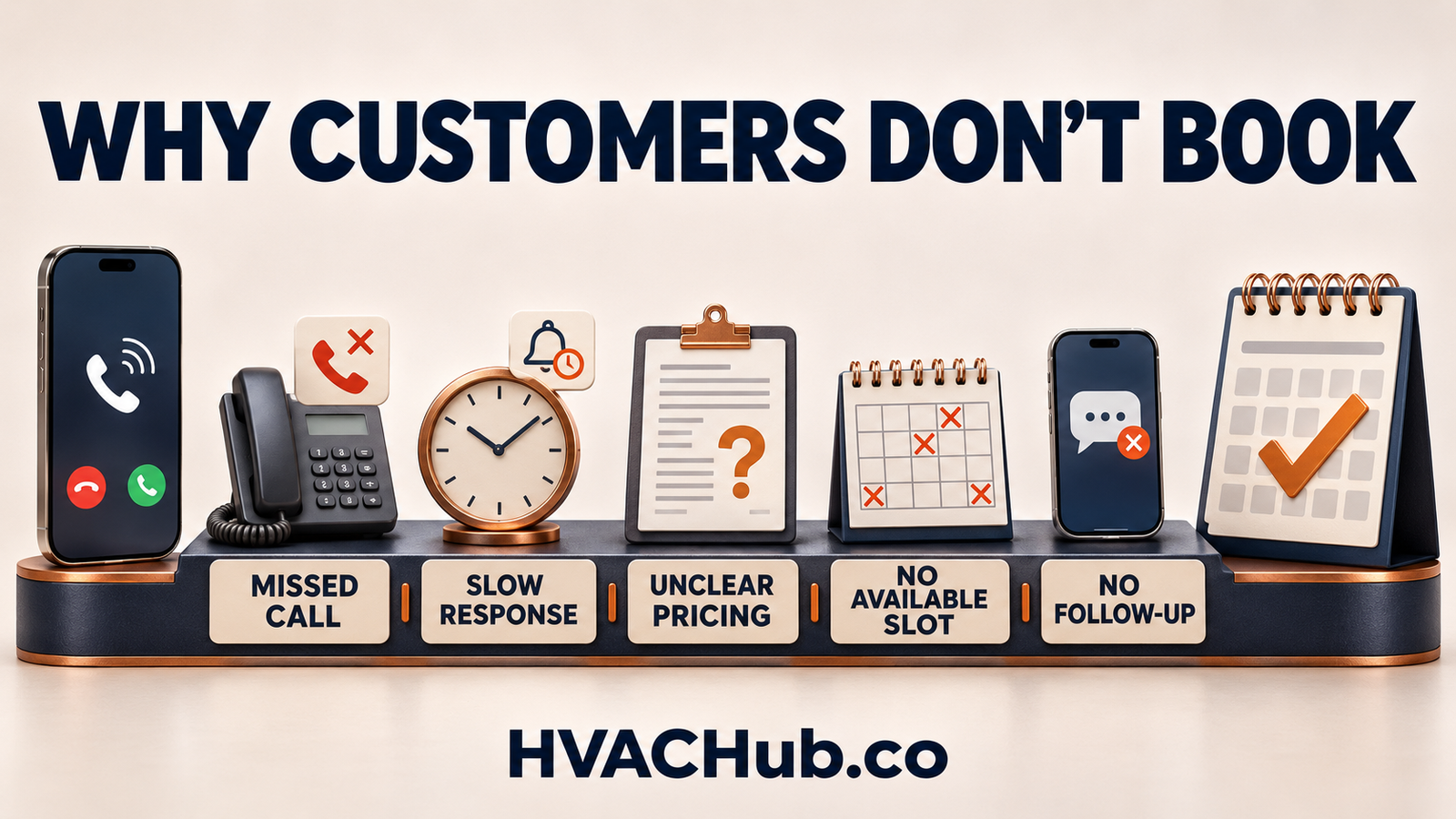
The Five Booking Barriers HVAC Companies Often Overlook
1. The call is missed when the customer needs help
A missed call does not always mean you lost the customer. Some callers leave a voicemail or try again. Others contact another contractor, particularly during uncomfortable weather or a breakdown. Review call logs and message timestamps to understand when inquiries arrive and whether someone responds.
Consider after-hours coverage, lunch periods, and peak-weather surges. A clearer callback process, an answering service, better staffing, or an online request form might help. The objective is to give customers a dependable next step, not to promise around-the-clock availability that the business cannot deliver.
2. The response comes after the customer has made other plans
Speed matters when a homeowner is dealing with a failed cooling or heating system, but response quality matters too. A rushed message with no useful information may not move the booking forward. A helpful reply should acknowledge the problem, confirm the service location, explain the next available appointment, and state what information is needed.
Measure how long your team takes to give a useful response after the customer first contacts you. Separate business-hours requests from overnight requests so performance is evaluated fairly. Track whether your team handled the inquiry, not just whether software sent an automatic reply.
3. Diagnostic fees and the booking process are unclear
Customers may hesitate when they do not understand what an initial visit includes, whether a diagnostic fee applies, or how repair approval works. Transparency can reduce uncertainty without requiring a contractor to diagnose equipment remotely or quote an exact repair price before inspection.
Use plain language: explain the service-call or diagnostic charge when applicable, what the technician will assess, how repair options are presented, and whether any fee is credited toward approved work under the company’s actual policy. Avoid vague promises such as “free estimate” when the service offered is not free.
4. The offered appointment does not fit the customer’s schedule
A customer may need your service and accept the price but cannot make the only time slot you offer. Review how often customers request another day, decline a long arrival window, or ask about emergency service. A waitlist or cancellation-fill process can help when used carefully and with customer consent.
Dispatchers should know which time slots are open, which jobs need special tools or skills, and which areas the team can serve. Offering a slot that later has to be withdrawn creates frustration and can harm trust.
5. Nobody closes the loop
Some inquiries end with “I’ll check with my partner” or “Send me the details.” Without a documented next step, they disappear into a notebook, inbox, or personal phone. A polite follow-up can answer questions and make it easy for customers to book or decline.
Follow-up should be proportionate to the request and consistent with applicable communications and privacy rules. Record the customer’s preferred channel, do not keep contacting people who decline, and avoid treating every unanswered inquiry as permission for ongoing marketing.
Follow the Customer From First Inquiry to Confirmed Booking
The best way to understand lost bookings is to map the actual customer journey. A homeowner might find a local HVAC company, call, leave a message, get a callback, ask about pricing, and choose a time. A commercial property manager may require service credentials, purchase-order details, or site access approval before scheduling.
Those are different journeys. Group inquiries by service type and customer need rather than forcing every caller into one script. Emergency no-cooling calls, maintenance requests, replacement estimates, and commercial service inquiries can have different qualification steps and booking timelines.
Keep a simple record for each real inquiry: date, source, service type, location, response time, contact outcome, service fit, appointment offer, booking result, and any known reason for not booking. Do not guess at reasons the customer never supplied.
Use reasons that lead to action
Useful nonbooking categories include outside service area, unsupported equipment, no suitable appointment, customer declined diagnostic fee, customer requested later follow-up, duplicate inquiry, and customer chose another provider when explicitly stated. Keep an “unknown” category. An honest unknown is better than inaccurate data.
How to Build a Useful HVAC Lead Conversion Funnel
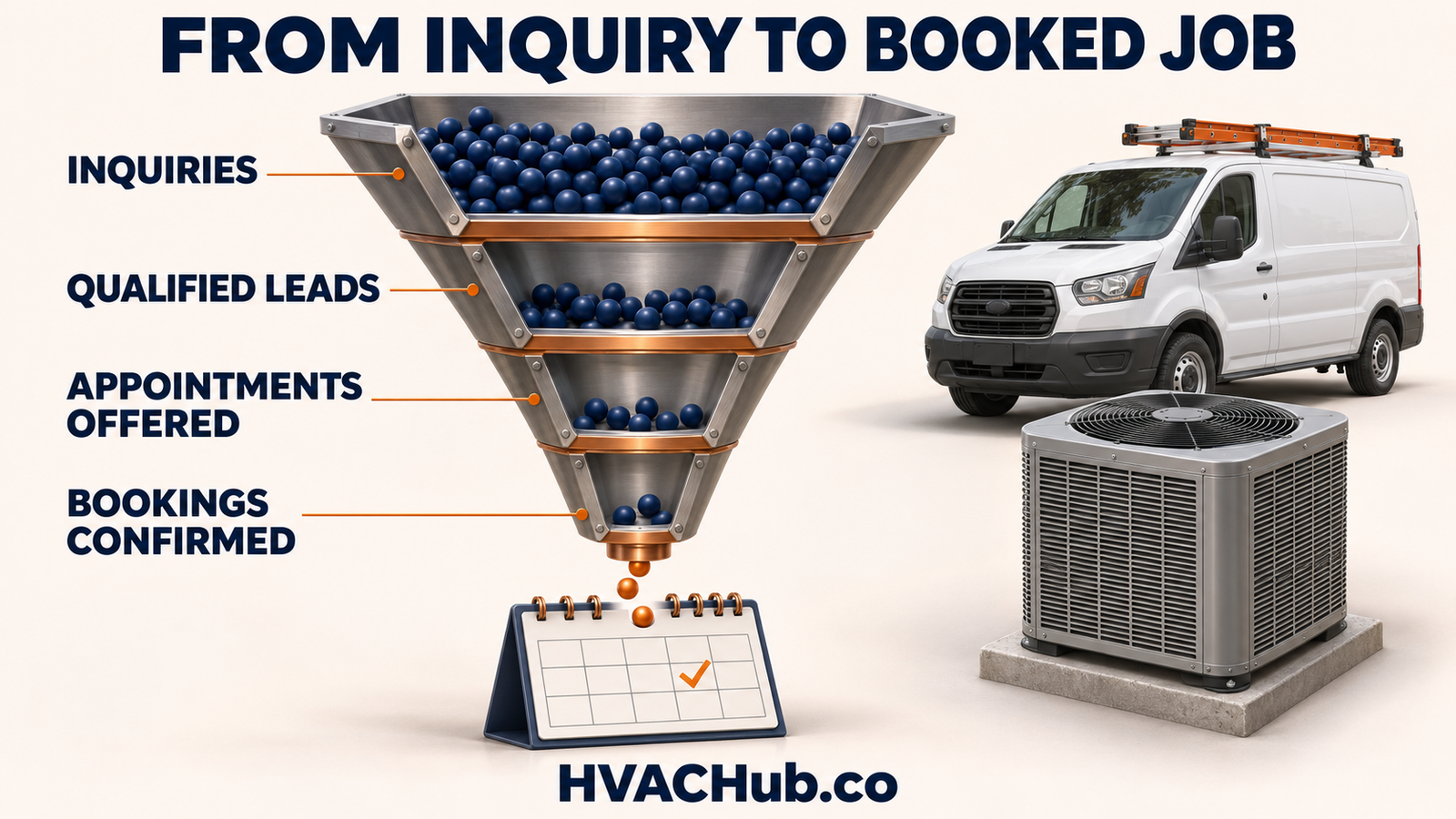
A practical funnel moves through four stages: inquiries, qualified leads, appointments offered, and bookings confirmed. Each stage needs a consistent definition. For example, a qualified lead might be a customer within the service area requesting a service the company provides and supplying enough information to consider scheduling.
Suppose 100 legitimate inquiries arrive in a month. After screening, 75 are qualified. Staff offer appointments to 60 prospects, and 42 accept. The overall inquiry-to-booking rate is 42%. The qualified-lead-to-booking rate is 56%, while the offered-appointment acceptance rate is 70%. All numbers are hypothetical.
These different percentages reveal where to investigate. When many suitable customers never receive an appointment offer, check phone coverage and scheduling. If offers are made but frequently declined, examine timing, communication, and the fit between customer expectations and service options.
Avoid comparing unlike sources
Website forms, paid-search calls, existing customer referrals, and emergency requests may have different levels of intent. A campaign attracting broad information requests should not automatically be judged against a referral stream of customers already prepared to book. Compare each source against its own purpose and track lead quality as well as volume.
Similarly, a technician may generate a replacement opportunity during a service visit. That is not equivalent to an inbound lead from a first-time homeowner. Separate those pathways so the business can make fair decisions about marketing and operations.
What an Effective HVAC Booking Conversation Sounds Like
A useful booking conversation starts with listening. The team member should listen to the problem, confirm the address and contact details, check for safety concerns, and explain the next available visit. If the caller reports a possible gas leak, carbon monoxide exposure, electrical danger, or another emergency, give appropriate safety guidance instead of a sales pitch.
Instead of immediately pushing for a commitment, the dispatcher can explain the visit process: “We can arrange a technician to diagnose the issue. The diagnostic charge is [your actual fee], and the technician will discuss any recommended repair before proceeding.” Use wording that matches the company’s real policies.
When a customer hesitates, ask a respectful question such as “Is there anything about the visit or timing I can clarify?” That may uncover an unresolved concern. It should not become a pressure tactic or an attempt to sell work the customer does not need.
The Missed Connection: When Capacity Exists but the Job Never Books

One of the most frustrating situations is a missed opportunity when a technician actually has an open slot. The customer assumes the company is unavailable, while dispatch has capacity that was never communicated. This happens when staff fail to update calendars, calls reach the wrong person, or requests sit unread in an inbox.
Review the handoff between marketing channels, office staff, dispatch, and field technicians. Who owns an incoming website request? Who checks voicemail? Who can offer a cancellation slot? If everyone assumes someone else is responsible, inquiries can go unanswered.
A clear ownership rule is more valuable than a complicated process. Each new inquiry should have a designated person or team responsible for the next action and a visible status. Customers should not have to repeat their story every time they call.
Measure Booking Quality, Not Just Booking Quantity
A higher booking rate is not automatically better if appointments are made for customers outside the service area, jobs the company cannot safely perform, or time windows that cannot be honored. These bookings can lead to more cancellations, travel time, complaints, and wasted technician hours.
Pair conversion metrics with cancellation rate, no-show rate, completed-job rate, customer complaints, and the proportion of visits requiring rescheduling. If booking rates rise while these results get worse, the process may create more problems than progress.
Be careful with employee incentives. Paying dispatchers only for booking volume can encourage poor-fit appointments. Balanced measures should recognize accurate qualification, clear communication, dependable scheduling, and customer experience.
A 30-Day Plan to Improve HVAC Lead Conversion
Week 1: Establish a reliable baseline
Collect recent inquiries from calls, website forms, email, and other channels. Remove spam and duplicate inquiries. Then define which inquiries and leads qualify. Count confirmed appointments and note where records are incomplete. Do not present estimates as precise facts.
Week 2: Investigate the biggest drop-off
Choose one gap. If calls are missed, review staffing and routing during peak periods. If many qualified leads are not offered appointments, examine dispatch capacity and handoffs. If customers decline offers, look for patterns in time windows and explanations.
Week 3: Test one operational change
Introduce a manageable improvement such as a same-day callback queue during business hours, clearer diagnostic-fee language, a documented follow-up step, or better visibility into cancellation slots. Train your team and write down the new process before you measure the results.
Week 4: Compare results and customer outcomes
Compare the new period with the baseline while noting differences in weather, advertising spend, service mix, and lead volume. Review booking rates alongside cancellations and completed visits. Results can swing widely when you have few leads, so treat early changes as clues, not proof.
Common Mistakes When Interpreting Conversion Data
- Counting repeat calls from the same customer as multiple new leads.
- Treating all website visitors as service inquiries.
- Comparing peak-season emergency leads with off-season maintenance requests without context.
- Marking every unbooked inquiry as a lost sale.
- Assuming an automated acknowledgment equals a real customer response.
- Optimizing booking totals without tracking appointment quality.
- Changing scripts, pricing, staffing, and advertising simultaneously, then attributing results to one change.
Clear definitions and steady tracking often help more than a complex dashboard. A small contractor can begin with a shared log and a weekly review. As volume grows, integrated scheduling and customer records may reduce duplicate entry and missed handoffs.
Frequently Asked Questions
How do you calculate an HVAC lead conversion rate?
Divide the number of confirmed appointments by the number of eligible inquiries or qualified leads in the same period, then multiply by 100. State which denominator you use so comparisons remain meaningful.
What is a good HVAC lead conversion rate?
There is no single trustworthy rate that applies to every HVAC business. Results depend on lead source, season, service type, qualification rules, market, and how a booking is defined. Establish a consistent baseline and improve the specific stages where qualified customers drop out.
Do missed calls always mean lost HVAC jobs?
No. Some callers leave messages, return later, or were never qualified prospects. However, unanswered legitimate inquiries create friction. Tracking callback completion and subsequent bookings can show whether missed calls are a material problem.
Should HVAC contractors follow up with every inquiry?
Follow up on legitimate requests when appropriate and consistent with customer preferences and applicable rules. Avoid repeated unsolicited messages, honor opt-outs, and distinguish service follow-up from promotional marketing.
Is lead conversion the same as closing a replacement estimate?
No. Booking an initial diagnostic or estimate is one stage; converting a quoted repair or replacement into an approved job is another. Track each step separately to see what needs work.
The Contractor Discussion: More Leads or Better Booking?
Before increasing the marketing budget, inspect what happens to the inquiries already arriving. You may need better phone coverage, clearer expectations, more useful appointment options, or a stronger handoff to dispatch. More advertising cannot reliably fix a broken booking process.
For HVAC owners and dispatch teams: are you losing more potential jobs because the phone is not ringing—or because the calls you already receive are not turning into appointments? What change has made the biggest difference in your business? Join the conversation at HVACHub.co.

Responses