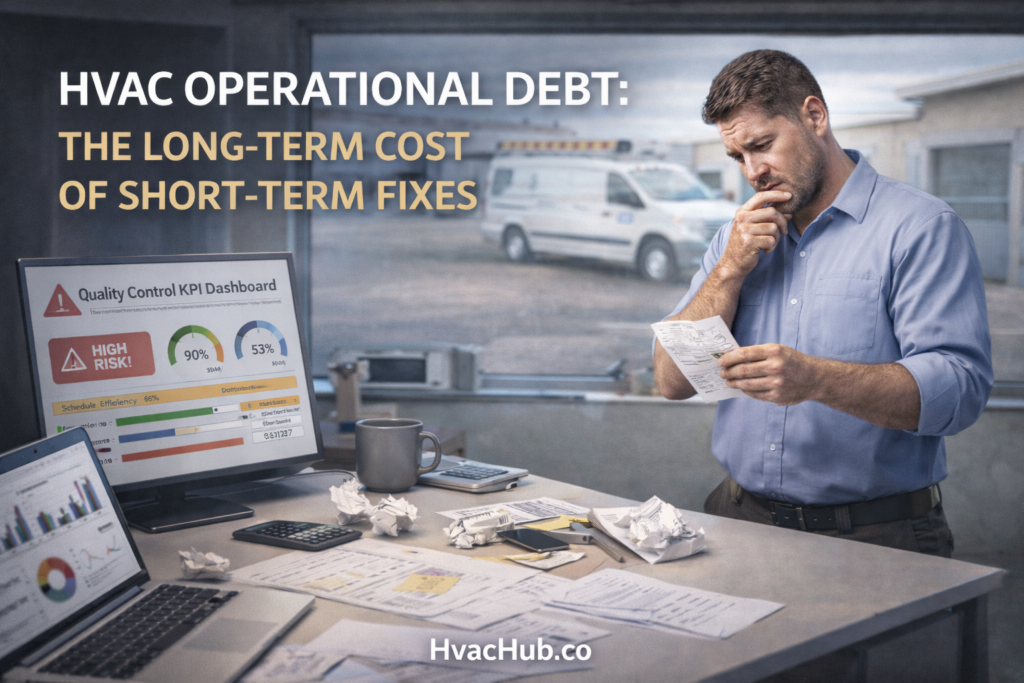
HVAC Operational Debt: The Long-Term Cost of Short-Term Fixes

Most HVAC businesses don’t intentionally create problems for themselves. They solve what’s urgent, fix what’s broken, and move on. But over time, these short-term decisions stack up and quietly create HVAC operational debt – inefficiencies and limitations that slow growth, increase stress, and make scaling far more difficult.
Operational debt doesn’t appear suddenly. It builds slowly when temporary fixes replace long-term systems. The business keeps running, but performance becomes harder to sustain as complexity increases.
Understanding this concept is critical for HVAC owners who want controlled, predictable growth.
1. Operational Debt Starts With “Quick Fix” Thinking
Short-term fixes often feel responsible in the moment.
Common examples include:
- Manual scheduling “just for now”
- Owner approval for every decision
- Informal processes known only by a few people
- Temporary workarounds that never get revisited
Each fix solves today’s issue, but none are designed to scale. Over time, these temporary solutions become permanent constraints.
2. Operational Debt Grows as the Business Expands
What works at three or five trucks breaks at ten or fifteen.
As the business grows:
- Communication becomes harder
- Coordination takes more time
- Errors increase
- Visibility decreases
When systems haven’t evolved, growth amplifies inefficiencies. This is where HVAC operational debt becomes expensive – not just financially, but operationally.
3. Operational Debt Reduces Clarity and Control
One of the most damaging effects of HVAC operational debt is loss of visibility.
Owners begin to lose clarity around:
- Job-level profitability
- Technician efficiency
- True operating costs
- Where time and money are actually being spent
Decisions start relying on intuition instead of data, increasing risk and uncertainty.
4. Operational Debt Impacts Team Performance
Teams feel operational debt before owners do.
Common symptoms include:
- Confusion around responsibilities
- Inconsistent expectations
- Repeated firefighting
- Frustration with unclear processes
Strong technicians and staff perform best in structured environments. Operational debt creates friction that lowers morale and increases turnover.
5. Operational Debt Makes Scaling Risky
Growth should create opportunity, not instability.
When HVAC operational debt exists:
- Adding technicians adds chaos
- Expanding service areas reduces consistency
- Peak seasons become overwhelming
- Customer experience suffers
Growth without structure magnifies problems instead of solving them.
6. HVAC Operational Debt Keeps Owners Trapped in the Business
Perhaps the most overlooked cost is personal.
Owners dealing with HVAC operational debt often:
- Can’t step away from daily operations
- Struggle to delegate
- Constantly solve avoidable problems
- Spend time managing symptoms instead of strategy
This limits both business potential and quality of life.
Reducing Operational Debt the Right Way
Eliminating operational debt doesn’t mean rebuilding everything overnight. It means replacing temporary fixes with intentional systems.
Successful HVAC businesses focus on:
- Standard operating procedures
- Clear ownership and accountability
- Scalable scheduling and communication systems
- Consistent onboarding and training
- Regular review of operational performance
Each improvement reduces friction and restores control.
Final Thoughts
HVAC operational debt is the long-term cost of choosing speed over structure. While short-term fixes keep businesses moving, they quietly restrict scalability, clarity, and stability.
HVAC companies that address operational debt early gain consistency, confidence, and the ability to grow without chaos. Structure doesn’t slow growth – it protects it.
If you want to learn how modern HVAC businesses replace short-term fixes with scalable systems…
👉 Join the HVAC Community Hub
Where HVAC owners learn to build businesses that grow with control, not stress.

Responses