
Manual HVAC Processes: Hidden Cost Impact

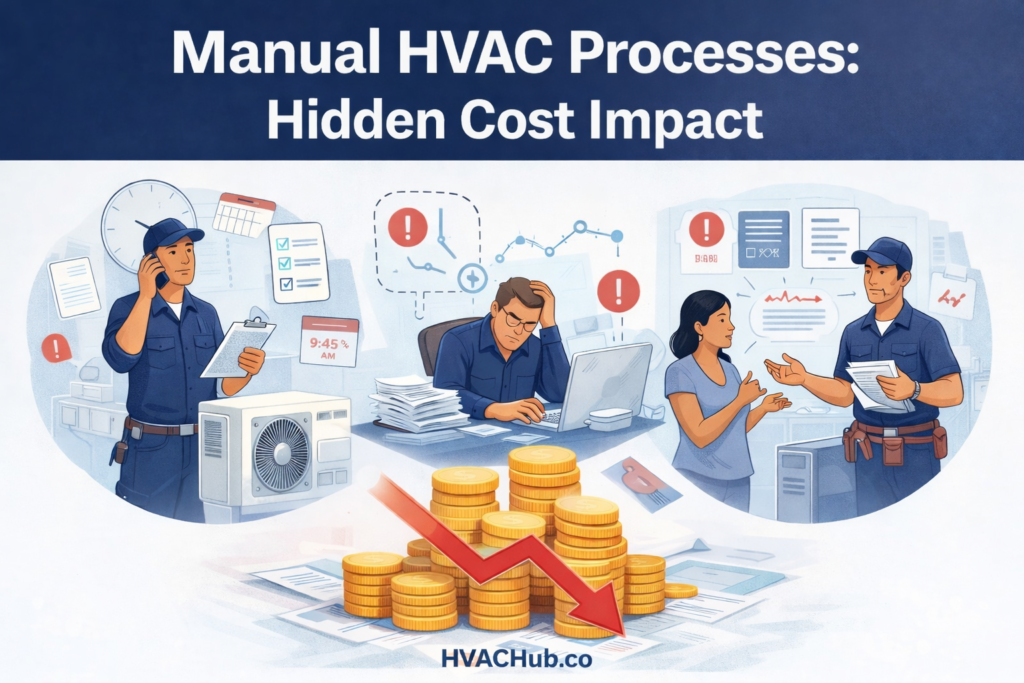
Many HVAC businesses rely heavily on manual work. At first, it feels manageable – calls are answered manually, schedules are updated by hand, follow-ups are remembered mentally, and reports are checked occasionally. But over time, these manual HVAC processes create hidden costs that quietly slow growth, increase stress, and reduce profitability.
The problem isn’t effort. Most HVAC owners and teams work extremely hard. The real issue is that manual systems don’t scale – and the cost of staying manual grows every year.
Here’s how manual processes impact HVAC businesses more than most owners realize.
1. Manual Processes Drain Time Every Single Day
Time is the first hidden cost.
Manual work consumes hours that could be spent on growth, customer experience, or leadership.
Examples include:
- Manually assigning jobs
- Calling customers for updates
- Writing notes after every job
- Tracking leads in spreadsheets
- Following up from memory
These small tasks add up to massive time loss across a week.
2. Manual Processes Increase Human Error
When everything depends on people remembering tasks, mistakes happen.
Common errors include:
- Missed follow-ups
- Incorrect scheduling
- Lost customer details
- Forgotten maintenance reminders
- Duplicate or incomplete records
These errors lead to frustrated customers, missed revenue, and internal confusion.
3. Manual Processes Create Inconsistent Customer Experience
Customers expect clarity, speed, and consistency. Manual workflows make this difficult.
This results in:
- Different experiences with different technicians
- Inconsistent communication
- Delayed updates
- Unclear pricing explanations
- No post-service follow-up
Inconsistent experiences reduce trust — even when the technical work is solid.
4. Manual Processes Slow Down Decision-Making
Without automation and structured data, owners operate blindly.
Manual systems make it hard to track:
- Job profitability
- Cost per lead
- Technician performance
- Conversion rates
- Maintenance plan renewals
Without real-time insight, decisions are based on assumptions instead of facts.
5. Manual Processes Limit Team Efficiency
Teams perform better when systems support them.
Manual processes cause:
- Confusion between dispatch and technicians
- Poor job preparation
- Delays due to missing information
- Stress during busy seasons
Strong systems allow teams to focus on execution, not coordination.
6. Manual Processes Make Scaling Extremely Difficult
What works for a small team breaks quickly as the business grows.
Manual systems fail when:
- Call volume increases
- More technicians are added
- Multiple locations are involved
- Customer base expands
Growth requires systems that work without constant manual control.
7. Manual HVAC Processes Lead to Owner Burnout
The final hidden cost is personal.
When everything depends on the owner:
- Decisions slow down
- Stress increases
- Delegation becomes impossible
- Growth feels overwhelming
Automation and structure don’t replace people – they protect them.
Final Thoughts
The hidden cost of manual processes isn’t just time or money – it’s lost momentum. Businesses don’t fall behind overnight; they fall behind slowly because systems never evolved.
Moving from manual to structured systems improves clarity, consistency, and control. It allows HVAC owners to lead instead of constantly reacting.
If you want to learn how modern HVAC businesses replace manual work with smarter systems…
👉 Join the HVAC Community Hub
Build systems that support growth – not stress.
Responses