
The HVAC Industry Built Speed – Not Certainty

The HVAC industry did not evolve by accident. Instead, it developed exactly according to what it rewarded. Over time, the HVAC industry built speed – faster dispatching, quicker diagnostics, and rapid turnover. However, it never built certainty. As a result, that imbalance now shows up everywhere.
Callbacks increase. Teams burn out. Customers lose confidence. Meanwhile, owners feel like they must constantly hold everything together.
This is not a technician problem.
Rather, it is a system problem.
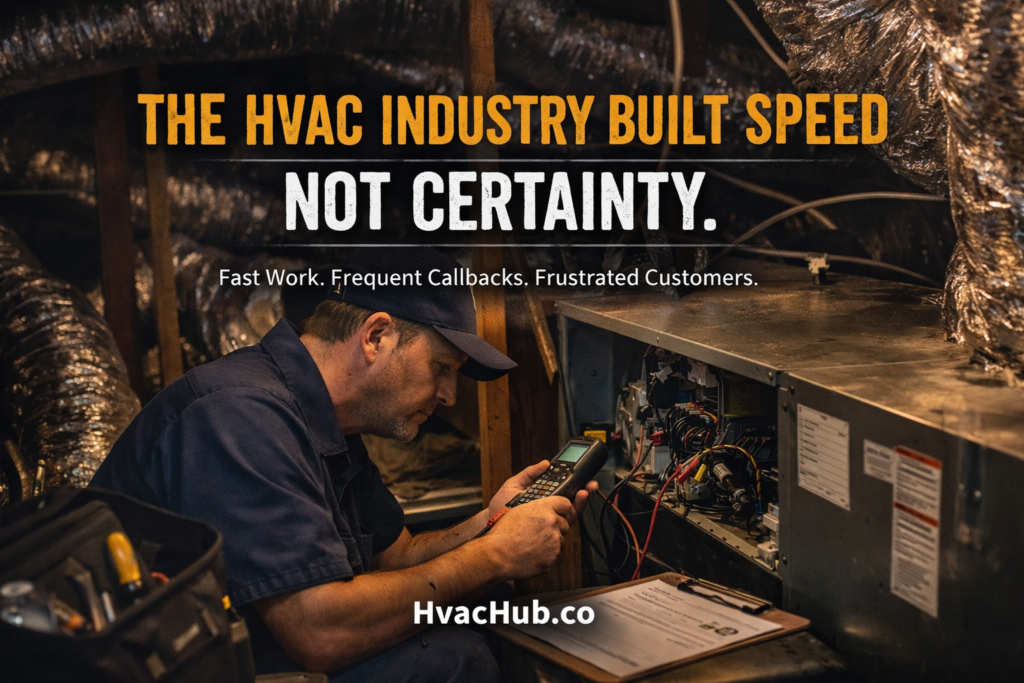
How the HVAC Industry Built Speed Into Daily Operations
Speed sits at the center of most HVAC operations.
For example, it appears through:
- Tight scheduling windows
- High daily call expectations
- Minimal time allocated for diagnostics
- Pressure to fix the most visible issue and move on
On paper, this looks efficient. In reality, it trades certainty for throughput. Consequently, accuracy suffers as volume increases.
Why the HVAC Industry Built Speed Instead of Certainty
Speed is easy to measure. Certainty is not.
Because of this, businesses track:
- Calls completed
- Jobs per day
- Average ticket time
However, they rarely measure:
- Diagnostic accuracy
- Root-cause verification
- Long-term system reliability
- Customer confidence
As a result, the industry optimized what was visible and measurable while ignoring what truly supported stability.
The Cost of an HVAC Industry Built on Speed
When speed becomes the primary goal, problems do not disappear. Instead, they repeat.
Over time, this leads to:
- Recurring callbacks
- Technicians making judgment calls under pressure
- Customers questioning recommendations
- Owners reacting rather than leading
Therefore, each service call becomes a risk instead of a repeatable, reliable process.
Why Technicians Carry the Blame for a Structural Problem
Most technicians want to deliver quality work. However, when systems reward speed over certainty, their options narrow.
Under pressure:
- Teams skip full diagnostics
- Verification becomes optional
- Root causes remain unconfirmed
These shortcuts are not character flaws. Instead, they represent a survival response to how the business model operates.
How the HVAC Industry Built Speed Masks Risk
During slower periods, speed-focused operations seem manageable. In contrast, during peak season, cracks appear quickly.
At that point:
- Small misses compound
- Schedules collapse
- Teams feel overwhelmed
- Customers feel ignored
Therefore, peak season does not create the problem. It exposes it.
What Certainty Actually Requires in HVAC Operations
Certainty does not mean slowing everything down. Instead, it means designing systems that continue working under pressure.
To achieve certainty, HVAC operations need:
- Clear diagnostic standards
- Consistent decision frameworks
- Time aligned with expectations
- Leadership accountability for structure
Without these elements, speed simply accelerates instability.
Why This Is Ultimately a Leadership Conversation
This issue does not come down to tools or technician capability. Instead, it comes down to leadership decisions.
Once owners realize the HVAC industry built speed, not certainty, they begin questioning how their business truly functions. More importantly, they start rethinking how they want it to grow.
That realization rarely happens alone.
Why These Conversations Belong in a Community
No single hire or policy fixes structural problems. Instead, owners solve them when they:
- Compare real-world experiences
- Challenge long-standing industry assumptions
- Learn from peers under similar pressure
- Build structure intentionally
This is precisely why the HVAC Community Hub exists.
If this post feels uncomfortable, that reaction makes sense. It means the issue finally has a name.
Final Thought
The HVAC industry built speed.
However, the next generation of HVAC businesses will build certainty.
Ultimately, the question is simple:
Do you continue operating inside a system that was never designed to protect you – or do you step into conversations that help you redesign it?
Join the HVAC Community Hub to explore these challenges with other HVAC owners facing the same reality.


Responses