

You Have 100 HVAC Customers. Can You Remember What You Did for Every One of Them?

Picture an HVAC contractor who has served 100 homeowners. They can remember the house with the difficult attic access, the family who replaced their old air conditioner, and the customer who always asks about maintenance. But ask for the exact date of the last visit, the invoice status, or the recommendation made six months ago, and the search begins.
Someone opens a spreadsheet. Someone else checks a phone. The technician remembers writing a note, but it may be in a different system. The customer is waiting while the business tries to reconstruct its own history.
The challenge is not whether an owner can memorize 100 people. The question is whether the company can retrieve accurate, relevant information when someone needs it. That matters whether the business has one technician or several service crews.
This article uses illustrative HVAC scenarios, not actual customer data. The goal is to help contractors evaluate how records are collected, shared, protected, and used in daily work.
You Have 100 HVAC Customers. What Do You Actually Know About Them?
A contact list might contain a name, address, and phone number. Those details help you reach someone, but they do not tell the whole service story. When a homeowner calls again, your team may need to know which system was serviced, what work was completed, which recommendations were declined, and whether a follow-up was promised.
Useful records should be factual, appropriately limited, and relevant to providing service. A contractor does not need to collect every personal detail about a household. It needs dependable information about the service relationship.
Think about the last ten calls your office handled. How many required someone to search old texts, call a technician, or ask the homeowner to repeat information the company should already have? That is a practical starting point for improving record quality.
A Phone Number Is Not a Customer History
Imagine a homeowner calling about a cooling problem. The office recognizes the phone number and finds the customer’s name. That is helpful. But the homeowner then asks, “Wasn’t this the same issue you repaired last summer?”
Without service notes, the office cannot confidently answer. The technician may need to review the job, the invoice, the equipment details, and any previous recommendations before deciding whether the symptoms are related. Guessing would be worse than admitting that the records need checking.
Customer history is more than a marketing convenience. When accurate and accessible to authorized staff, it supports continuity, better preparation, clearer conversations, and fewer repeated questions.

The Four Records Every HVAC Business Should Be Able to Find
1. Service history and equipment information
Record the date of each visit, the equipment serviced, work performed, relevant measurements, and factual technician observations. When available, capture equipment make, model, serial number, and installation details accurately. Avoid copying guesses into permanent records.
A technician arriving for a repeat visit benefits from knowing what happened previously. However, an old diagnosis should never replace a fresh inspection of current conditions.
2. Invoices and payment status
The office should be able to locate the invoice associated with a job and determine its recorded status. Distinguish an issued invoice from a paid invoice, and reconcile payment information with the actual payment processor or accounting records before making claims to customers.
An organized invoice history can help resolve questions without asking a homeowner to dig through old email messages. It also reduces the risk of contradictory answers from different employees.
3. Appointments and visit outcomes
A calendar shows when work is planned, but the business should also know whether an appointment is requested, confirmed, completed, canceled, or rescheduled. If a technician could not access the equipment or a return visit was needed, document the outcome clearly.
That distinction matters when a customer calls about a missed appointment or a job that remains unfinished. Do not treat a scheduled appointment as proof that the work was completed.
4. Follow-up commitments and customer preferences
If someone promised to send a written estimate, clarify a warranty question, or check on a part, record the commitment and who owns it. Relevant communication preferences should be respected, and promotional outreach must follow applicable consent and privacy requirements.
Not every service recommendation should trigger repeated sales messages. The purpose of a follow-up record is to support appropriate communication, not to pressure a homeowner.
Can Your Office Find the Right Information in 30 Seconds?
Thirty seconds is a useful challenge, not a universal performance standard. Some historical records legitimately take longer to verify. But for routine questions—such as the last service date or whether an appointment is confirmed—staff should not have to search five disconnected places.
Try a controlled test using a real record your team is authorized to access. Ask someone to find the most recent completed service, its invoice, the next appointment, and any open customer commitment. Record where the search slows down.
If the answer is scattered across personal phones, paper notes, email, and several unrelated files, the problem may be record organization rather than employee effort.

Why Good Technicians Still Leave Incomplete Records
HVAC technicians work under real time pressure. They diagnose equipment, explain options, source parts, travel between calls, and handle unexpected conditions. Documentation can become the last task of a demanding day.
A form that requires excessive typing or asks for irrelevant information is unlikely to produce consistent results. A better process identifies a small set of essential fields and makes them practical to complete before closing the job.
Train technicians on what belongs in a service record: factual findings, work completed, relevant measurements, customer decisions, and follow-up needs. Encourage clear language rather than vague notes such as “fixed unit” or “customer informed.”
Office staff also need a process for correcting errors. Changes should preserve accountability where appropriate, particularly for invoices, authorizations, and safety-related documentation.
The Hidden Cost of Asking Customers to Start Over
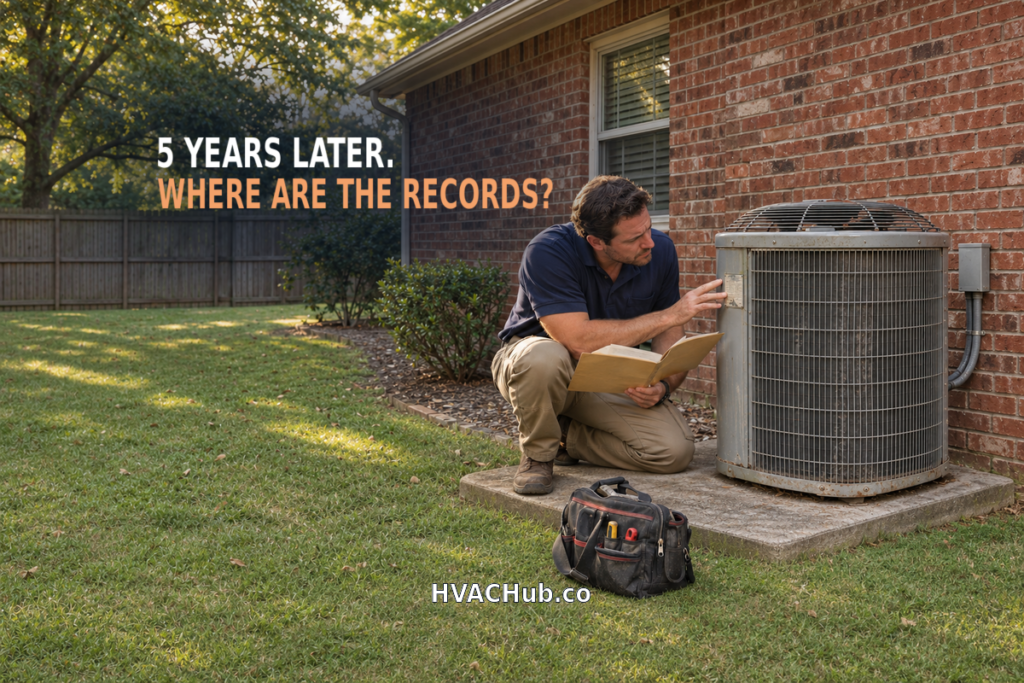
Consider a homeowner who has used the same HVAC company for several years. They call about a maintenance visit, only to be asked what equipment they have, whether the company installed it, and when anyone last visited.
Some verification questions are necessary. Addresses change, equipment gets replaced, and records may be incomplete. But repeatedly asking customers to reconstruct basic service history makes the company seem less prepared than it may actually be.
The more useful approach is to start with what the company can verify: “I see we serviced the upstairs system last spring. Is that the equipment you’re calling about today?” That question respects both the existing record and the possibility that circumstances have changed.
Don’t Confuse More Data With Better Data
A folder containing hundreds of unstructured notes is not automatically useful. Records need consistent categories, understandable descriptions, accurate dates, and a way to distinguish completed work from pending recommendations.
Avoid creating duplicate customer profiles for every phone number or spelling variation. Establish a process for matching records carefully, especially when multiple properties, landlords, or household members are involved.
Only collect information needed for legitimate business purposes. Restrict access according to job responsibilities, protect customer details, and follow applicable privacy and record-retention obligations. An organized system should also be a responsible system.
What Happens When Your Best Technician Leaves?
A long-serving technician may know which homeowner has a difficult access panel or which system has a history of intermittent faults. That practical experience is valuable, but essential service knowledge should not live exclusively in one person’s memory.
If that technician retires or moves to another company, the next person should still be able to review authorized service records and understand what was done. Good documentation supports continuity without pretending that notes can replace technical judgment.
Build a habit of recording useful job information while it is fresh. Review samples for clarity and coach the team when important details are routinely missing.
How to Build a Reliable Customer Record Without Creating More Office Work
Start with one consistent customer profile
Define which fields identify a customer and service location. Multiple properties may belong to the same customer, and different customers may share an address over time. Your process should account for those realities without merging unrelated histories.
Connect each service visit to the correct location and equipment
When practical, link service notes and invoices to the relevant job, property, and system. That makes it easier to distinguish an upstairs air handler from a downstairs condenser or a newer replacement from older equipment.
Make completion statuses explicit
Use clear distinctions such as pending, scheduled, completed, canceled, invoiced, and paid where appropriate. A status should reflect verified events rather than assumptions.
Assign responsibility for unresolved items
When a technician recommends further evaluation or promises a follow-up, record who will act and when. Without an owner, a reminder can become another forgotten note.
Review records regularly
A weekly spot check can reveal missing invoices, incomplete visit notes, duplicate profiles, and unresolved commitments. Fix the process that creates the errors instead of expecting staff to remember more.
A Realistic One-Week Customer Records Audit
Monday: Pick ten completed jobs
Select a small sample across maintenance, repairs, and installations. Use records you are authorized to inspect. Check whether the customer, property, equipment, and work performed are identifiable.
Tuesday: Reconcile invoice information
Confirm that each sampled job links to the correct invoice and that payment status is supported by the relevant records. Flag discrepancies for review rather than silently changing them.
Wednesday: Test retrieval
Ask an office team member to find service history, appointment status, and outstanding commitments for several sample customers. Note the systems they must open and any ambiguous information.
Thursday: Interview the field team
Ask technicians which fields are hardest to complete and which past details would actually help them on return visits. Use their answers to simplify documentation.
Friday: Fix one recurring gap
Choose one improvement, such as linking invoices to completed jobs or requiring a clear follow-up owner. Define how success will be checked in the following weeks.
When a Customer Calls Six Months Later, What Should Happen?
Imagine a homeowner calling about maintenance after a previous repair. A well-prepared office can verify the customer’s identity, find the last completed visit, review any relevant recommendations, and explain the next available appointment options.
That does not mean every answer is immediate. A warranty question may require document review, and a new technical concern requires proper diagnosis. The benefit is that the company begins from an accurate record rather than a blank page.
A business that can retrieve its own history is better positioned to communicate consistently, even when different employees handle the call.
Can a Business Management Platform Help?
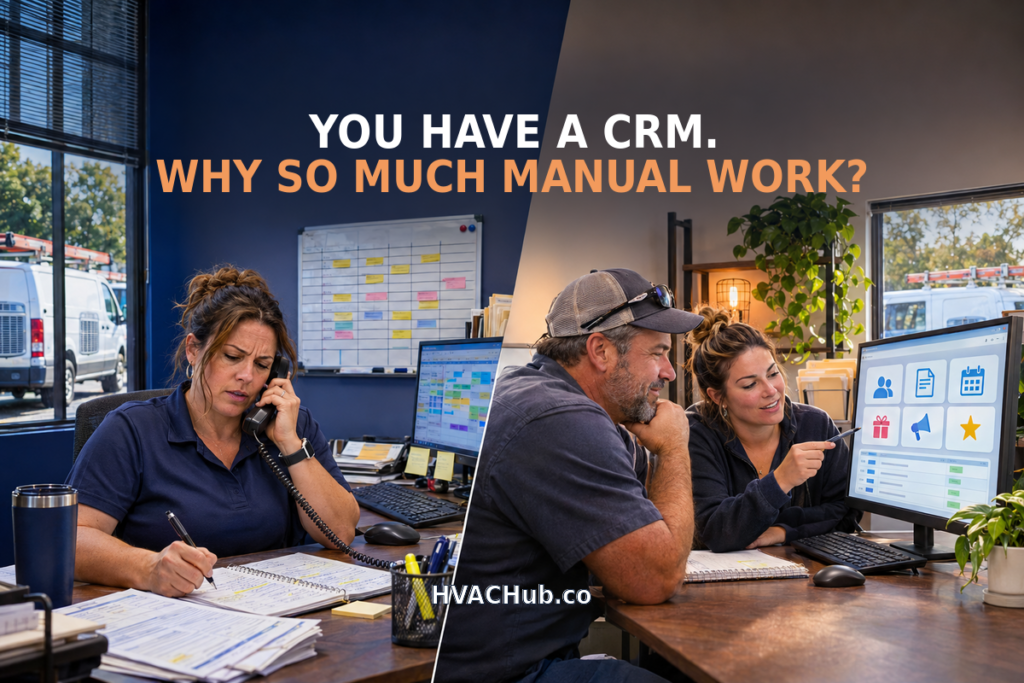
A business-management platform can provide a more structured place for customer information and everyday workflows. But buying software does not automatically correct incomplete notes, duplicate records, unclear ownership, or inconsistent staff habits.
Before choosing any system, test how easily your team can find a customer’s history, understand an invoice, review appointments, and identify follow-up commitments. Confirm what the product actually supports and what still requires human action.
Explore HVACB Business Suite
HVAC Community Hub and HVACB.com are affiliated. HVACB Business Suite is a business-management platform offering six core areas: Customers, Invoices, Appointments, Loyalty Rewards, Campaigns, and Reviews. This is a disclosed affiliated offer, not an independent third-party product review.
For contractors who want to explore organizing everyday business information, HVACB Business Suite may be an option to evaluate. Check the platform’s current features and onboarding details to determine whether it suits your workflow.

The proposed promotional terms for this article are the first three months free, followed by $39 per month only if you choose to continue. Because the live claim-page terms have not been independently verified here, confirm the current offer before publishing this draft. Review the details and claim process at HVACB.com/black-friday-sale/.
Frequently Asked Questions
What customer records should an HVAC company keep?
Typically useful records include customer and service-location details, equipment information, completed service notes, invoices, appointment status, and relevant follow-up commitments. Specific retention requirements depend on the business and applicable law.
Is a spreadsheet enough for a small HVAC business?
It may be sufficient for some small teams if information is accurate, protected, and consistently maintained. As workflows grow more complex, contractors may benefit from evaluating more structured tools.
How can I find missing service history?
Review existing job files, invoices, technician notes, and authorized communications. Mark information as unverified when necessary rather than reconstructing details from guesses.
Should every employee see every customer record?
No. Access should reflect legitimate job responsibilities and applicable privacy obligations. Sensitive information should be protected appropriately.
Will software automatically solve poor documentation?
No. Clear standards, staff training, accurate data entry, and periodic reviews remain essential regardless of the tool.
Your Business Should Remember What Your Memory Cannot
You do not need to remember every capacitor, appointment, invoice, and service recommendation across 100 customers. Your company does need a dependable way to retrieve the information that matters.
Start with a simple test: pick a returning customer and ask how quickly an authorized employee can reconstruct the relevant service history. The answer will tell you more about your operations than the size of your contact list.
What record is hardest for your HVAC company to find when a customer calls back? Join the contractor discussion at HVACHub.co.



Responses