

Your HVAC Customer Paid $8,000 for a New AC. So Why Does Your Company Treat Them Like a Stranger Six Months Later?

A homeowner spends $8,000 on a new air-conditioning system. Your installation crew arrives, completes the work, explains the thermostat, collects payment, and leaves the customer with a working system. Six months later, the homeowner calls the same company with a question. The first response? “Have we ever been to your property before?”
The homeowner gives the address, repeats the installation date, searches for the invoice, and tries to describe the equipment. Nothing is necessarily wrong with the new system. But something is wrong with the experience: a major customer relationship has become a first-time inquiry.
The $8,000 figure is an illustrative example, not a universal installation price. The lesson applies to any significant HVAC installation. Customers remember the investment and expect the contractor to recognize the work it performed.
The Installation Was Successful. The Relationship Wasn’t Finished.
Contractors put enormous effort into winning installation jobs. They answer inquiries, visit properties, calculate loads, explain options, prepare estimates, schedule crews, order equipment, and coordinate the installation. A successful job requires technical skill and operational discipline.
After the final walkthrough, however, many companies treat the customer file as a completed transaction. The crew moves to the next installation. The office closes the invoice. The homeowner is left to manage the paperwork.
That approach overlooks what the customer actually bought. They paid for installed equipment and professional work, but they also expect a company to stand behind the accuracy of its records, answer reasonable questions, and make future service straightforward.
A strong post-installation experience does not mean unlimited free support or automatic warranty coverage. It means the contractor can identify the installation, explain what documentation exists, and direct the customer to the right next step.
Six Months Later: A Phone Call That Should Have Been Simple
Imagine a homeowner calling because the thermostat behaves differently than expected. The office asks whether the company installed the equipment. The homeowner says yes. The representative asks for the model number. The homeowner cannot find it. Next comes a request for the invoice, followed by a long hold while someone searches old email threads.
The office employee may be doing their best. The problem often lies in how the business stores information. A sales estimate might live in one inbox, the equipment details in a technician’s notes, the invoice in accounting software, and the warranty paperwork in a shared folder.
The homeowner sees only one company. They do not know or care which internal system contains the answer. From their perspective, they paid a substantial amount and now have to prove the relationship exists.
A useful record would let staff confirm the property and previous installation, identify relevant documents, and ask a focused question about the current concern. It would not replace troubleshooting or authorize anyone to diagnose a fault over the phone without sufficient information.
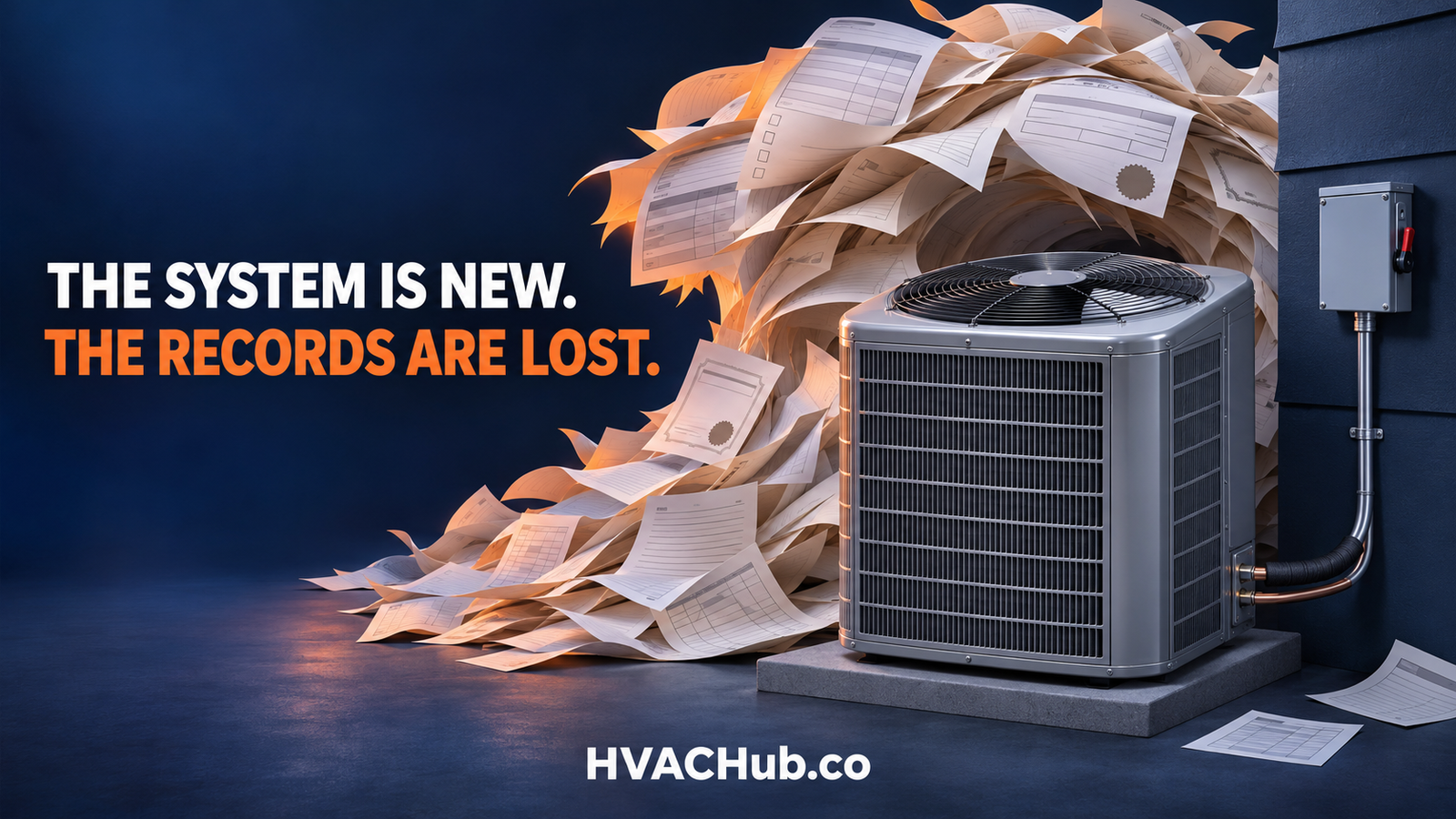
What Should a Contractor Be Able to Find After an Installation?
The goal is not to collect every possible detail. It is to preserve the information that makes service, documentation, and customer communication more accurate.
The installation date and service address
Start with the basics: the correct property, installation date, customer contact information, and any relevant access instructions. Confirm changes when the customer contacts you again. Properties change owners, phone numbers change, and assumptions become outdated.
Equipment identification
Record equipment type, manufacturer, model, and serial numbers where appropriate. Include the indoor and outdoor components when the installation involves a matched system. Accurate identifiers can help the team locate documentation and determine what needs verification.
Never substitute an assumed model number for one the crew did not actually document. If information is missing, say so and arrange to verify it.
Scope of work and commissioning notes
Preserve what was installed, what was replaced, and what checks the crew actually performed. Where relevant, include documented airflow, refrigerant, electrical, drainage, and operational checks according to the equipment and job scope.
A completed checklist is useful only if the checks were performed. Avoid creating the appearance of testing after the fact. The purpose of documentation is to support accurate service, not to decorate a customer file.
Estimate, approvals, and final invoice
Keep the accepted scope, approved changes, payment record, and final invoice accessible to authorized staff. This helps answer questions about what the homeowner purchased and what work the company agreed to perform.
Warranty and registration information
Record which warranties may apply and where supporting documentation can be found. Manufacturer coverage, labor warranties, registration deadlines, exclusions, and transferability can differ. Never tell a homeowner that a repair is covered until the applicable terms and circumstances have been checked.
Customer communication preferences
Note how the homeowner prefers to receive essential service information and whether they have agreed to optional marketing communications. Keep consent and opt-out information accurate. A good relationship does not require constant messages.
The Difference Between a Customer Record and a Customer Experience
A database can contain hundreds of fields and still leave customers frustrated. What matters is whether the right employee can use reliable information at the right moment.
Suppose the homeowner calls about a thermostat question. A helpful office response might be: “I can see we installed your system in May. Let me confirm the address and check the equipment information before we decide whether you need a technician.”
That response is simple, but it changes the interaction. The homeowner no longer needs to reconstruct the entire job. The office acknowledges the history without assuming that the previous installation caused the current concern.
If a service visit is needed, the technician can review relevant notes before arriving. They should still assess the equipment and current conditions independently. Historical records inform a diagnosis; they do not replace one.
The Four Moments That Shape the Post-Installation Relationship
1. Before the crew leaves
Walk the homeowner through basic system operation, thermostat settings, filter access, and any safety or maintenance instructions relevant to the installed equipment. Explain what documentation they will receive and whom to contact with questions.
Use plain language. Homeowners do not need a technical lecture, but they should know where the equipment is, how to recognize a concern, and which tasks require a qualified professional.
2. When the final documents arrive
Send a clear invoice and installation summary through the agreed channel. Include the company name, contact details, installation date, equipment information when available, and relevant warranty documentation.
Check that attachments open correctly and that contact details are current. A perfect document that never reaches the customer provides little value.
3. When the homeowner has a question
Make it easy for staff to retrieve the installation history. A customer should not have to remember the original salesperson’s name to get a reasonable answer. Give employees a clear escalation path when they cannot verify a warranty term, technical detail, or prior commitment.
4. When future service becomes appropriate
Offer relevant maintenance information or a follow-up when it reflects equipment needs, the company’s service commitments, and customer preferences. Do not invent urgency or imply that every new system requires the same schedule. Follow manufacturer guidance and applicable requirements.

Why the Office Often Loses the Thread
The breakdown is not always caused by a careless employee. Installation work moves through multiple people and systems. A salesperson may collect the original customer details, a dispatcher books the job, installers document equipment, accounting sends the invoice, and a service coordinator handles later calls.
If each handoff depends on someone remembering to forward an email or copy a spreadsheet row, information can become fragmented. Staff turnover makes the gaps more visible. The person who remembers the job may no longer work there.
Map the handoffs. Who confirms equipment identifiers? Who stores the final invoice? Who checks whether the warranty documents were delivered? Who updates the record when a customer changes their contact information? Clear ownership matters more than a complicated checklist nobody follows.
The Warranty Question Can Expose Every Weakness
A homeowner might call six months after installation and ask, “Is this covered?” That sounds like a simple yes-or-no question, but the answer can depend on the manufacturer, component, registration status, labor terms, cause of failure, and service conditions.
A well-organized company can quickly find the relevant paperwork and explain the next step. It should not promise coverage before verifying the terms or determining what happened. Nor should it imply that all installation-related concerns require a charge.
Clear documentation helps both sides. The customer understands what to expect, and the contractor has a reliable record of the original agreement and subsequent communication.
Don’t Confuse Follow-Up With Constant Marketing
Some contractors respond to retention problems by sending more messages. But a customer who recently purchased a major system may not want frequent replacement offers. Relevance matters.
A useful post-installation message might confirm that the homeowner received the documents, explain where to find operating instructions, or follow up on an issue the customer raised. A maintenance reminder may make sense later, based on the system and the customer’s preferences.
Promotional campaigns and loyalty rewards can have a place, but they should not overshadow service obligations. Separate essential transactional communications from optional marketing, and respect applicable consent rules and opt-outs.
A Practical Customer Journey: From Installation to Ongoing Care
Before: The job closes and the information scatters
The salesperson sends the quote by email. Installers write model numbers on paper. The invoice is stored separately. A warranty document sits in a folder nobody else knows about. Six months later, the homeowner calls and the office starts searching.
After: The company can recognize its own work
The team confirms the customer and service address, records equipment identifiers, attaches or links the relevant documents, and notes what was completed. The office can locate the installation history when the homeowner calls again.
The homeowner still needs to describe the new concern, and the contractor still needs to diagnose it appropriately. But the conversation begins with shared context instead of repeated introductions.
That difference can reduce frustration and help employees respond consistently. It does not guarantee loyalty, eliminate callbacks, or prove that every installation was completed correctly.
Five Checks to Run on Your Last Ten Installations
Can you find the installed equipment details?
Pick ten recent completed installations. For each one, check whether the office can locate the relevant model and serial information without calling the original installer. Record missing details and identify why they were missed.
Can you retrieve the approved scope and final invoice?
Confirm that staff can distinguish the original estimate, approved changes, and final billing. Make sure documents are stored securely and accessible to the people who need them.
Can you explain the warranty documentation?
Check whether the company has the applicable warranty information and can tell the homeowner where to find it. Identify any gaps in registration or documentation without assuming that missing paperwork automatically determines coverage.
Can the next employee understand the job?
Ask someone who was not involved in the installation to review the record. Can they explain what equipment was installed and which questions still need verification? If the record depends on one person’s memory, improve the handoff.
Can the homeowner reach you again easily?
Review the final invoice and follow-up message from the customer’s perspective. Is the company name obvious? Is the phone number correct? Is the process for requesting service clear? Fix confusing details before adding more campaigns.
What to Measure Beyond Installation Revenue
Installation revenue matters, but it cannot tell you whether the customer experience remained coherent afterward. Consider tracking documentation completeness, time needed to retrieve installation records, unresolved post-installation questions, and customer feedback about follow-up.
Look for patterns rather than chasing one impressive number. If several customers call because they cannot find warranty information, improve how it is delivered. If office staff repeatedly ask installers for model numbers, strengthen the installation closeout process.
These are operational measures, not promises of increased revenue. They help reveal whether your business can support the relationships it has already earned.
Where Business Management Tools Can Fit
Some contractors can improve their process using the systems they already have. Others may benefit from consolidating customer records, invoices, appointments, and communication-related work. The right choice depends on the business, its staff, and how the tools actually work.
When evaluating a platform, ask for a demonstration of a realistic scenario: a homeowner calls six months after installation. Can the team find the customer, retrieve the invoice, see relevant appointment history, and arrange the next step? Verify how equipment details and documents are handled rather than assuming every platform includes specialized installation or warranty tracking.
An Affiliated Option for HVAC Community Hub Readers
HVAC Community Hub shares practical business discussions for contractors. HVACB Business Suite is an affiliated business-management option that brings together Customers, Invoices, Appointments, Loyalty Rewards, Campaigns, and Reviews. HVAC Community Hub and HVACB.com are affiliated; this is a disclosed community offer, not an independent third-party recommendation.
Those feature areas may help a company organize parts of its customer journey, but they do not by themselves guarantee installation documentation, warranty verification, automated follow-up, or repeat bookings. Review the current product capabilities and terms to see whether they suit your workflow.

Readers interested in the current free-access promotion can review the official HVACB Business Suite claim page. Promotional eligibility and availability depend on the published terms; a submitted request is not a guarantee of a slot. For more contractor discussions, visit HVACHub.co.
Frequently Asked Questions
What records should an HVAC contractor keep after an installation?
Relevant records can include customer and property information, installation date, equipment identifiers, approved scope, commissioning notes, invoice, and warranty documents. Store information securely and according to applicable requirements.
Does a new HVAC installation automatically include a warranty?
Coverage depends on the applicable manufacturer and contractor terms, the component, and the circumstances. Verify the documents and conditions before telling a homeowner that a specific issue is covered.
How soon should an HVAC company follow up after installation?
The appropriate timing depends on the work, commitments made, customer preferences, and whether a specific issue needs attention. A useful follow-up has a clear purpose; more messages are not always better.
Can software prevent post-installation customer frustration?
Software can help organize information and workflows, but staff still need accurate records, clear responsibilities, and sound service judgment. No platform guarantees a better experience on its own.
What is the first process a small HVAC business should improve?
Start with installation closeout. Confirm that the customer receives clear documents and that authorized office staff can find the equipment and invoice details later.
A Major Installation Shouldn’t Become a Forgotten Transaction
The homeowner does not expect every employee to remember every conversation. They do expect the company to recognize the work it performed and help them find the information they reasonably need.
That is the difference between completing an installation and maintaining a professional relationship. Keep accurate records, deliver understandable documents, respect communication preferences, and make the next interaction easier than the first.
How does your company handle calls from homeowners six months after a new installation? Share what works—and what still causes frustration—with fellow contractors at HVACHub.co.




Responses