
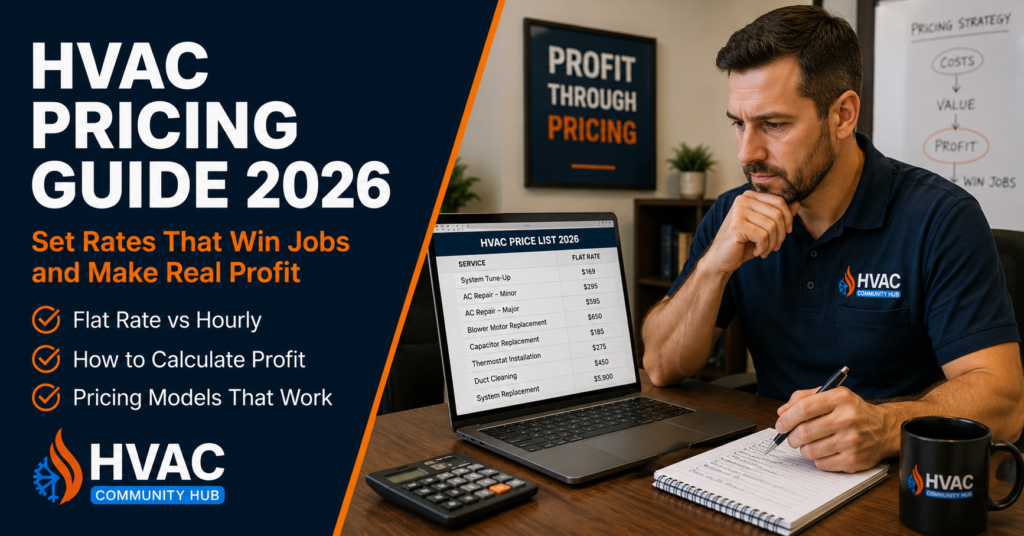
HVAC Pricing: Set Rates That Win Jobs and Make Profit

Getting your HVAC pricing right is one of the most important things you can do for your business in 2026. Set your rates too low and you work hard for little reward. Set them too high without the right approach and customers go elsewhere. Most HVAC owners guess their prices based on what competitors charge — and that single habit costs them thousands of dollars every year. This guide shows you exactly how to set your HVAC pricing correctly, which pricing model works best, and how to protect your profit on every single job.
Why Most HVAC Businesses Get Their Pricing Wrong
Many HVAC business owners price their jobs by looking at what competitors charge and matching that rate. However, this approach is one of the fastest ways to hurt your business. A lot of new HVAC owners look around, see what the competition is charging, and just try to match that. The problem is that is the fastest way to undercut yourself. Your pricing should reflect your true costs, your overhead, and your profit goals — not someone else’s numbers.
The Real Cost of Undercharging
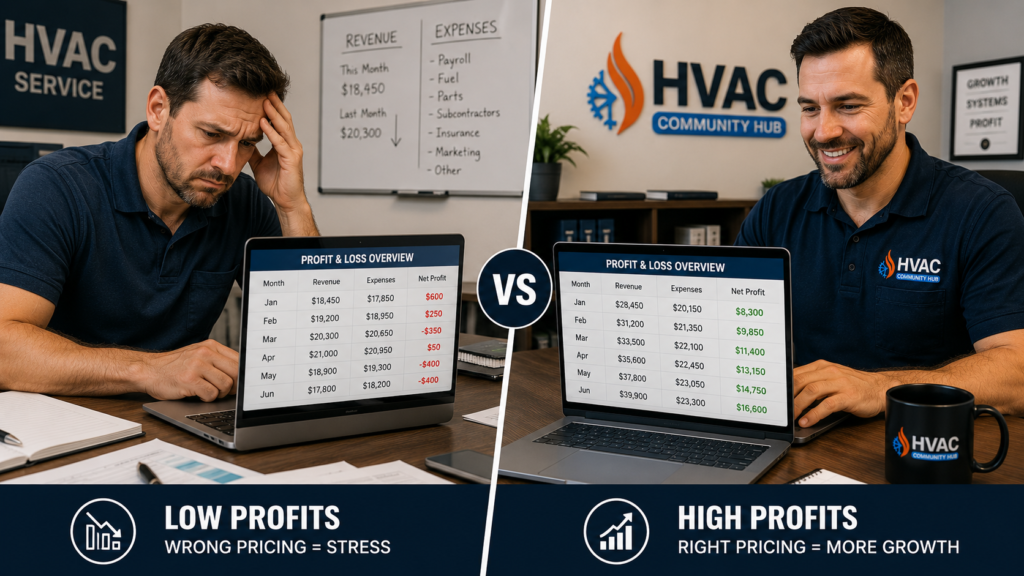
When you charge too little, you might win more jobs. But winning more jobs at the wrong price just means working harder for less money. A $30 per hour tech actually costs you $42 to $45 per hour when fully burdened with taxes, insurance, and benefits. So if you price jobs using the technician’s basic wage, you lose money on every single job without realising it.
This is why many HVAC businesses look busy but never seem to grow. The revenue is there. The profit is not. Fixing your pricing is the single fastest way to change that.
What Good HVAC Pricing Actually Covers
Your price for any job needs to cover four things. First, direct labour costs — including wages, taxes, insurance, and benefits. Second, materials and parts — at your actual cost plus a fair markup. Third, overhead — your truck costs, office expenses, insurance, software, and marketing divided across every job. Fourth, your target profit margin on top of all of that.
Many HVAC contractors discover they have been losing money on certain job types for years once they run these numbers honestly. Getting clear on your real costs is the starting point for setting prices that actually work.
The Two Main HVAC Pricing Models — Which One Is Right for You?
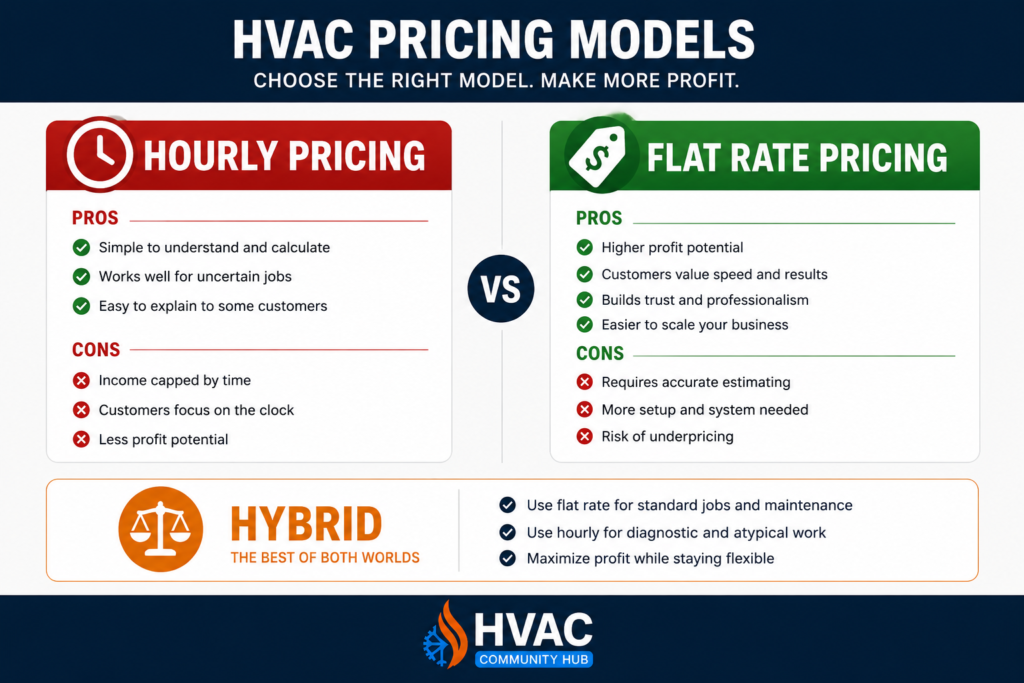
Every HVAC business uses one of two main pricing models — or a combination of both. Understanding the difference helps you choose the right approach for your business.
Hourly Rate Pricing — Time and Materials
With hourly pricing, you charge the customer based on how long the job takes plus the cost of materials. Many customers like this model because it feels transparent. They can see exactly what they are paying for.
However, hourly pricing has a big problem. The customer will start watching the clock. Every minute your technician spends on a job, the customer is calculating the cost. This creates pressure and can lead to disputes over the final bill. Furthermore, if your technician works efficiently and finishes quickly, you earn less — even though you delivered a great result.
Flat Rate Pricing — One Fixed Price Per Job
With flat rate pricing, you set a fixed price for each type of job before the work begins. The customer knows the total cost upfront and there are no surprises at the end. Flat rate shops typically see 15 to 25% higher revenue per job compared to hourly billing.
Why? Because customers feel certain about what they are paying. They stop watching the clock. Your technicians can focus on doing the job well rather than rushing. And you earn the same amount whether the job takes 45 minutes or 90 minutes — which rewards efficiency.
The Hybrid Approach — Best of Both
Many successful HVAC businesses use a combination of both models. They use flat rate pricing for standard residential jobs — repairs, maintenance, and tune-ups. They switch to hourly pricing for large commercial projects or unusual jobs where the scope is hard to predict upfront.
Using a combination of the hourly and flat rate approach may help you get more accurate pricing without cutting into profits. Start with flat rate for your most common jobs and build from there.
How to Calculate Your HVAC Pricing Step by Step
Now that you understand the pricing models, here is exactly how to calculate the right price for any job.
Step 1 — Calculate Your True Labour Cost Per Hour
Start with your technician’s hourly wage. Then add all the additional costs — payroll taxes, health insurance, paid leave, and any other benefits. The median HVAC technician earns $28.75 per hour. Fully burdened with taxes, insurance, and benefits, that is about $37 per hour.
Use your actual numbers — not industry averages. Your labour cost is the foundation of every price you set. If you get this wrong, everything else will be wrong too.
Step 2 — Calculate Your Overhead Per Job
Add up every monthly expense that is not direct labour or materials. This includes truck costs, fuel, insurance, office rent, software, marketing, and any admin staff wages. Then divide that total by the number of jobs you complete each month.
If you run $30,000 in overhead and complete 150 jobs per month, your overhead per job is $200. Add this number to every job you price. Without it, every job you complete is subsidising your overhead out of your own pocket.
Step 3 — Add Your Materials Markup
Never charge customers your cost price for parts and materials. Always add a markup. Materials markup should land between 30 and 65% depending on the category. Commodity items like standard fittings might carry a 30% markup, while specialty equipment or hard to source parts can carry 50 to 65%.
Your markup on materials is not just extra profit. It covers the time spent sourcing parts, the cost of carrying stock, and the risk of ordering the wrong item.
Step 4 — Add Your Target Profit Margin
Finally, add your target profit margin on top of your total costs. Set target margin ranges by job type — routine service calls 20 to 35%, repairs 25 to 40%, full system installations 30 to 45%.
Many HVAC owners feel uncomfortable charging a healthy margin. However, your profit is what funds your business growth, your next vehicle, your next technician, and your family. Charge what your business needs — not the minimum you can get away with.
How to Present Your HVAC Pricing to Customers With Confidence
Setting the right price is only half the job. Presenting it confidently and winning the customer is equally important.
[H3] Use a Good Better Best Pricing Structure
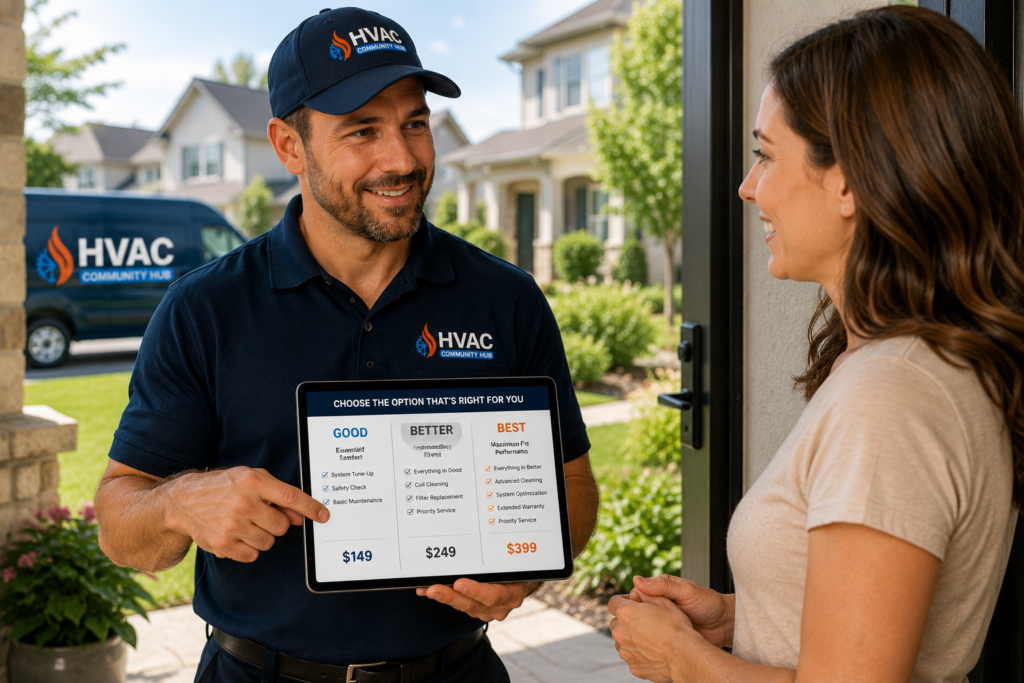
One of the most effective ways to present HVAC pricing is the Good Better Best approach. You offer three options at three price points — a basic option, a standard option, and a premium option. Each one includes more value than the last.
This approach works because it shifts the customer’s decision from “should I use this company” to “which option should I choose.” Customers who choose the Best option typically include a maintenance agreement and have three times higher lifetime value. Furthermore, presenting three options makes your middle option feel like the most reasonable choice — which is usually your most profitable package.
Never Apologise for Your Price
Many HVAC technicians and owners feel awkward quoting a price. They hedge, they add disclaimers, and they offer discounts before the customer even asks. This signals a lack of confidence in your own value.
State your price clearly and then stop talking. If the customer asks why it costs that much, explain what is included — your experience, your warranty, your response time, and the quality of your work. Your price reflects your value. Own it.
Handle Objections With Facts Not Discounts
When a customer says your price is too high, resist the urge to drop it immediately. Instead, help them understand what they are getting. For example, mention your warranty, your response time, your reviews, and your years of experience. Furthermore, remind them that the cheapest option often costs more in the long run through callbacks, poor workmanship, and failed equipment.
You can also refer customers to our guide on how HVAC reputation and trust affect buying decisions — HVAC Reputattion
Common HVAC Pricing Mistakes to Avoid
Even experienced HVAC owners make these pricing mistakes. Recognising them is the first step to fixing them.
Pricing Based on Competitor Rates
Matching competitors without knowing your own costs is guessing. Your competitor may have lower overheads, different technician wages, or a different business model. Their price has nothing to do with what you need to charge to be profitable.
Not Reviewing Prices Regularly
Refrigerant costs fluctuate. Equipment gets backordered. Labour rates rise. If your pricing system is not built on real numbers, your margins shrink fast. Review your prices at least every six months. When your costs go up, your prices must go up too.
Giving Discounts Too Easily
Every discount comes directly out of your profit — not your revenue. A 10% discount on a $500 job with a 20% margin does not just reduce your profit by 10%. It cuts your margin in half. Train your team to hold the price and justify the value instead of discounting as a first response.
Frequently Asked Questions About HVAC Pricing
What is a good profit margin for an HVAC business?
A healthy net profit margin for an HVAC business is between 15 and 25%. However, many HVAC businesses operate at 5% or less because they underestimate their true costs. Start by calculating your real cost per job and work up from there.
Should I use flat rate or hourly pricing?
For most residential HVAC work, flat rate pricing produces better results. It gives customers certainty, removes the clock-watching problem, and rewards efficient technicians. Use hourly pricing for large commercial jobs or unusual projects where the scope is hard to define upfront.
How do I calculate my overhead cost per job?
Add up all your monthly expenses that are not direct labour or materials. Divide that total by the number of jobs you complete per month. Add that number to every job you price. This is your overhead allocation per job.
How often should I review my HVAC pricing?
Review your pricing at least every six months. Check whether your labour costs, material costs, and overhead have changed. If they have gone up, your prices need to go up too. Many HVAC owners lose margin slowly over time simply by not keeping their prices current.
How do I explain higher prices to customers?
Focus on value rather than cost. Explain what is included — your warranty, your experience, your response time, and your reviews. Customers who understand the value rarely argue about the price. Those who only care about the cheapest option are rarely the customers you want anyway.
Set Your HVAC Pricing Right and Everything Else Gets Easier
Getting your HVAC pricing right is not just about making more money on each job. It is about building a business that is sustainable, stable, and able to grow. When your prices cover your real costs and include a healthy profit margin, you can invest in better equipment, better staff, and better marketing.
Where to Start Today
First, calculate your true labour cost per hour including all burdens. Then work out your overhead per job. Then review your current prices against those numbers. Most HVAC owners who do this exercise find they need to raise prices — sometimes significantly.
Furthermore, if you want support setting up your pricing system — including templates, a community of HVAC owners sharing what works, and courses built specifically for your business — HVAC Hub is exactly where to start.
Pricing decisions also affect how you finance jobs and collect payment. Our related guides cover offering HVAC financing, why customer financing applications are declined, and getting invoices paid faster.
Visit hvachub.co to join free and start building the pricing system your business needs to grow profitably in 2026. You can also read more about how our pricing and contracts course helps HVAC owners get this right — HVAC PRICING AND CONTRACTS

Responses