
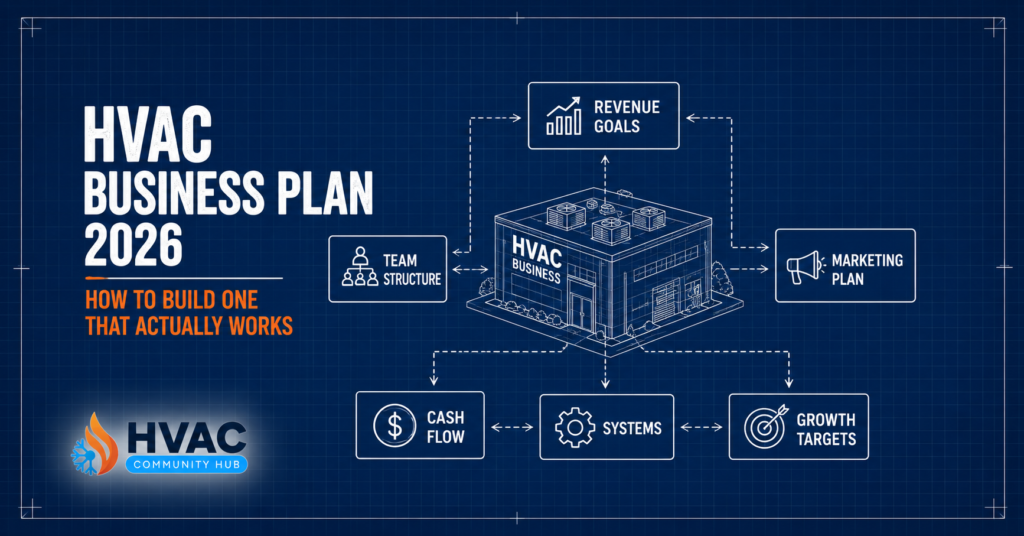
HVAC Business Plan: How to Build One That Actually Works

A solid HVAC business plan is the difference between an HVAC business that grows with purpose and one that reacts to every problem as it arrives. In fact, research from BDR shows that HVAC businesses with a strategic financial plan can increase profit margins to 10 to 20% — compared to the industry average of 2 to 5% for businesses operating without one. Furthermore, a traditional twelve-month business plan written once a year and filed in a drawer is not what works in 2026. The HVAC market is too unpredictable — weather shifts, supply delays, seasonal swings, and staffing changes can make a fixed annual plan collapse by February. This guide shows you exactly how to build an HVAC business plan that guides real daily decisions, keeps your team focused, and grows your profit consistently throughout the year.
Why Most HVAC Business Plans Fail Before the Year Is Over
Most HVAC business plans are written for banks and investors — not for daily operations. They look impressive in a document, include detailed financial projections, and are filed away after securing funding. Then January arrives, an emergency job floods the schedule, a key technician resigns, and the plan becomes irrelevant within weeks.
The problem is not that HVAC owners are bad at planning. The problem is that a traditional twelve-month plan cannot keep up with how unpredictable the HVAC industry actually is. Weather swings, emergency calls, supply delays, and customer payment timing make a fixed plan collapse quickly. The HVAC businesses that grow consistently use a different approach — one built around 90-day planning cycles, real operational numbers, and weekly reviews that keep the business on track regardless of what the season throws at it.
What a Real HVAC Business Plan Actually Does
A real HVAC business plan is not a document you write once. It is a system you run continuously. It answers four questions at all times. Where is the business right now? Where does it need to be in 90 days? What specific actions will get it there? And what numbers tell you whether it is working?
When your business plan answers these four questions clearly, every decision your team makes — hiring, pricing, scheduling, marketing — connects to a specific goal. As a result, your business moves with intention rather than reacting to whatever comes up next.
The Numbers That Actually Matter in an HVAC Business Plan
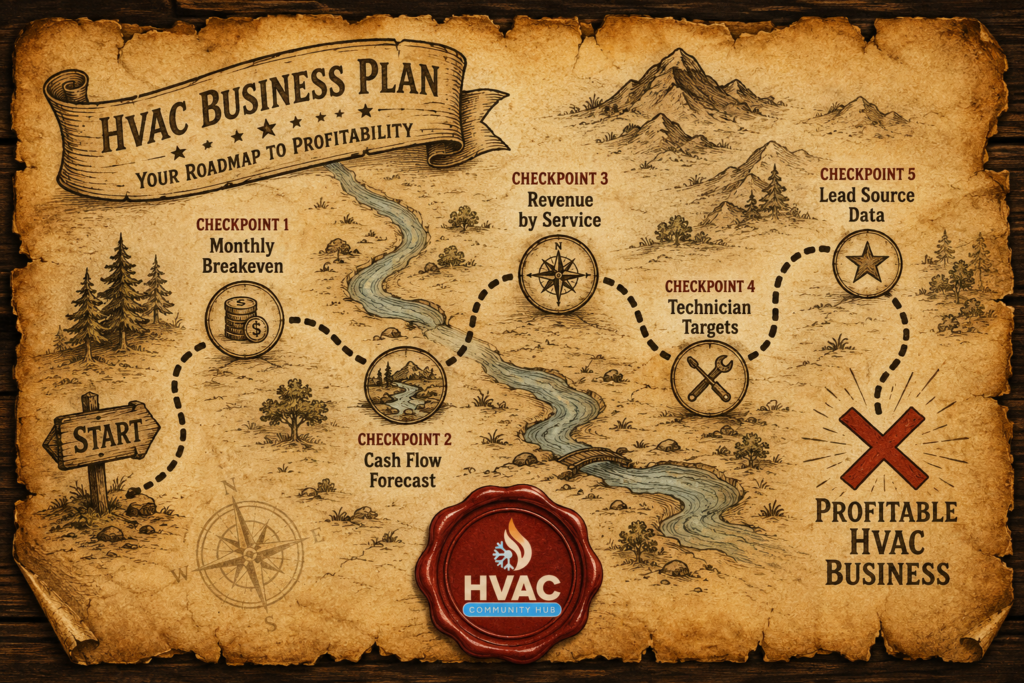
Many HVAC owners track revenue and bank balance. However, the numbers that drive real decisions are different. The most important metrics for any HVAC business plan are true monthly breakeven, rolling 13-week cash flow, revenue by service type, technician daily revenue targets, and lead source performance. These five numbers tell you exactly where your business stands at any given time — and exactly what needs to change to hit your next target.
The 7 Essential Sections of an HVAC Business Plan That Works
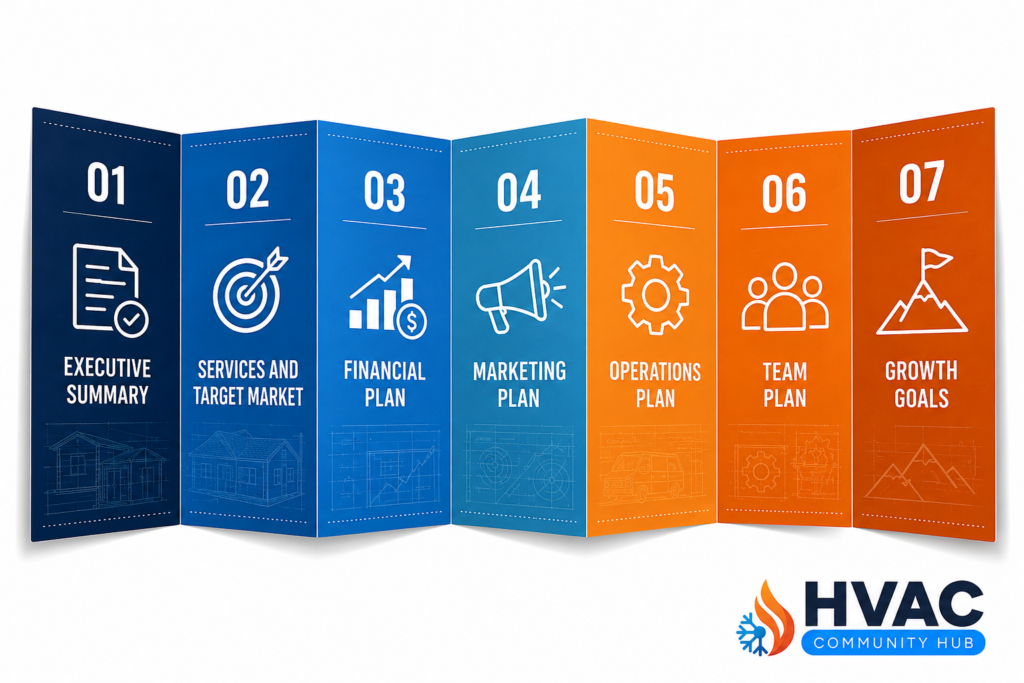
Here is exactly what to include in your HVAC business plan. Furthermore, each section should be reviewed and updated every 90 days — not once a year.
1. Executive Summary — Your Business in One Page
Your executive summary is a one-page overview of your business. It covers who you are, what services you offer, which markets you serve, and what your primary goal is for the next 90 days. Keep it short and specific. A clear and honest one-page summary is far more useful than a lengthy document full of vague aspirations.
Furthermore, your executive summary should be something you can hand to a new team member, a bank manager, or a potential business partner and have them understand your business in two minutes. If it takes longer than that to explain, simplify it.
2. Services and Target Market — Who You Serve and What You Do
Define exactly which services your business offers and which customers you target. Being specific here is more valuable than being broad. An HVAC business that specialises in residential split systems in a specific geographic area is far easier to market and operate than one that tries to serve every type of customer with every type of HVAC work.
Define the services you will offer — such as installation, repair, or maintenance — along with your target customers and service area. You should also decide how you will price jobs, estimate your startup costs, and research competitor pricing in your area. This clarity directly affects every marketing decision, every hiring decision, and every pricing decision your business makes.
3. Financial Plan — Your Numbers in Black and White
Your financial plan is the most important section of your HVAC business plan. It covers four key areas. First, your startup or current operating costs — what it costs to run your business every month before revenue. Second, your pricing structure — how you charge for different types of work and what margin each job produces. Third, your revenue targets — what you need to earn each month to be profitable. Fourth, your cash flow forecast — when money comes in and when it goes out across the next 13 weeks.
With a strategic financial plan, HVAC profit margins can increase to 10 to 20%. To ensure growth, keep expenses below 60% of gross revenue, aim for a minimum gross profit of 40%, and maintain overhead between 25% and 35% of total revenue. These are not suggestions — they are operational targets that the most profitable HVAC businesses hit consistently. You can read more about pricing strategy in our full guide — HVAC PRICING
4. Marketing Plan — How You Win New Customers
Your marketing plan covers which channels you use to attract new customers, how much each lead costs, and which sources produce the best results. A solid HVAC marketing plan in 2026 focuses on Google Business Profile, local SEO, customer reviews, referral programmes, and email marketing — all of which produce leads at a fraction of the cost of paid advertising.
Define four channels, then a weekly cadence for each one. For example — post to your Google Business Profile twice a week, ask every customer for a review after every job, send one email to your customer list each month, and brief your team on the referral programme at every morning meeting. Simple and consistent beats complex and sporadic every time. You can read our full marketing guide for a detailed breakdown —HVAC MARKETING
5. Operations Plan — How Your Business Runs Day to Day
Your operations plan covers how jobs are scheduled, how technicians are dispatched, how invoices are sent, how customer follow-up happens, and how quality is maintained across every job. This section is where your systems live.
Every process that happens repeatedly in your business should be documented. How does a new customer booking get entered into the system? How does a technician update job status from the field? How is a complaint handled? Documented processes are the foundation of a scalable business. Without them, every team member does things differently — and quality becomes inconsistent as the business grows. You can read more about building your scheduling system in our full guide —HVAC SCHEDULING
6. Team Plan — Who You Need and When You Need Them
Your team plan covers your current staffing structure, where the gaps are, and when you plan to hire. Furthermore, it covers how you will develop your current team through training and how you will retain your best people through competitive pay and a strong culture.
Be specific about your hiring triggers. For example — “when monthly revenue consistently exceeds $50,000, we will hire a second technician.” This prevents both understaffing — which burns out your current team — and overstaffing — which eats your margin before the revenue is there to support it.
7. Growth Goals — Where You Want to Be in 90 Days
Your growth goals section is the most actionable part of your business plan. Set three to five specific, measurable goals for the next 90 days. Not vague aspirations like “grow revenue” — specific targets like “increase average job value from $350 to $420 by the end of March” or “add 20 new Google reviews in the next 90 days.”
Each move builds momentum, week by week, season after season. That is how the top HVAC businesses win. They are not chasing control — they are creating it. Their 90-day system keeps the business sharp, the team confident, and the momentum alive all year long.
Why 90-Day Planning Works Better Than Annual Plans
A yearly HVAC business plan cannot keep up with how unpredictable the HVAC industry actually is. A 90-day planning cycle solves this problem directly. Every 90 days, you review what happened, adjust your targets based on what you learned, and set three to five focused goals for the next quarter. As a result, your plan always reflects your current reality — not the projections you made twelve months ago.
How to Run a 90-Day Planning Session
A 90-day planning session does not need to take more than two hours. Start by reviewing your key numbers from the past 90 days — revenue, profit margin, average job value, lead sources, and technician performance. Then identify the two or three things that had the biggest positive impact and the two or three things that most held the business back.
Set your goals for the next 90 days based on this honest review. Assign each goal a specific owner and a measurable outcome. Review progress on these goals in a brief weekly meeting — no more than 30 minutes — to keep the team aligned and catch any drift early.
What to Review Every Week
Between 90-day planning sessions, a weekly review keeps the business on track. Review your job completion rate, invoice payment status, review score, and technician utilisation rate every week. These four numbers tell you whether the business is running well or whether something needs attention before it becomes a bigger problem.
Furthermore, a weekly team briefing — even five minutes at the start of Monday morning — gives every team member a clear sense of where the business stands and what the priorities are for the week. Teams that operate with this level of shared clarity perform significantly better than those who simply turn up and react to whatever the day brings.
Common HVAC Business Planning Mistakes to Avoid
Even well-intentioned business owners make these planning mistakes regularly. Recognising them is the first step to fixing them.
Setting Goals Without Tracking Numbers
Goals without numbers are wishes. Every goal in your HVAC business plan must have a specific measurable target and a clear date for review. “Improve customer service” is not a goal. “Increase our Google review score from 4.2 to 4.7 by the end of June” is a goal. One gives you something to work toward. The other gives you nothing to measure.
Ignoring Cash Flow Until It Becomes a Crisis
Cash flow is the number one cause of business failure in the HVAC industry — even among businesses that are technically profitable. Many HVAC businesses have strong revenue but poor cash flow because they invoice late, allow long payment terms, and carry too much unsettled debt.
Include a 13-week cash flow forecast in your business plan and update it every week. This simple document shows you exactly when money comes in and when bills go out — giving you early warning of any shortfall weeks before it becomes a crisis. You can read more about improving your invoicing process in our full guide — HVAC INVOICING
Planning for Growth Without Planning for Systems
Many HVAC owners set ambitious revenue growth targets without planning the systems needed to support that growth. More revenue without better systems just means more chaos. Before setting a target to double your revenue, ask what systems need to be in place to handle double the jobs — scheduling, invoicing, quality control, customer communication, and team management all need to scale alongside revenue.
Frequently Asked Questions About HVAC Business Plans
Do I need a business plan if I am already running an established HVAC business?
Yes — but for a different reason than when starting out. An established business needs a plan to manage growth, control costs, and make smarter decisions about hiring, pricing, and marketing. Furthermore, a rolling 90-day plan is more useful for an established business than the one-time document you might have written when you started.
How long should an HVAC business plan be?
A working HVAC business plan should be no longer than 10 to 15 pages. The goal is clarity and usability — not impressive length. A concise plan that your whole team understands and references regularly is far more valuable than a comprehensive document that nobody reads.
What financial targets should an HVAC business aim for?
Aim for gross profit of at least 40%, overhead between 25% and 35% of revenue, and net profit margin of 10 to 20%. If your numbers are below these targets, your business plan should include specific actions to close the gap — pricing adjustments, cost reductions, or revenue growth strategies.
How do I know if my HVAC business plan is working?
Your business plan is working if your key numbers are moving in the right direction — revenue growing, margin improving, cash flow positive, and retention increasing. Review these numbers monthly. If any are moving in the wrong direction, your plan needs to be adjusted — not abandoned.
Can HVAC Hub help me build my business plan?
Yes. HVAC Hub’s community includes business owners who have built and refined their own plans — and are sharing what works. Our courses cover pricing, CRM, marketing, and operations — all the building blocks of a strong business plan. Visit hvachub.co to join free and get started.
Build a Plan That Guides Real Decisions — Not Just Looks Good on Paper
The best HVAC business plan is not the most detailed one. It is the one that gets used every week. A simple, honest, regularly updated plan that guides your pricing, hiring, marketing, and operations decisions is worth more than a comprehensive document filed away after one reading.
Start Your 90-Day Plan This Week
First, write down your three most important goals for the next 90 days. Make each one specific and measurable. Second, identify the one number — revenue, margin, average job value, or review score — that most needs to improve right now. Third, define one action you will take this week to move that number in the right direction.
Furthermore, if you want support building your business plan — including financial templates, 90-day planning frameworks, and a community of HVAC owners sharing what works — HVAC Hub is exactly where to start.
Visit hvachub.co to join free and start building the HVAC business plan your business needs to grow with purpose in 2026. You can also read our HVAC software guide to see which tools make your plan easier to execute — HVAC SOFTWARE

Responses