
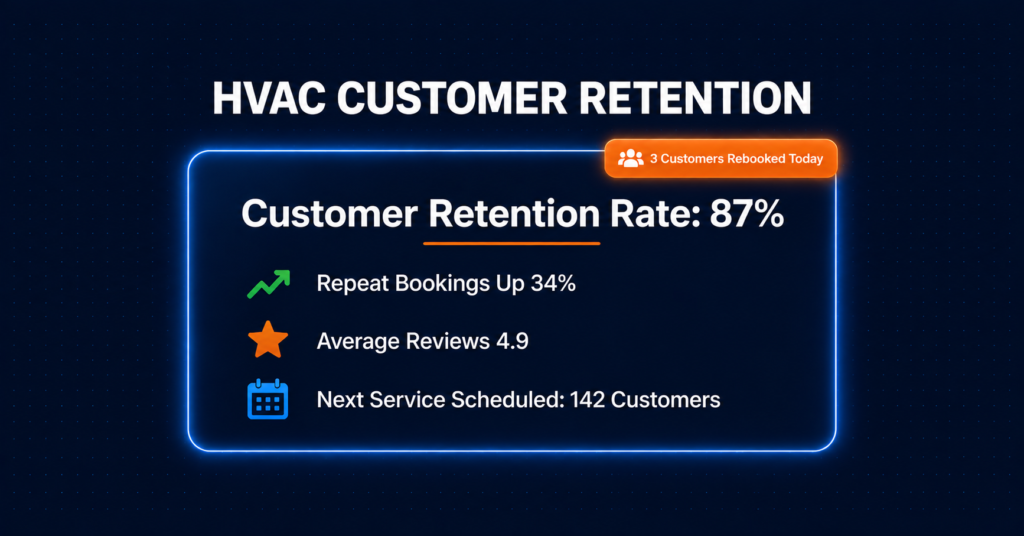
HVAC Customer Retention: Keep Customers Coming Back

HVAC customer retention is one of the most powerful growth strategies available to any HVAC business owner — yet most owners focus almost entirely on finding new customers rather than keeping the ones they already have. Winning a new customer costs five times more than retaining an existing one. A returning customer already trusts your business. They know your team and rarely shop around before accepting a quote. This guide explains why HVAC customer retention matters so much, the most common reasons customers stop coming back, and the proven strategies that keep your best customers loyal year after year.
Why HVAC Customer Retention Matters More Than New Leads
Most HVAC businesses measure success by how many new leads come in each week. New leads matter — but they are only half the picture. The other half is how many of your existing customers come back for their next service, their next installation, or their next repair.
A customer who books with you once and never returns represents a significant lost opportunity. You already spent time and money winning that customer. You delivered the work. You built a relationship. If they call a competitor next time, all of that investment disappears.
HVAC customer retention fixes that problem. It turns one-time customers into repeat customers, and repeat customers into loyal advocates who refer friends, family, and neighbours without being asked. That kind of growth costs almost nothing compared to paid advertising or aggressive lead generation campaigns.
Furthermore, retained customers are more profitable. They accept quotes faster, complain less, and spend more over time. A customer on an annual service agreement is worth far more over three years. A one-time installation customer who never calls again delivers a fraction of that value.
The Real Reasons HVAC Customers Stop Coming Back
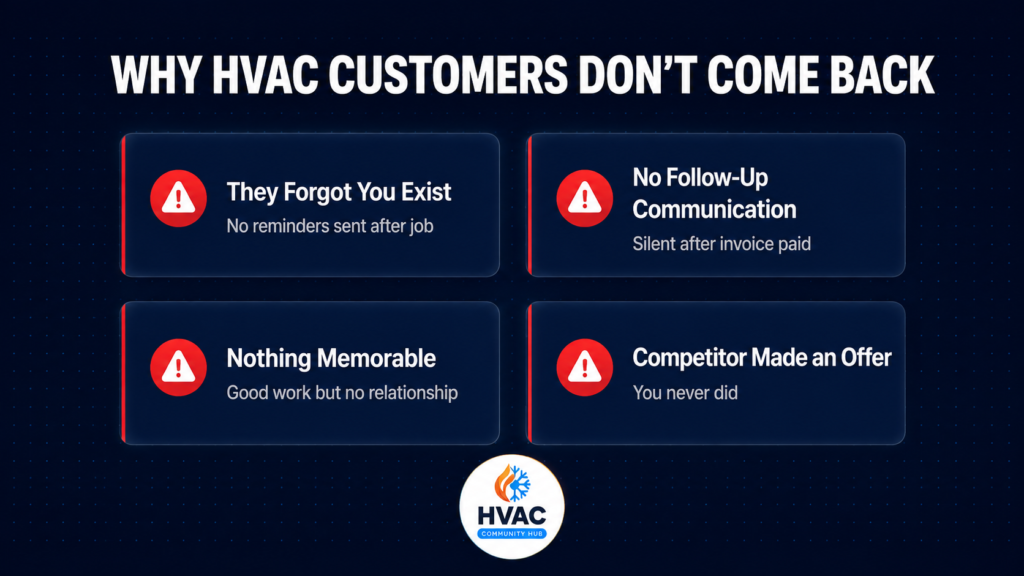
Before building a retention strategy, it helps to understand exactly why customers leave. Most HVAC businesses lose customers not because of poor workmanship but because of poor communication and follow-up.
They Simply Forgot About You
This is the most common reason HVAC customers do not return. Life gets busy. The air conditioner works fine for two years after you service it. By the time it needs attention again, the customer cannot remember who did the last service. They search Google, find a competitor, and book with them instead. They did not leave because they were unhappy — they left because you were not in front of them when they needed you again.
They Never Heard From You Again After the Job
If the only communication a customer receives from your business is a quote and an invoice, you are missing every opportunity to build a relationship. Customers who never receive a follow-up, a service reminder, or a simple thank-you message after a job feel like a transaction rather than a valued client. That feeling makes it easy to choose someone else next time.
The Experience Did Not Feel Special Enough to Remember
In a competitive market, doing a good job is the baseline expectation — not a differentiator. Customers who receive nothing beyond a technically correct piece of work have no compelling reason to choose you again over any other HVAC company. HVAC customer retention requires giving customers a reason to remember you positively and specifically.
A Competitor Made a Better Offer
Sometimes customers leave because a competitor actively pursued them with a better maintenance plan, a loyalty discount, or a more attractive service package. If your business does not proactively offer these things, a competitor who does will take your customers — even ones who were happy with your work.
Proven HVAC Customer Retention Strategies That Work
These strategies work for HVAC businesses of every size. You do not need a large marketing budget or a dedicated customer service team. You need consistent systems that keep your business in front of existing customers at the right moments.
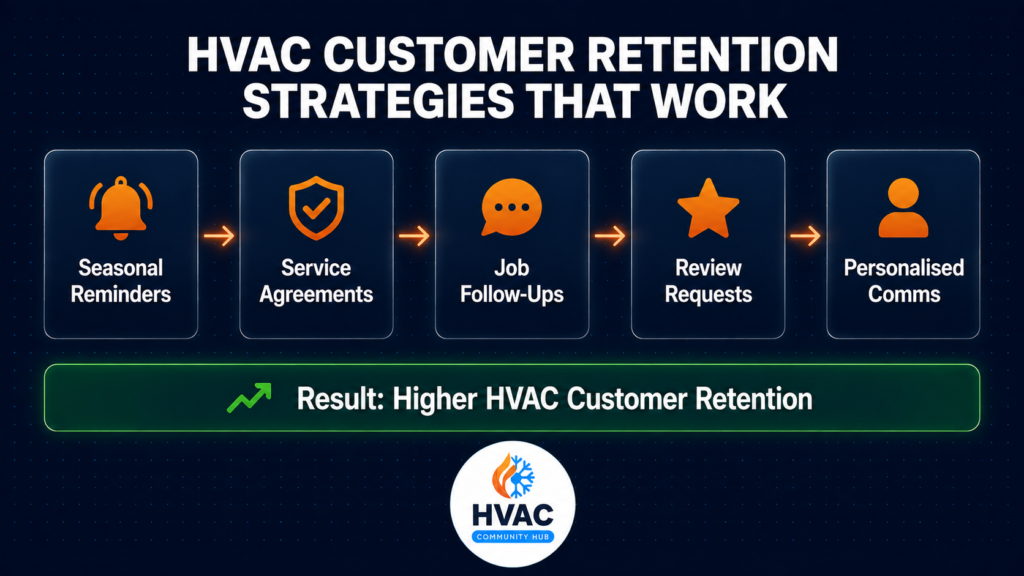
Send Seasonal Service Reminders
Most HVAC systems need servicing twice a year — once before summer and once before winter. If you send a simple reminder to every existing customer three to four weeks before each season, you give them a reason to book with you before they even think about searching for someone else. This single strategy alone recovers a significant number of customers who would otherwise drift away between services.
A short, friendly message — by email or SMS — reminding a customer that their system is due for a seasonal check is one of the most effective HVAC customer retention tools available. It shows you remember them, you care about their comfort, and you are proactive rather than reactive.
Offer a Service Agreement or Maintenance Plan
A service agreement locks in a customer for twelve months at a time. Customers pay a fixed annual or monthly fee and receive regular scheduled servicing, priority response times, and sometimes a discount on parts and labour. It removes the hassle of remembering to book. Your business gains predictable recurring revenue and dramatically improves HVAC customer retention rates.
Service agreements also strengthen the relationship. A customer on a maintenance plan interacts with your business multiple times a year rather than once every two or three years. That frequency builds familiarity, trust, and loyalty that a one-time service customer never develops.
Follow Up After Every Job
A simple follow-up message twenty-four to forty-eight hours after completing a job makes a significant difference to how customers feel about your business. Ask whether everything is working correctly. Thank them for choosing your company. Let them know you are available if anything needs attention.
Most HVAC companies never do this. Customers who receive a genuine follow-up remember it. It signals that you care about the outcome of the work — not just the payment. That feeling drives HVAC customer retention more effectively than any discount or special offer.
Ask for Reviews at the Right Moment
A customer who leaves a five-star review is significantly more likely to return than one who does not. The act of writing a positive review reinforces their own satisfaction and creates a sense of loyalty to your business. Ask for a review within twenty-four hours of job completion — when satisfaction is highest and the experience is freshest in their mind.
An automated review request at the right moment removes the awkwardness of asking in person and ensures every satisfied customer receives the invitation — not just the ones your team remembers to ask manually.
Personalise Your Communication
Using a customer’s name, referencing their specific system, and acknowledging their service history in your communications makes every interaction feel personal rather than generic. A message that reads “Hi Sarah, your Daikin split system is due for its annual service this month” lands very differently from a generic “Dear Customer, book your service today.”
Personalisation shows customers that your business knows them — not just their address. That recognition builds the kind of loyalty that survives competitor offers and price comparisons.
How HVAC Business Automation Powers Customer Retention
The strategies above work extremely well — but only if they happen consistently. Sending seasonal reminders manually, remembering to follow up after every job, and asking every customer for a review requires discipline that is hard to maintain across a busy week of jobs.
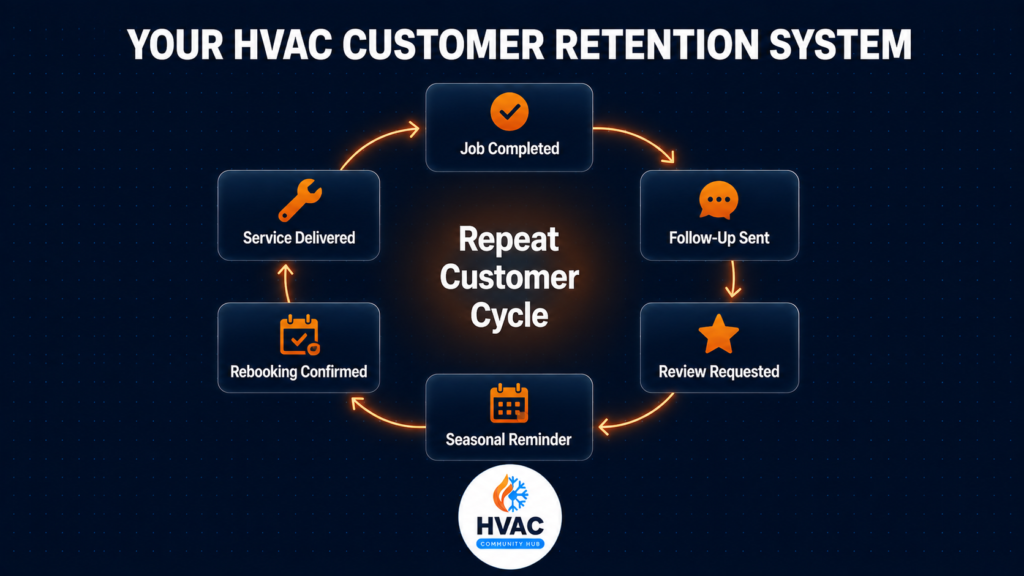
HVAC business automation solves that problem. Once your retention systems run automatically, every customer receives the right message at the right time — regardless of how busy your week gets. Seasonal reminders go out on schedule. Follow-up messages send automatically after job completion. Review requests arrive at the perfect moment without anyone on your team having to remember.
You can read more about how to set up these systems in our HVAC business automation guide — it covers exactly which tools to use and how to connect them into a retention system that runs on autopilot.
How to Measure Your HVAC Customer Retention Rate
Knowing your retention rate tells you whether your strategies are working. It also tells you how much revenue you could recover by improving it.
Your retention rate is the percentage of customers who return within a set period — usually twelve months. To calculate it, divide the number of customers who booked more than once in the last twelve months by your total number of customers, then multiply by 100.
For example, if you had 200 customers last year and 140 of them booked again within twelve months, your retention rate is 70%. Most HVAC businesses sit between 40% and 60%. Businesses with strong HVAC customer retention systems regularly achieve 75% or above.
Improving your retention rate by just 10% grows annual revenue significantly. You spend nothing extra on new lead generation to achieve it. Bain and Company’s research on customer retention shows that increasing customer retention rates by just 5% increases profits by 25% to 95%. That is one of the most powerful numbers in business — and it applies directly to HVAC companies of every size.
Building a Customer Retention System for Your HVAC Business
A retention system does not need to be complicated. At its core it is three things working together consistently: staying in touch, delivering value at every interaction, and making it easy for customers to book again.
Start by building a complete list of every customer you have served in the last three years. Segment them by service type, system age, and last booking date. This gives you the data you need to send relevant, timely messages rather than generic blasts.
Next, map out the key touchpoints in your customer journey — the moments where a well-timed message makes the biggest difference. Job completion, service anniversaries, seasonal changeovers, and system warranty expiry dates are all natural moments to reach out with something useful rather than something salesy.
Finally, automate as much of this as possible so the system runs without relying on your team to remember every step. The best HVAC customer retention systems work hardest when your team is busiest — exactly when manual follow-up would otherwise fall through the cracks.
Frequently Asked Questions About HVAC Customer Retention
How long does it take to improve HVAC customer retention?
Most businesses see measurable improvement within three to six months of implementing consistent follow-up and reminder systems. The first seasonal reminder campaign typically brings back a meaningful number of customers who had not booked in over a year.
What is a good HVAC customer retention rate?
Most HVAC businesses retain between 40% and 60% of customers year on year. Businesses with strong retention systems regularly achieve 75% or above. If your rate is below 50%, implementing even basic follow-up and reminder strategies will make a significant difference within the first few months.
Should I offer discounts to keep customers?
Discounts can help in specific situations — such as winning back a lapsed customer — but they should not be your primary retention tool. Customers who stay because of discounts leave the moment a competitor offers a better price. Customers who stay because of great communication and consistent service are far more loyal and far more profitable over time.
How do I get customers to sign up for a maintenance plan?
The best time to offer a maintenance plan is immediately after completing a job — when customer satisfaction is at its highest. A simple offer at the end of a service visit converts well. Back it up with a follow-up email the next day. Both work far better than a cold offer to someone who has not recently used your service.
HVAC Customer Retention Is Your Cheapest Growth Strategy
Every dollar you spend on HVAC customer retention delivers a higher return than almost any other marketing activity. Your existing customers already trust you. They already know the quality of your work. They already have your number. All they need is a reason to call it again.
Give them that reason consistently. Use timely reminders, genuine follow-up, and service that feels personal. Your business grows without the constant pressure of chasing new customers every week.
Customer loyalty also depends on resolving service problems and giving satisfied customers a reason to recommend your company. Explore handling HVAC customer complaints, building an HVAC referral program, and stronger HVAC customer service.
Take the Next Step
First, calculate your current customer retention rate using the formula above and write down the number. Second, identify the last time you proactively contacted an existing customer who was not asking for anything. Third, send a seasonal service reminder to your ten most loyal customers this week and see how many respond.
If you want a complete HVAC customer retention system built and running for your business, HVAC Hub helps HVAC business owners set up automated follow-up, reminder, and loyalty systems that keep customers coming back without any manual effort from your team.
Visit hvachub.co to find out how we help HVAC businesses grow through retention rather than just lead generation. You can also read our HVAC business automation guide to see exactly how automation and customer retention work together to build a more stable and profitable HVAC business in 2026.
Responses