
HVAC Email Marketing: Turn Leads Into Jobs in 2026

HVAC email marketing is one of the highest-return growth strategies available to any HVAC business owner in 2026 — yet most HVAC companies either ignore it completely or use it so inconsistently that it delivers almost no results. Every customer whose email address you have collected over the years represents a warm lead who already knows your business, already trusts your work, and is far more likely to book again than a cold prospect who has never heard of you. This guide explains how HVAC email marketing works, what to send, how often to send it, and how to turn a simple customer list into a steady stream of repeat bookings and referrals.
Why HVAC Email Marketing Delivers the Highest Return of Any Marketing Channel
Email marketing consistently delivers a higher return on investment than social media, paid advertising, or SEO for most service businesses. Research from the Data and Marketing Association shows that email marketing generates an average return of 36 dollars for every dollar spent. No other marketing channel comes close to that ratio.
For HVAC businesses, the reason is simple. Your email list is not a cold audience. Every person on it has already chosen your business once. They know what you do, they know the quality of your work, and they have your contact details saved somewhere. A well-timed email from your business does not feel like advertising — it feels like a reminder from a trusted service provider they already rely on.
Furthermore, email marketing works while your team is on the job. A seasonal reminder sent to five hundred customers on a Monday morning can generate twenty booking requests before lunchtime — without a single manual phone call or follow-up from your team. That efficiency is what makes HVAC email marketing so powerful for growing businesses.
Building Your HVAC Email List
Before sending a single email, you need a list of customer email addresses. Most HVAC businesses already have more than they realise — spread across old invoices, job management software, and paper records. Collecting them into one place is the first step.
Collect Emails at Every Customer Touchpoint
Every interaction with a customer is an opportunity to collect an email address. Ask for it when booking a job, include an email field on your quote form, and request it when sending an invoice. Most customers are happy to provide their email address when you explain it is for service reminders and updates — especially if they find your service reliable.Use Your Website to Grow Your List
Use Your Website to Grow Your List
A simple email signup form on your website — offering a free HVAC maintenance checklist or seasonal service reminder in exchange for an email address — builds your list passively while your website attracts visitors. New subscribers who sign up this way are already interested in HVAC advice and represent highly qualified potential customers for your business.
Import Your Existing Customer Records
Go through your job management system, invoicing software, and any paper records from the last three years. Every customer whose email address you can find belongs on your list. Even customers you have not heard from in two years are worth including — a well-timed re-engagement email often recovers customers who simply forgot about your business rather than choosing a competitor.
What to Send in Your HVAC Email Marketing Campaigns
The most common question HVAC business owners ask about email marketing is what to actually write. The answer is simpler than most people expect. Your emails do not need to be long, polished, or complicated. They need to be relevant, timely, and useful.
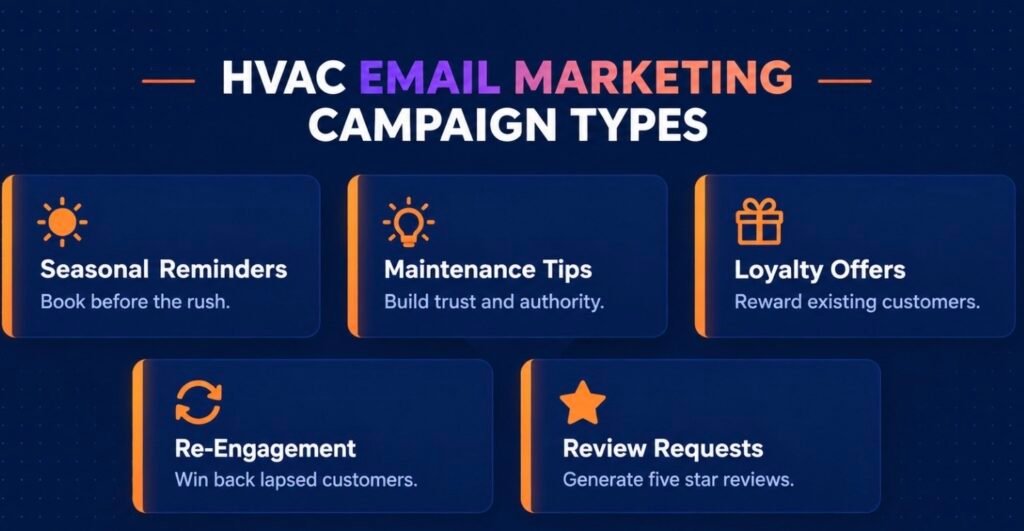
Seasonal Service Reminders
Seasonal reminders are the single most effective email type for HVAC businesses. An email sent four weeks before summer reminding customers to book their annual air conditioning service generates more bookings per send than almost any other email type. Keep it short — three to four sentences explaining why now is the right time to book, followed by a clear call to action linking directly to your booking page.
Maintenance Tips and Advice
A short monthly email sharing one practical HVAC maintenance tip positions your business as the trusted local expert. Tips like “how to check if your air filter needs changing”, “signs your system is low on refrigerant”, or “why your HVAC system smells musty after winter” give customers genuine value. Customers who receive useful advice from your business remember you when they need a service or repair.
Special Offers for Existing Customers
A loyalty offer sent exclusively to existing customers — a discounted annual service, a free filter check with every booked job, or a referral reward — makes customers feel valued and gives them a reason to book sooner rather than later. Exclusive offers work better than public promotions because they create a sense of being a valued insider rather than just another prospect seeing a generic advertisement.
Re-Engagement Emails for Lapsed Customers
Any customer who has not booked in over twelve months is at risk of choosing a competitor next time. A short, friendly re-engagement email acknowledging the gap and offering a simple reason to rebook — a seasonal reminder, a small loyalty discount, or a genuine check-in asking whether everything is still working well — recovers a meaningful percentage of lapsed customers every time it goes out.
Review and Referral Requests
An email asking a satisfied customer for a Google review or a referral is one of the simplest and most effective uses of HVAC email marketing. Send it within forty-eight hours of completing a job — when satisfaction is highest. Include a direct link to your Google review page so the customer can leave a review in one click without searching for your business manually.
How Often Should You Send HVAC Marketing Emails
Frequency is one of the most misunderstood aspects of HVAC email marketing. Send too often and customers unsubscribe. Send too rarely and they forget your business exists.
For most HVAC businesses, one email per month is the right starting frequency. That is frequent enough to stay visible without overwhelming your audience. During peak seasons — the weeks before summer and the weeks before winter — increasing to two emails per month is appropriate and expected by customers who anticipate seasonal service reminders.
Every email you send should earn its place in the customer’s inbox. Ask yourself whether the email contains something useful, relevant, or timely for the customer receiving it. If the honest answer is no, delay it until you have something worth saying. Customers forgive infrequent emails far more readily than they forgive irrelevant ones.
How to Write HVAC Emails That Get Opened and Clicked
An email that nobody opens delivers no results regardless of how good the content is. These principles apply to every HVAC email marketing campaign you send.
Write Subject Lines That Create Curiosity or Urgency
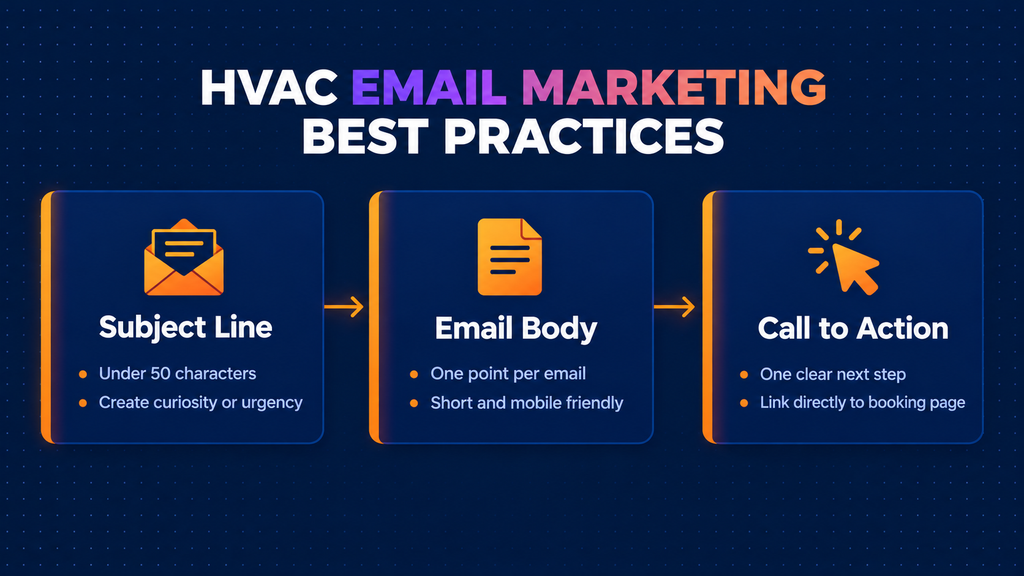
The subject line determines whether your email gets opened or ignored. Keep it under fifty characters so it displays fully on mobile screens. Use curiosity — “Is your air conditioner ready for summer?” — or urgency — “Book before our schedule fills up” — to give customers a reason to open immediately rather than saving it for later.
Keep the Email Short and Focused
Most people read emails on their phone while doing something else. Long emails with multiple sections and competing calls to action get skimmed and closed. Each email should make one point, offer one piece of value, and include one clear call to action. Short, focused emails consistently outperform long, detailed ones in open rate, click rate, and conversion.
Personalise Every Email
Using a customer’s first name in the subject line and opening sentence significantly improves open rates. Going further — referencing their specific system, their last service date, or their location — makes the email feel like a personal message rather than a mass broadcast. Most email marketing platforms make basic personalisation simple and automatic once your customer data is set up correctly.
Setting Up HVAC Email Marketing Automation
Sending every email manually is time-consuming and inconsistent. Automation solves both problems. Once you set up your email sequences correctly, they run automatically — sending the right email to the right customer at exactly the right moment without anyone on your team having to remember or act.
A basic HVAC email marketing automation setup includes three sequences. First, a welcome email that goes out automatically when a new customer books their first job — thanking them, setting expectations, and inviting them to follow your social media. Second, a post-job follow-up that sends automatically twenty-four hours after job completion — checking everything works correctly and asking for a review. Third, a seasonal reminder that goes out automatically at the same time each year to every customer who has not booked a service in the last twelve months.
These three automated sequences alone recover significant revenue that most HVAC businesses currently lose to inaction and forgetfulness. You can read more about connecting email automation to your broader business systems in our HVAC business automation guide.
Measuring the Results of Your HVAC Email Marketing
Tracking your email performance tells you what is working and where to improve. These are the key metrics worth monitoring every month.
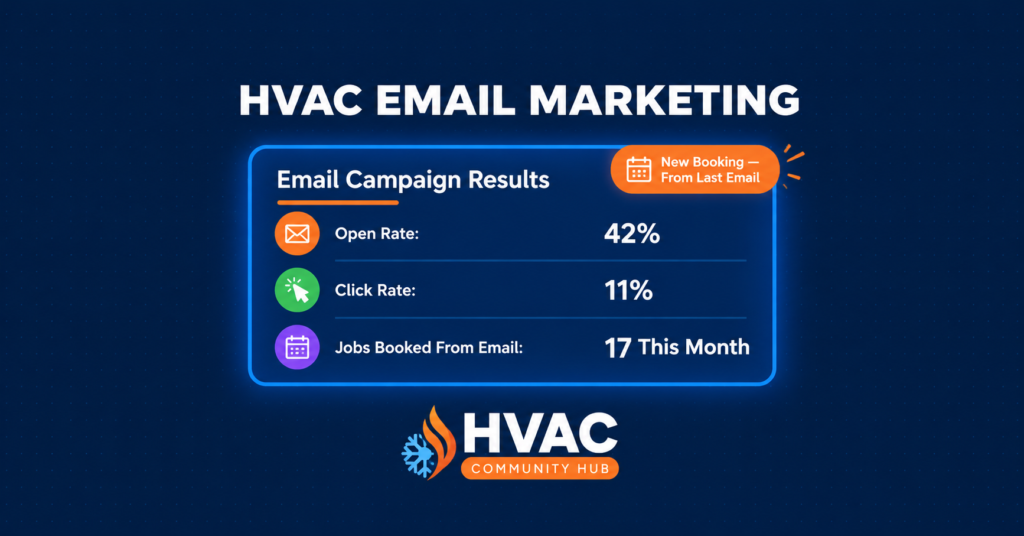
Open rate measures the percentage of recipients who open your email. A strong open rate for HVAC email marketing sits between 35% and 50%. Anything below 25% suggests your subject lines need improvement or your list needs cleaning.
Click rate measures the percentage of openers who click a link inside your email. A strong click rate sits between 8% and 15%. Low click rates usually mean the email body is too long, the call to action is unclear, or the offer is not compelling enough.
Unsubscribe rate measures the percentage of recipients who opt out after each send. A rate above 0.5% per email suggests you are sending too frequently or the content is not relevant enough to your audience.
Review these three metrics after every campaign. Small improvements in each one compound over time into significantly better results from the same list size.
Common HVAC Email Marketing Mistakes to Avoid
Most HVAC businesses that try email marketing and give up make the same mistakes. Sending emails from a personal Gmail address rather than a professional business email address damages deliverability and credibility at the same time. Buying email lists rather than building them organically produces almost no results and risks your sending reputation with major email providers.
Sending the same generic email to every customer on your list — regardless of their service history, system type, or location — wastes the personalisation opportunity that makes email marketing so effective. Segmenting your list by customer type and sending relevant content to each segment consistently outperforms a one-size-fits-all approach.
Finally, giving up after two or three sends is the most common reason HVAC email marketing fails. Results build over months of consistent sending — not after a single campaign. Mailchimp’s email marketing benchmarks for service industries show that consistent senders achieve open rates more than double those of occasional senders — proof that persistence pays off in email marketing far more than any single clever campaign.
Frequently Asked Questions About HVAC Email Marketing
How do I start HVAC email marketing with a small list?
Start with whatever list you have — even fifty customers is enough to begin. A small engaged list delivers better results than a large unengaged one. Focus on sending valuable, relevant content consistently and your list will grow naturally through referrals and website signups over time.
Which email platform should I use for HVAC email marketing?
Mailchimp, ActiveCampaign, and Campaign Monitor all work well for HVAC businesses. Choose based on your budget and the level of automation you need. Mailchimp offers a free plan suitable for lists under 500 contacts — a good starting point for most small HVAC businesses.
Is HVAC email marketing legal?
Yes — provided you follow anti-spam laws in your country. In the USA this means complying with the CAN-SPAM Act. In Australia and New Zealand this means complying with the Spam Act 2003. The core rules are simple — only email people who have given you their address, include your business name and address in every email, and include a clear unsubscribe link in every send.
How do I grow my email list quickly?
The fastest way to grow your HVAC email list is to ask every customer for their email address at the point of booking and again when sending an invoice. Adding a simple signup form to your website offering a free seasonal maintenance checklist in exchange for an email address also builds your list passively over time.
HVAC Email Marketing Turns Your Biggest Asset Into Your Best Sales Tool
Your customer list is the most valuable asset your HVAC business owns. Every email address on it represents a person who has already chosen your business and experienced your work. HVAC email marketing turns that existing trust into repeat bookings, referrals, and long-term customer relationships that no competitor can easily disrupt. The HVAC businesses winning the most repeat work in 2026 are not the ones spending the most on advertising. They are the ones staying in front of their existing customers consistently — with the right message, at the right time, through the right channel.
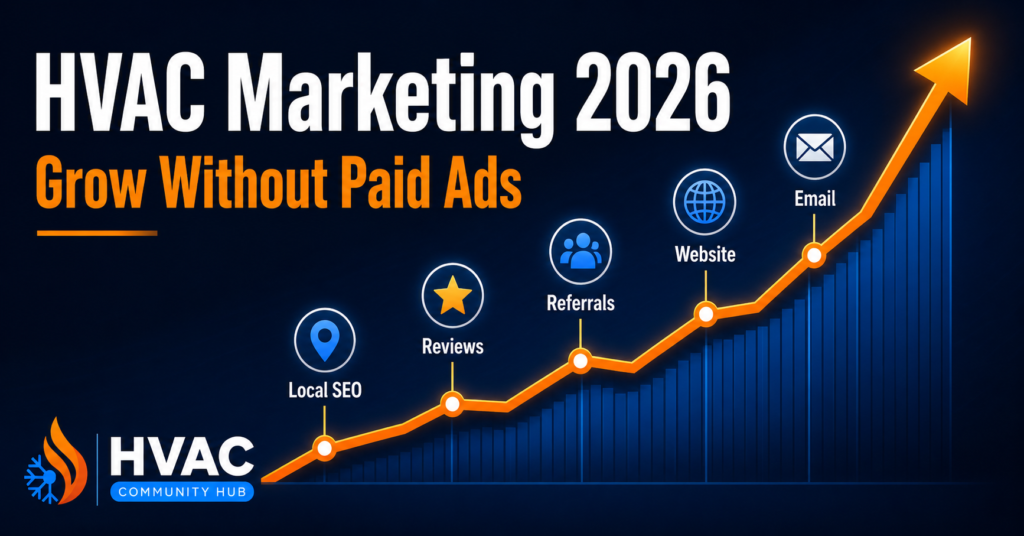
For a broader lead-generation strategy, see our guide to HVAC marketing without paid ads.
Take the Next Step
First, collect every customer email address you have from your invoicing system, job management software, and paper records into one spreadsheet this week. Second, choose one email platform and import your list. Third, send your first email this month — a simple seasonal reminder or a thank-you message to your most recent customers.
If you want a complete HVAC email marketing system built and running for your business, HVAC Hub helps HVAC business owners set up professional email campaigns that generate consistent bookings without any manual effort from your team.
Visit hvachub.co to find out how we help HVAC businesses grow through email marketing in 2026. You can also read our HVAC customer retention guide to see how email marketing and customer retention work together to build a more stable and profitable HVAC business.

Responses