

HVAC Technician Productivity: Get More From Every Workday

HVAC technician productivity has a direct impact on how much work your business can complete every day. However, improving productivity does not mean telling technicians to work faster or pushing your team to take on more jobs. Real HVAC technician productivity comes from removing the wasted time, confusion, waiting, unnecessary travel, and repeated work that make a normal workday harder than it needs to be.
Many HVAC owners see the same problem without immediately knowing what causes it. The schedule looks full, the phones keep ringing, and technicians are working all day. Yet fewer jobs get completed than expected. Some technicians regularly finish on time while others fall behind. One job takes longer than planned, another requires a return visit, and someone spends part of the afternoon waiting for a missing part.
The solution is not always hiring another technician. Sometimes the bigger opportunity is improving how the existing team spends its working hours. This guide explains what HVAC technician productivity really means, where productive time gets lost, and how HVAC business owners can build better workdays without putting unnecessary pressure on their technicians.
What HVAC Technician Productivity Actually Means
HVAC technician productivity is not simply the number of jobs a technician completes.
A technician can complete several jobs in one day and still spend a large amount of time dealing with avoidable problems. Another technician may complete fewer jobs because the work is more complex, yet produce excellent results with very little wasted time.
That is why productivity needs more context.
Good HVAC technician productivity means using available working hours effectively while maintaining quality, safety, customer service, and proper workmanship. The goal is not to rush through every appointment. Instead, the goal is to make sure technicians spend as much of their day as possible doing productive HVAC work.
Travel between jobs is sometimes necessary.
Waiting for equipment is sometimes necessary.
Administrative work is sometimes necessary.
However, unnecessary versions of these activities can quietly consume hours every week.
When an HVAC owner understands where that time disappears, the business can start improving productivity without making the workday harder for the field team.
Why HVAC Technician Productivity Matters as Your Business Grows
A small HVAC company can often survive with informal processes.
The owner knows every technician. The office knows what each job needs. Everyone understands how the business normally operates. When something goes wrong, the owner can usually step in and fix it.
Growth changes that.
As the number of technicians and jobs increases, small inefficiencies become much more expensive. A few minutes lost on one job may not matter much. However, the same problem repeated across several technicians and hundreds of appointments can consume a significant amount of productive time.
For example, imagine five technicians each losing 30 minutes every workday because of poor job information, unnecessary waiting, or inefficient travel. That does not look like a major problem when viewed one technician at a time.
Across the entire team, however, the lost time adds up quickly.
This is why HVAC technician productivity becomes increasingly important as the company grows. Better systems allow the business to get more value from the hours it already pays for.
Where HVAC Technicians Lose the Most Productive Time
Most productivity problems do not come from one dramatic failure.
Instead, they appear as small interruptions throughout the day.
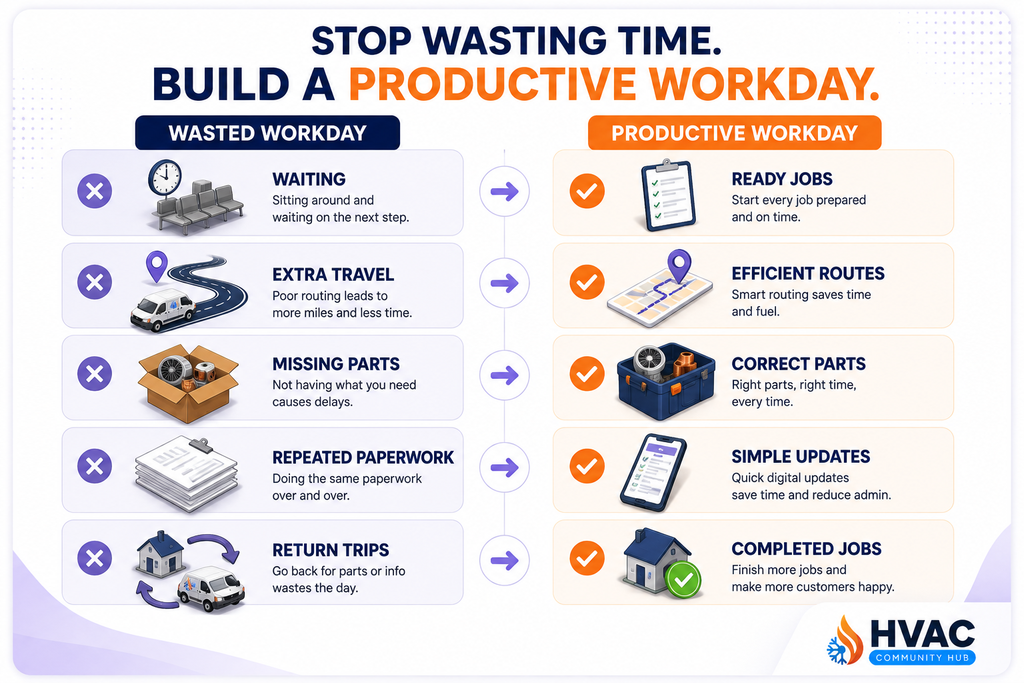
A technician waits for information. A part is missing. A customer is not ready. The previous job runs longer than expected. The next address is farther away than planned. Paperwork takes longer than expected. The technician returns to the shop because the required tool was left behind.
Each event seems manageable.
Together, they create a workday that feels constantly busy without producing as much completed work as the schedule suggested.
Waiting for Parts and Equipment
Waiting is one of the easiest ways to lose productive technician time.
A technician may arrive at a job and discover that the required part is unavailable. They then have to contact the office, locate the part, travel to collect it, or reschedule the work.
The technician is still being paid during that time.
The customer is also waiting.
Meanwhile, another appointment may be delayed.
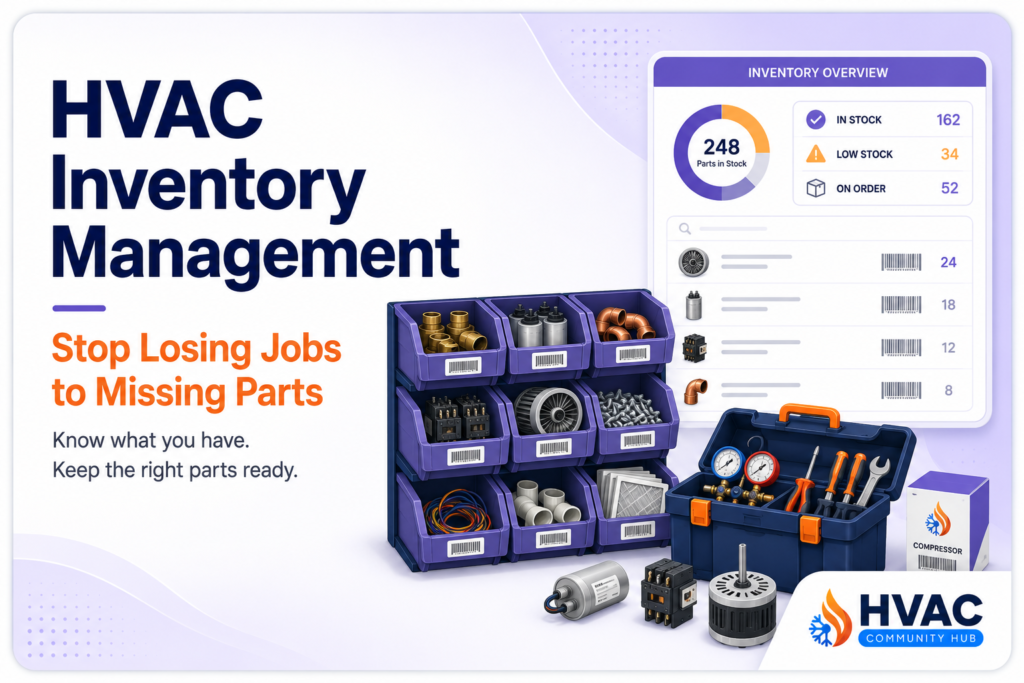
Better preparation can prevent many of these situations. Clear job information, accurate equipment details, and proper parts planning give technicians a better chance of arriving ready to work.
Poor Job Information
Technicians work more efficiently when they know what they are walking into.
A job description that simply says “AC not working” does not provide the same preparation value as detailed information about the equipment, customer complaint, previous service history, property access, and known issues.
The more useful information the office provides before the appointment, the better prepared the technician can be.
Good information does not guarantee a quick job.
It does, however, reduce unnecessary surprises.
Unnecessary Travel
Travel is part of HVAC work.
It cannot be eliminated.
However, unnecessary travel can often be reduced.
Poor scheduling may send technicians across town repeatedly instead of grouping nearby appointments. Emergency work can also disrupt an otherwise efficient route.
When technicians spend less time driving unnecessarily, they have more time available for productive work.
Administrative Work
Technicians should not spend more time than necessary on tasks that could be simplified.
Long paperwork processes, repeated data entry, manual updates, and unnecessary phone calls can all interrupt the workday.
A technician who finishes a job but then spends 20 minutes completing repetitive administrative work is not using that time for another customer or service task.
Simple digital workflows can reduce this burden.
Return Visits and Callbacks
A return visit can consume far more than the time shown on the calendar.
The technician has to travel back to the customer, investigate the issue again, complete the correction, and update the job.
The customer also has to make time for another appointment.
Some callbacks are unavoidable. Others come from incomplete diagnosis, poor communication, installation mistakes, or missing information.
Reducing preventable callbacks improves both technician productivity and customer experience.
The Difference Between Working Hard and Working Productively
HVAC technicians are already working hard.
That is important to recognize before changing anything.
A productivity strategy should never assume that technicians are the problem simply because the business wants more completed work. In many cases, technicians are doing everything they can within a system that creates unnecessary obstacles.
A technician cannot control a missing part.
They cannot control incomplete information from the office.
They cannot control an inefficient route.
They cannot control a customer who was given the wrong appointment expectations.
They can only work within the process the business gives them.
Therefore, improving HVAC technician productivity starts by examining the system around the technician.
Ask what makes the job easier.
Ask what slows the technician down.
Ask what information they need earlier.
Ask which tasks could be removed or simplified.
Those questions usually produce better results than simply asking technicians to work faster.
How Better Preparation Improves HVAC Technician Productivity
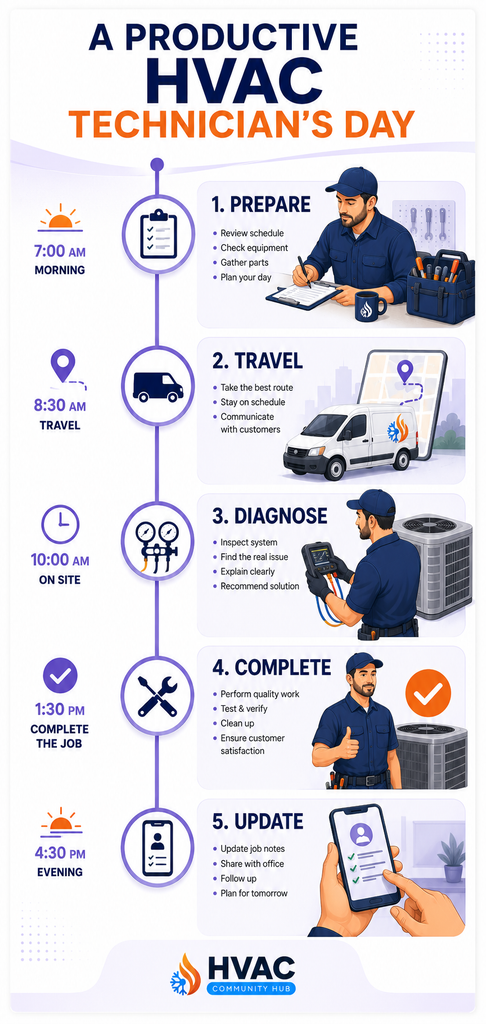
Preparation begins before the technician leaves for the first appointment.
The office should provide enough information for the technician to understand the job, prepare the right equipment, and anticipate potential issues.
Customer history can help.
Equipment information can help.
Previous service notes can help.
Photos can help.
Clear appointment details can help.
When this information is available in one place, technicians spend less time calling the office to find answers.
Preparation also means checking the schedule before the day begins.
A technician should have a reasonable understanding of the day’s appointments, locations, job types, and any special requirements.
That small amount of preparation can make the entire workday more predictable.
How Scheduling Affects HVAC Technician Productivity
Scheduling has a major influence on how technicians use their time.
A schedule is more than a list of customer appointments. It determines how much travel happens between jobs, how much time technicians have to complete each appointment, and how easily the team can respond when something unexpected happens.
An unrealistic schedule creates pressure.
If every appointment is booked too tightly, one longer job can disrupt the entire day. The technician then arrives late to the next customer, the office receives more calls, and the rest of the schedule becomes harder to manage.
On the other hand, an overly loose schedule can leave productive capacity unused.
The goal is not to fill every minute.
The goal is to create a schedule that gives technicians enough time to complete the work properly while reducing unnecessary gaps and travel.
Good scheduling therefore supports HVAC technician productivity without turning the workday into a race.
Communication Between the Office and Field Matters
The office and field team need the same information.
When communication breaks down, productivity suffers.
A technician may arrive at a property without knowing that the customer requested a specific service. The office may not know that additional equipment is required. A customer may call with a question while the technician is already driving to another appointment.
These small communication gaps create unnecessary interruptions.
A shared system can help keep customer information, job notes, appointment details, photos, and updates together.
The benefit is not simply better communication.
It is fewer interruptions.
Fewer interruptions allow technicians to stay focused on the work in front of them.
Technology Can Support HVAC Technician Productivity
Technology should make the technician’s work easier.
It should not create another complicated system that technicians have to manage.
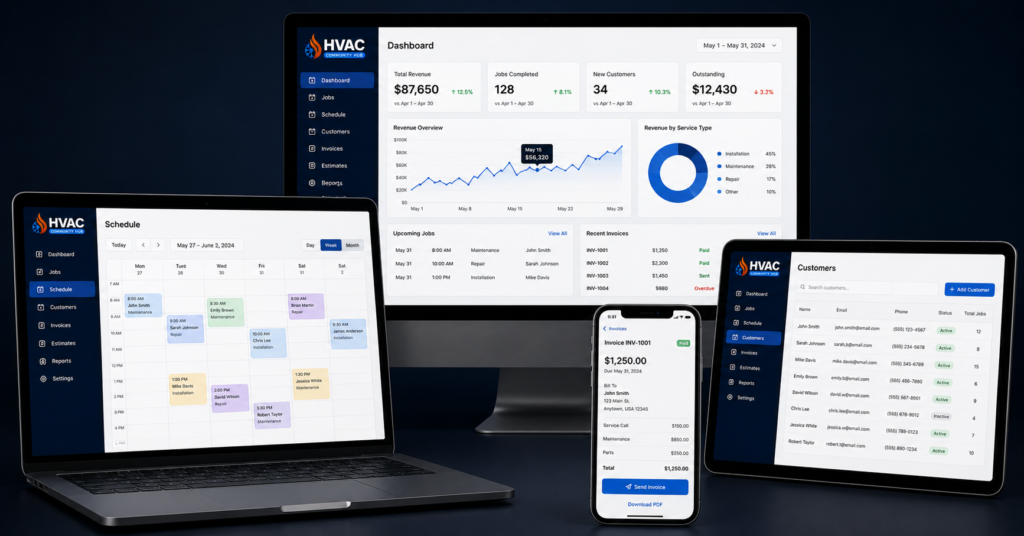
A good field workflow can give technicians access to customer information, job details, equipment history, notes, photos, estimates, invoices, and other important information from the field.
That reduces the need to call the office for information that already exists somewhere in the business.
Mobile forms can also simplify repetitive paperwork. Digital job updates can reduce manual data entry. Automated notifications can keep customers informed without requiring technicians to make every communication manually.
The technology itself is not the solution.
The workflow is.
If a tool removes unnecessary steps, it can improve productivity. If it adds more clicks and duplicate work, it can make productivity worse.
How to Measure HVAC Technician Productivity
You cannot improve what you never measure.
However, measurement does not need to become complicated.
Start by looking at a few basic patterns.
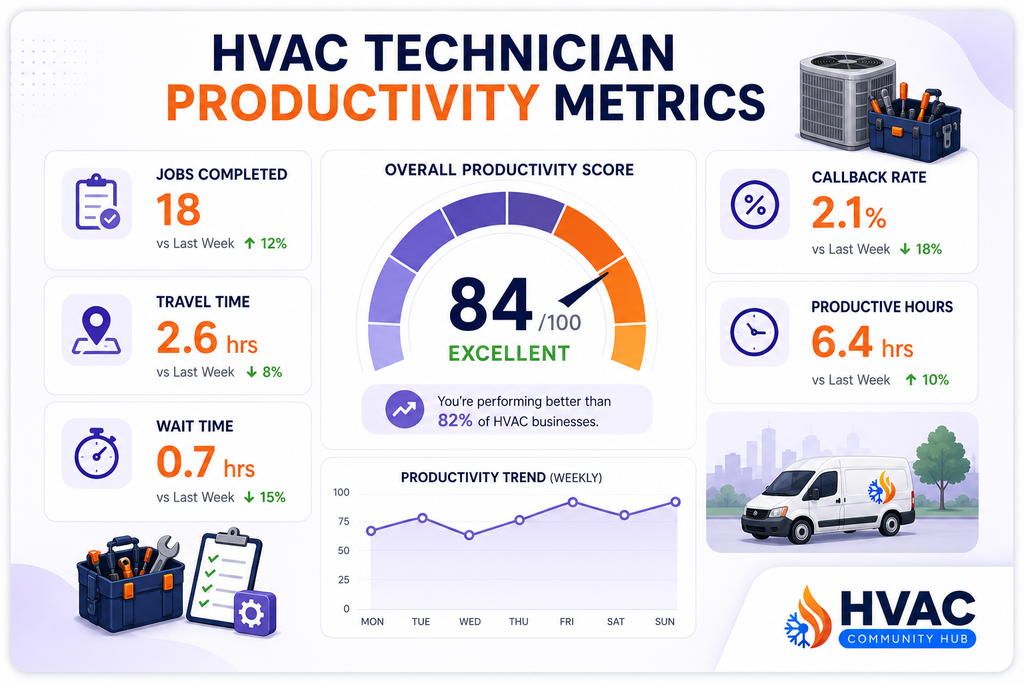
How many jobs does each technician complete?
How much time do technicians spend travelling?
How often do jobs require a return visit?
How frequently do technicians wait for parts?
How often does a technician need to contact the office for information?
How much administrative work happens in the field?
These numbers can reveal where productivity is being lost.
The goal is not to compare technicians unfairly.
Instead, use the information to identify process problems.
If every technician loses time because parts are not prepared correctly, the problem is probably not individual technician performance.
It is a process problem.
If one technician consistently needs much more time than others on similar jobs, that may point to a training opportunity.
Good measurement helps you find the real cause.
Track Productive Time, Not Just Hours Worked
Hours worked do not tell the whole story.
A technician can work a full day while spending significant time on travel, waiting, paperwork, and return trips.
Therefore, look at how those hours are being used.
The goal is not to eliminate every non-service activity. Some tasks are necessary.
Instead, identify the unnecessary time and reduce it.
That is where meaningful productivity improvement usually begins.
Watch Patterns Over Time
One difficult day does not tell you much.
A technician may have a complicated emergency call, a difficult customer, or an equipment problem that takes longer than expected.
Look for patterns over several weeks.
If the same delay appears repeatedly, investigate it.
Patterns show you where the system needs attention.
Common Mistakes HVAC Owners Make When Improving Productivity
One common mistake is focusing only on the number of jobs completed.
That number matters, but it does not tell you whether the work was completed efficiently or whether the quality was maintained.
Another mistake is comparing technicians without considering job complexity.
A technician handling difficult installations or complex diagnostics may naturally complete fewer appointments than someone handling simple maintenance calls.
The third mistake is pushing the team harder instead of fixing the process.
If technicians are already working efficiently, asking them to move faster can increase stress and reduce quality.
The fourth mistake is introducing too many systems at once.
A new CRM, mobile app, scheduling system, digital forms, and communication platform can create confusion if the team does not understand how they fit together.
Start with the biggest productivity problem.
Fix it.
Measure the result.
Then improve the next problem.
How to Improve HVAC Technician Productivity Without Hurting Morale
Productivity improvement works best when technicians understand why changes are happening.
Explain the problem clearly.
Ask technicians where they lose time.
Field employees often know exactly which processes create unnecessary work because they experience those problems every day.
Listen to their feedback.
Then involve them in the solution.
For example, if technicians repeatedly report that they arrive without enough job information, improve the information provided before appointments.
If they repeatedly wait for parts, review the parts process.
If they spend too much time on paperwork, simplify the forms.
When technicians see that productivity improvements remove frustration instead of simply increasing pressure, adoption becomes much easier.
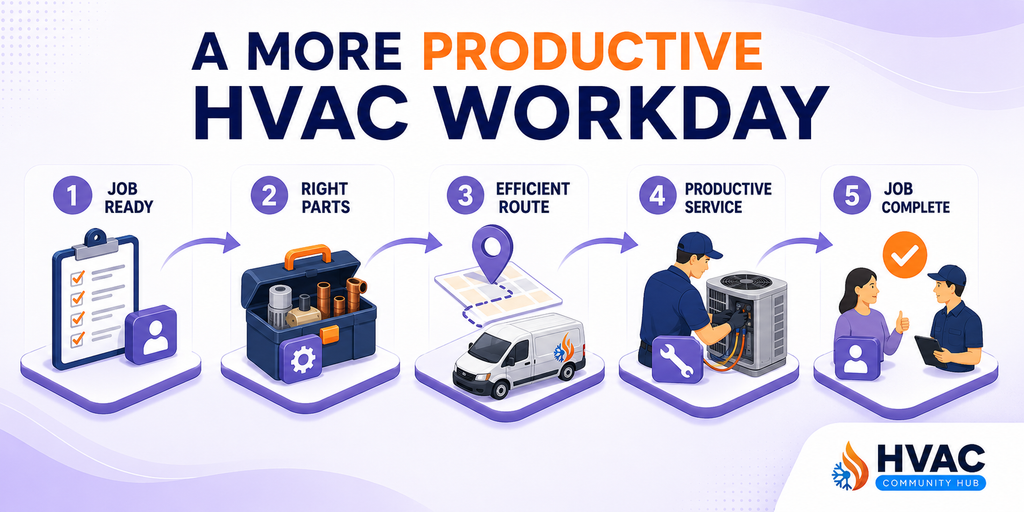
What a More Productive HVAC Workday Looks Like
A productive workday does not mean a technician finishes one appointment and immediately races to the next.
Instead, it means the technician starts the day prepared.
The first job has clear information.
The required tools and parts are available.
The route makes sense.
The customer knows what to expect.
The technician can access the information needed to complete the work.
The job gets documented without unnecessary paperwork.
The next appointment is ready.
When something unexpected happens, the office and field team can communicate quickly.
That is what productive operations look like.
The technician still works hard.
The difference is that the business removes unnecessary obstacles around that work.
Frequently Asked Questions About HVAC Technician Productivity
How can I improve HVAC technician productivity?
Start by identifying where technicians lose time. Look at travel, waiting for parts, poor job information, administrative work, scheduling gaps, and preventable return visits. Then fix the biggest recurring problem first.
Does HVAC technician productivity mean completing more jobs?
Not necessarily. Productivity also includes quality, preparation, efficient use of time, accurate documentation, and reducing preventable rework. Completing more jobs should never come at the expense of quality or customer service.
How do I measure HVAC technician productivity?
Track completed jobs alongside factors such as productive hours, travel time, waiting time, callbacks, and administrative work. Reviewing these numbers together gives you a better picture than simply counting jobs.
How can scheduling improve technician productivity?
Better scheduling can reduce unnecessary travel, prevent unrealistic appointment gaps, and give technicians enough time for each job. A balanced schedule helps technicians stay productive without rushing customers or cutting corners.
Should HVAC technicians be measured against each other?
Use technician data to identify patterns rather than create unfair comparisons. Job complexity, service type, travel distance, and experience can all affect performance. The goal should be improving the system and identifying training opportunities.
Can technology improve HVAC technician productivity?
Yes, when technology removes unnecessary work. Mobile job information, digital forms, customer history, scheduling tools, and simple communication workflows can reduce interruptions and repetitive administrative tasks.
HVAC Technician Productivity Starts With Better Systems
Your technicians may not need to work harder.
They may need a better system around them.
Every wasted trip, missing part, unclear job description, unnecessary phone call, repeated form, and preventable callback takes productive time away from your team.
One problem may seem small.
However, repeated across hundreds of jobs, those small problems become a significant operational cost.
Improving HVAC technician productivity means finding those problems and removing them.
The result is not simply more completed work.
Your technicians have clearer days.
Customers receive better service.
The office deals with fewer interruptions.
The business gets more value from the hours it already pays for.
That is the real goal.
For a balanced approach to technician performance, explore HVAC team training, reducing dependence on one technician, and technician accountability.
Take the Next Step
Start by asking your technicians one simple question:
“Where do you lose the most time during a normal workday?”
Do not suggest the answer.
Listen to what they say.
Then look for patterns across the team.
You may discover that the biggest problem is not technician effort at all. It may be scheduling, missing parts, incomplete job information, excessive paperwork, or communication between the office and field.
Choose one recurring problem and fix it first.
Measure what changes over the following weeks.
Then move to the next problem.
HVAC Hub helps HVAC businesses improve their systems, workflows, technology, and day-to-day operations so technicians can spend more time doing productive work.
Visit hvachub.co to learn more about building better systems for your HVAC business.
You can also explore our HVAC CRM guide and related HVAC business resources to understand how better customer information, communication, and workflows can support your field team.



Responses