
HVAC Inventory Management Guide for Business Owners

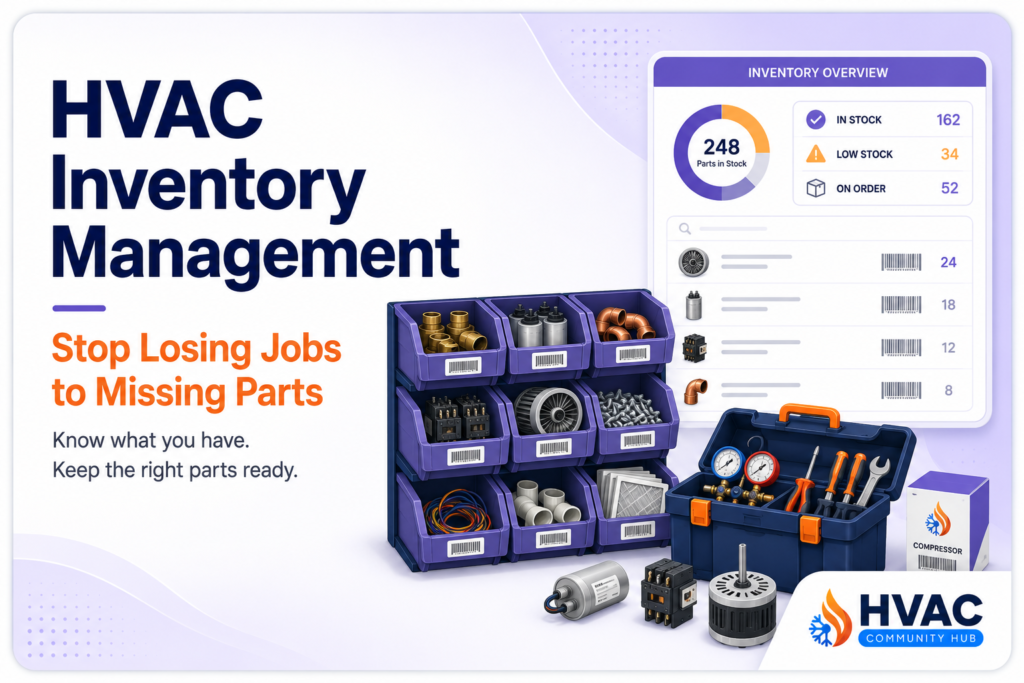
HVAC inventory management is one of those parts of running an HVAC business that becomes important only after something goes wrong. A technician arrives at a job and discovers the required part is missing. A customer waits while someone searches the warehouse. An office employee calls several suppliers trying to find equipment. Another technician drives back to the shop. What looked like a simple inventory problem suddenly affects the entire day.
Poor inventory management creates more than inconvenience. It can delay jobs, increase unnecessary travel, create emergency purchases, tie up cash in unused stock, and make technicians less productive. Meanwhile, the business owner may not even know exactly what is sitting in the warehouse, inside service vehicles, or waiting to be used.
Good HVAC inventory management gives your business control over what you have, what you need, and when you need to reorder it. This guide explains how inventory problems affect HVAC businesses, what a practical inventory system should include, and how to build better control without creating another complicated process for your team.
What HVAC Inventory Management Actually Means
HVAC inventory management means keeping track of the parts, materials, equipment, and supplies your business needs to complete its work.
That sounds simple.
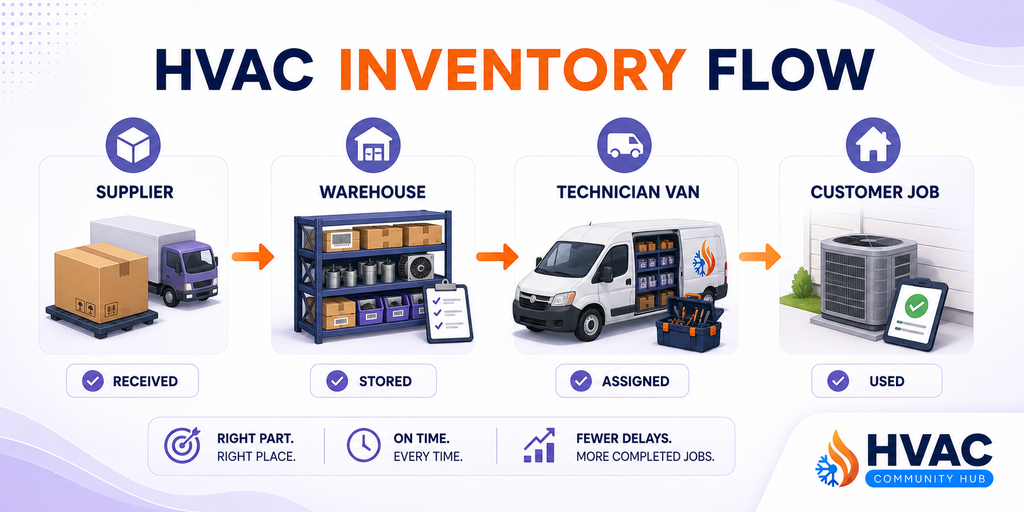
However, HVAC businesses often have inventory in several different places. Parts may sit in a main warehouse, inside technician vans, at an office, or at a temporary job location. Some items may already be assigned to upcoming jobs while others are available for general use.
Without a clear system, it becomes difficult to know what is actually available.
A part may appear to be in stock because the system says you have one. In reality, that part may already be sitting inside a technician’s van or reserved for another job.
Good HVAC inventory management connects those different pieces.
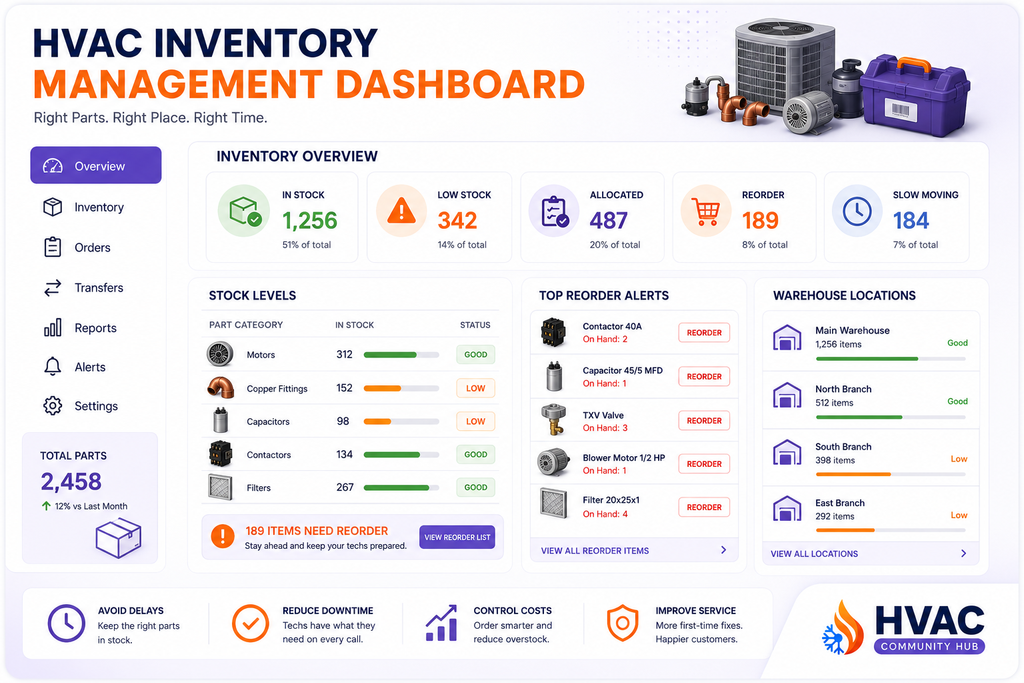
Your team should be able to understand what is available, where it is located, what has already been allocated, and what needs to be reordered.
The goal is not to track every screw with a complicated system.
The goal is to make sure the right inventory is available when your technicians need it.
Why Missing Parts Create Bigger Problems Than You Think
A missing part rarely affects only one task.
When a technician arrives without the required component, the job may stop immediately. Someone then has to locate the part, purchase it, collect it, or arrange another delivery.
The technician waits.
The customer waits.
The next appointment may also be affected.
One missing component can therefore create a chain reaction across the schedule.
Emergency purchases can create another problem. When the business needs a part immediately, the team may have fewer options and less time to compare suppliers or availability.
That urgency can make the purchase more expensive.
Even when the additional cost is small, repeated emergency purchases can become a regular drain on the business.
Better HVAC inventory management helps prevent these situations before they reach the customer.
Where HVAC Businesses Lose Control of Inventory
Inventory problems usually develop gradually.
A few parts are purchased without being recorded. A technician takes something from the warehouse and forgets to update the stock. Old equipment remains on a shelf. A part is ordered twice because nobody knows whether the original order arrived.
Over time, the inventory records stop matching reality.
This creates what business owners often experience as a simple question:
“Do we have it?”
If the answer requires three phone calls and someone physically searching the warehouse, the inventory system needs improvement.
Warehouse Inventory
Your main warehouse or storage area should give your team a clear picture of what is available.
Parts should have logical locations.
Commonly used items should be easy to find.
Slow-moving items should not be mixed randomly with frequently used stock.
Clear labels and consistent storage can make a surprisingly large difference.
The goal is simple: someone should be able to locate a required part without relying on one employee’s memory.
Technician Van Inventory
Service vehicles create another inventory challenge.
Every technician may carry different parts based on their experience, job type, and personal habits. Without a consistent process, one van may have too much of something while another has none.
That makes it harder for the office to know what is actually available.
A simple van inventory list can solve much of this problem.
When technicians use a part, the system should make it easy to record what was taken. The business can then replenish the vehicle before the next workday.
Parts Reserved for Jobs
Inventory becomes even harder to manage when a part has already been assigned to a customer job.
The part may still physically sit on a shelf.
However, it is not actually available for another job.
Your system should distinguish between available stock and allocated stock.
That small difference can prevent double-booking the same equipment or part.
How to Build a Simple HVAC Inventory Management System
You do not need a complicated warehouse operation to improve inventory control.
Instead, start with the parts your business uses most often.
Identify the components technicians regularly need for service, maintenance, repairs, and installations. Then create a simple record showing the item, available quantity, storage location, and reorder level.
Next, build the system around how your team actually works.
When technicians regularly take parts from the warehouse, keep the check-out process simple.
For technicians who carry common parts in their vans, create a standard van inventory.
When certain equipment is purchased specifically for upcoming jobs, mark it as allocated rather than available.
The system should support the workflow instead of creating extra work.
However, avoid a process that takes several minutes every time someone uses a part. Your team may eventually stop following it. Keep updates quick and practical.
Create Clear Inventory Categories
Start by grouping inventory into useful categories.
For example, you might separate common service parts, installation materials, electrical components, refrigerant-related supplies, tools, and larger equipment.
The exact categories depend on your business.
More importantly, keep the categories consistent.
Everyone should understand where an item belongs and how the team should record it.
Set Reorder Levels
Running out of an important part creates problems.
At the same time, keeping too much inventory can create problems.
Excess stock ties up money and takes up storage space. Some items may become obsolete or remain unused for long periods.
A reorder level gives your team a clear signal that stock needs attention.
When inventory reaches that level, the business can review current demand and place the next order before the item becomes unavailable.
Review Slow-Moving Inventory
Not everything sitting on a shelf is useful inventory.
Some items may have been purchased for an old equipment model, a one-time job, or a service line the business no longer handles frequently.
Review these items regularly.
You may discover inventory that you can return, use on upcoming work, transfer between locations, or remove from active stock records.
The Connection Between Inventory and Customer Experience
Customers do not see your inventory system.
They see the result.
If the technician arrives prepared and completes the work as expected, the customer experiences a smooth service.
However, if the technician has to leave to find a part, the customer experiences a delay.
That difference can affect how customers view the entire company.
Clear communication helps when a part genuinely is unavailable. Even so, preventing avoidable delays is better.
HVAC inventory management therefore supports customer experience indirectly.
The customer does not need to know how your warehouse works.
They simply need the technician to arrive prepared with the right equipment and materials whenever possible.
How Inventory Management Helps Technicians
Technicians want to complete the work correctly.
They do not want to spend part of the day searching through shelves, calling the office, or driving back for something that should have been prepared before the appointment.
A good inventory process removes some of that frustration.
Before a technician leaves for an installation or repair, the required materials can be checked against the job information.
If something is missing, the team can identify the problem before the technician reaches the customer.
That simple change can save time and reduce unnecessary interruptions.
It also gives technicians more confidence.
They know what they are carrying and why they are carrying it.

Common HVAC Inventory Management Mistakes
Even experienced HVAC owners can make inventory mistakes.
One common mistake is relying on memory.
A business may have one experienced employee who knows where everything is stored. That works until the employee is away, leaves the company, or simply cannot answer every question during a busy day.
Another mistake is treating every item as equally important.
Some parts are used constantly. Others may sit untouched for months. Your inventory process should reflect that difference.
A third mistake is failing to update inventory after parts are used.
A system is only useful when the information stays accurate.
The fourth mistake is ordering more whenever something appears to be missing.
Sometimes the part is not actually out of stock. It may be sitting in another van, allocated to a job, or stored in another location.
Finally, some businesses focus only on the warehouse and forget technician vehicles.
Van stock is still business inventory.
It needs the same level of control.
How Often Should HVAC Inventory Management Be Reviewed
Inventory should not receive attention only when something runs out.
Instead, create a simple review routine that keeps the system accurate without adding unnecessary administration.
Check frequently used items more often than slow-moving stock.
Also, review technician van inventory regularly.
Compare physical stock against your records.
Look for items that repeatedly reach low levels.
At the same time, identify inventory that has not moved for a long period.
A more detailed review can happen monthly or quarterly, depending on the size of your business and inventory volume.
The important part is consistency.
An inventory system becomes useful when your team trusts the information inside it.
When HVAC Inventory Management Becomes a Growth Problem
Inventory problems often become more visible as an HVAC company grows.
A small business may be able to operate with a few shelves and a simple spreadsheet.
As the team expands, the number of technicians, vehicles, jobs, suppliers, and parts increases.
The owner can no longer rely on personal knowledge to keep everything organized.
That is when a basic inventory process becomes an important business system.
Growth should not mean constantly buying more stock without knowing what is already available.
Instead, the business needs better visibility.
You should know what is being used, what is sitting unused, and what your team needs to complete upcoming work.
That information makes purchasing decisions easier and reduces unnecessary surprises.
Frequently Asked Questions About HVAC Inventory Management
Why is HVAC inventory management important?
HVAC inventory management helps businesses know what parts and materials they have, where those items are located, and when they need to reorder. Better control can reduce delays, unnecessary purchases, and time spent searching for parts.
Should HVAC technicians manage their own van inventory?
Technicians can help maintain their van inventory, but the business should still have a consistent system. Clear stock lists and simple update processes make it easier to know what each vehicle carries.
How do I stop technicians from running out of common parts?
Identify the parts technicians use most often and establish practical reorder levels. Review van stock regularly and replenish commonly used items before they become unavailable.
How often should HVAC inventory be checked?
Frequently used items should receive regular attention, while slow-moving inventory can be reviewed less often. The exact schedule depends on business size and inventory volume, but consistency matters more than a complicated process.
Should I track every HVAC part?
Start with the parts and materials that have the biggest effect on daily operations. Once the basic system works, expand it to other inventory categories as needed.
Can HVAC inventory management reduce customer delays?
Yes. Better inventory visibility helps the business identify missing parts before a technician arrives. It also makes it easier to prepare materials for upcoming jobs.
Better HVAC Inventory Management Creates a More Prepared Business
Your inventory may sit quietly on shelves or inside service vans, but it has a direct effect on how your business operates.
The right part can help a technician complete a job without interruption.
However, the missing part can turn a straightforward appointment into a delay.
That is why HVAC inventory management deserves more attention than simply counting boxes at the end of the month.
A good system gives your team visibility.
Technicians know what they have.
The office knows what is available.
Managers know what needs to be reordered.
Customers experience fewer avoidable delays.
Most importantly, the business becomes less dependent on memory and guesswork.
You do not need a complicated warehouse operation to achieve that.
Start with the parts your team uses most often.
Create clear locations.
Track what leaves the warehouse.
Keep van stock visible.
Set practical reorder levels.
Then review the system regularly.
Small improvements can make the entire operation easier to manage.
Take the Next Step
Start by choosing your 20 most frequently used parts and materials.
Write down how many you currently have and where they are located.
Then check your technician vehicles and compare their actual stock with what your business records show.
Next, identify the three items that cause the most problems when they are unavailable.
Those are the items that deserve clear reorder levels first.
You do not need to rebuild your entire inventory system in one day.
Instead, start with the areas that create the most delays.
HVAC Hub helps HVAC businesses build better systems and workflows that make day-to-day operations easier to manage.
Visit hvachub.co to explore resources for HVAC business owners and learn how better systems can support a growing HVAC company.
You can also explore our HVAC Technician Productivity guide to see how better preparation and field processes can help technicians spend more time on productive work.




Responses