
HVAC Profitability: Why More Jobs Don’t Always Mean More Money

HVAC profitability is one of the most important numbers in your business, yet many HVAC owners focus more on how many jobs they completed than how much money those jobs actually produced. A busy month can look successful from the outside while your actual profit gets smaller. More calls, more technicians, and more completed jobs do not automatically create a healthier business. Hidden costs, wasted time, callbacks, overhead, discounts, and poor financial tracking can quietly consume the money you worked hard to earn. This guide explains why HVAC profitability gets squeezed, where the money disappears, and what you can do to keep more profit as your business grows.
What HVAC Profitability Actually Means
HVAC profitability is the amount of money your business keeps after paying the costs required to operate it. Revenue tells you how much money came into the business. Profit tells you how much remains after the costs are accounted for.
That difference matters.
An HVAC company can generate a large amount of revenue and still struggle financially. You may complete more installations, send more technicians into the field, and collect more payments. However, if your labour costs, materials, vehicles, insurance, overhead, callbacks, and other expenses rise just as quickly, the extra revenue does not create meaningful profit.
This is why revenue alone is not enough to measure business health.
The U.S. Small Business Administration recommends keeping a clear view of revenue and expenses and using financial information to understand the health of the business.
For an HVAC owner, the goal is not simply to stay busy. The goal is to build a business where the work you complete produces enough profit to support your team, cover your overhead, invest in growth, and pay you properly.
Why More HVAC Jobs Can Still Mean Less Profit
More jobs should create more opportunity. However, every additional job also creates additional costs.
A technician has to travel to the customer. Equipment and materials have to be purchased. Labour has to be paid. Vehicles have to be maintained. Office staff still need to be paid. Insurance, software, advertising, rent, fuel, and other operating costs continue in the background.
When job volume increases without proper control, these costs can rise faster than revenue.
For example, imagine an HVAC business that suddenly receives 30% more jobs during peak season. That sounds like excellent growth. However, if technicians spend more time driving, overtime increases, emergency purchases become common, callbacks rise, and jobs are discounted to close them quickly, the extra revenue may not translate into the extra profit the owner expected.
The business becomes busier.
The owner becomes more stressed.
The bank account does not improve nearly as much as expected.
That is the difference between growth and profitable growth.
The Hidden Costs That Reduce HVAC Profitability
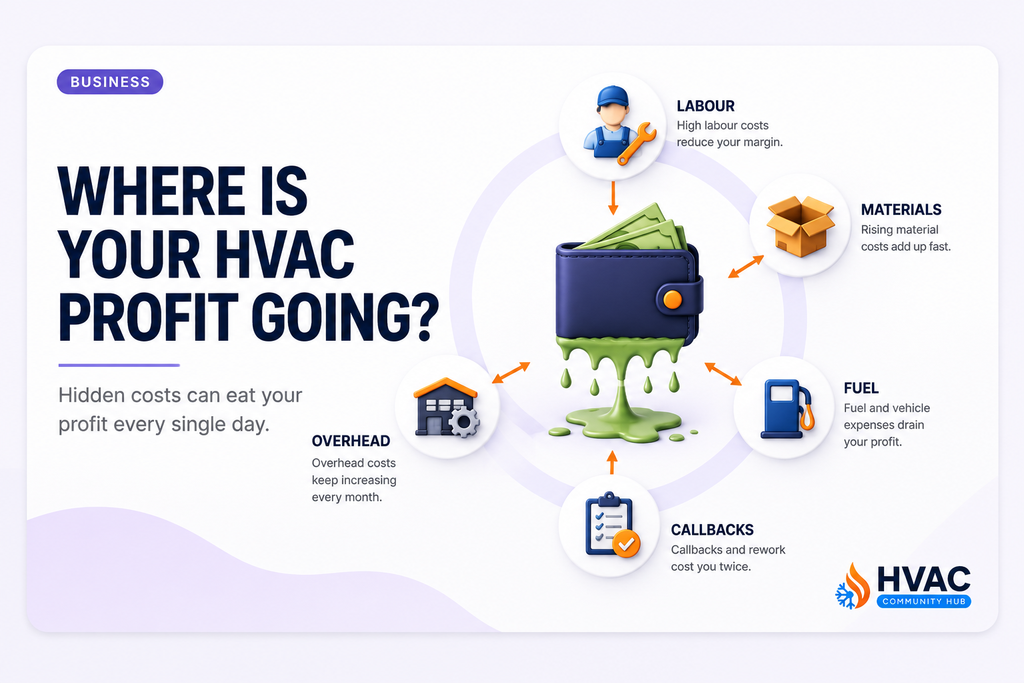
Most HVAC owners know their obvious expenses. The problem is that some of the biggest profit leaks are hidden inside everyday operations.
You may not notice them on a single job. However, when the same problem happens hundreds of times throughout the year, the financial impact becomes significant.
Unproductive Technician Time
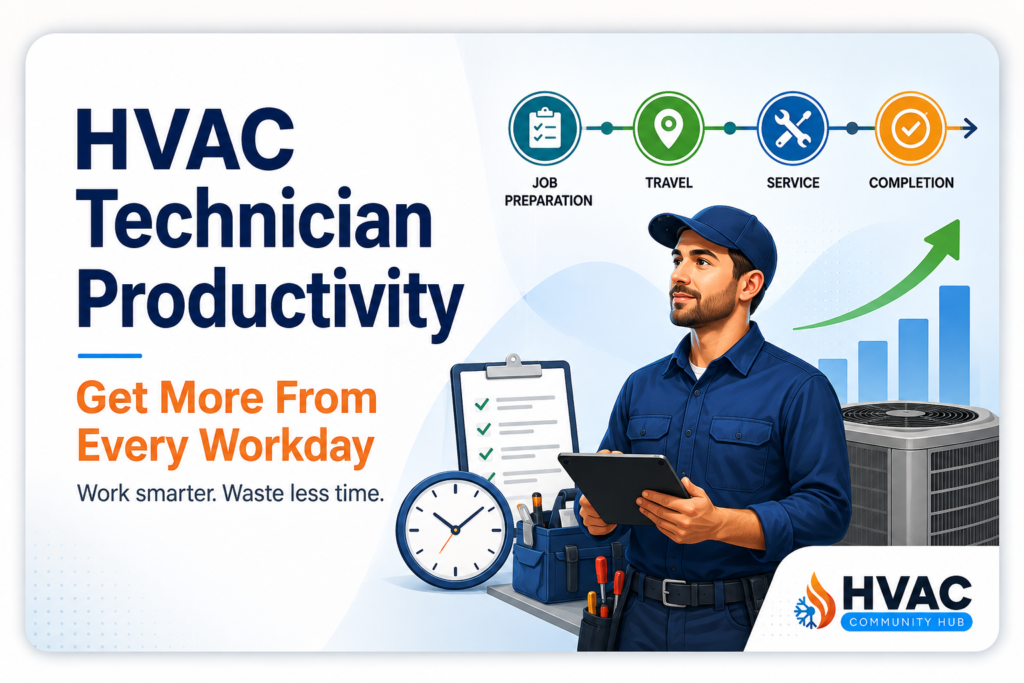
Technicians generate revenue when they are performing productive work. Time spent waiting, travelling unnecessarily, searching for parts, correcting paperwork, or returning to jobs without proper planning reduces the amount of productive work each technician can complete.
Two technicians can work the same number of hours and produce very different financial results.
That is why technician productivity matters to HVAC profitability.
The question is not simply, “How many hours did my technician work?”
The better question is, “How much productive revenue did those hours create?”
Material and Equipment Waste
Materials can quietly damage your margins.
Incorrect parts, emergency purchases, unused materials, damaged equipment, and poor inventory control all add costs. A small amount of waste on one job may not seem important. Across hundreds of jobs, it becomes a serious expense.
Equipment purchases create another challenge. Buying the wrong equipment, ordering too early, or keeping too much stock tied up in inventory can affect cash flow and profitability.
Every material decision should have a reason behind it.
Callbacks and Rework
A completed job is not always a profitable job.
If your technician has to return because something was installed incorrectly, a customer was not properly informed, or the original diagnosis was wrong, your business absorbs another round of labour and travel costs.
The customer may not pay you again for that visit.
Your business still pays the technician.
Callbacks therefore reduce HVAC profitability even when your revenue numbers initially look healthy.
Discounts That Become Normal
Discounting can help close a difficult sale. However, frequent discounting can quietly become part of your normal sales process.
A small discount may look harmless when you look at one invoice. Over an entire year, repeated discounts can remove a significant amount of potential profit.
The problem becomes even larger when your team starts offering discounts without understanding the financial impact.
A discount should be a business decision, not an automatic reaction to a customer’s objection.
Administrative Overhead
Every HVAC business has administrative costs.
Office staff, software, phones, accounting, insurance, rent, advertising, subscriptions, vehicles, and other overhead expenses all need to be covered before the business produces real profit.
As the company grows, overhead often grows too.
The important question is whether your additional overhead is helping the business produce more profit or simply making the company more expensive to operate.
Revenue Is Not the Same as Profit
One of the biggest mistakes HVAC business owners make is treating revenue as proof that the business is doing well.
Revenue is important.
However, revenue only tells you how much money your business generated before expenses.
Profit tells you what the business actually kept.
Imagine two HVAC companies that each generate $1 million in annual revenue.
Company A has strong cost control and keeps a healthy amount of profit.
Company B has high labour costs, excessive overhead, frequent callbacks, and poor expense control.
From the outside, both businesses look equally successful.
Financially, they are completely different.
This is why HVAC profitability should be measured alongside revenue.
Your goal should be to understand what happens to every dollar that enters the business.
The IRS also emphasizes the importance of maintaining records that clearly show business income and expenses. Good records help business owners monitor progress and prepare accurate financial statements.
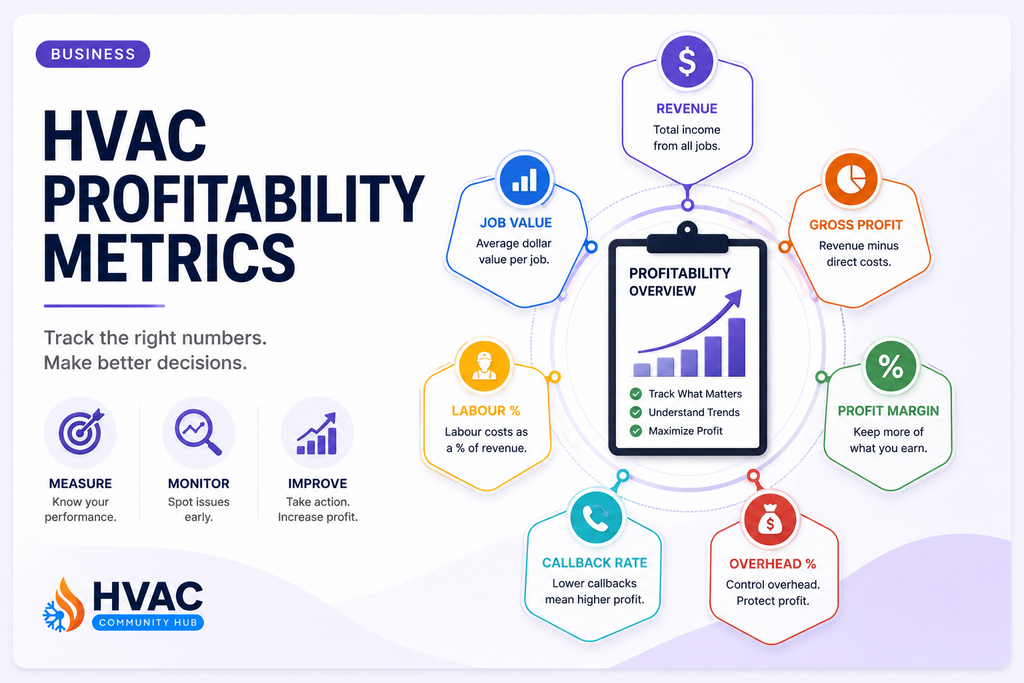
The Numbers Every HVAC Owner Should Watch
You do not need a complicated financial dashboard to understand your business better.
Start by tracking a small group of numbers consistently.
Revenue
Track total revenue over time and compare it against previous periods.
Revenue shows whether demand is increasing or decreasing. However, never use revenue alone as your measure of success.
Gross Profit
Gross profit shows what remains after the direct costs required to deliver your services.
This gives you a much clearer picture of how your actual jobs are performing.
Net Profit
Net profit shows what remains after operating expenses are included.
This is one of the most important numbers for understanding the overall financial health of the business.
Revenue Per Technician
Track how much revenue each technician generates over a consistent period.
This can help identify productivity differences and highlight areas where training, scheduling, or job allocation may need attention.
Callback Rate
Track how often completed jobs result in another visit.
A rising callback rate can indicate training problems, installation issues, poor diagnosis, or process failures.
Average Job Value
Knowing your average job value helps you understand what your typical customer transaction looks like.
Track this number over time rather than looking at individual jobs only.
Outstanding Payments
Revenue that has not been collected is not the same as cash available to operate the business.
Track outstanding payments carefully and understand how long customers typically take to pay.
How to Improve HVAC Profitability Without Simply Raising Prices
Improving HVAC profitability does not always mean charging customers more.
Instead, the biggest opportunity may be fixing what happens after the customer says yes.
Reduce Wasted Technician Time
First, look at where technicians lose time during a normal week.
Are they travelling too far between appointments?
Are they waiting for parts?
Do jobs regularly get scheduled in ways that create unnecessary gaps?
Are technicians spending time completing administrative tasks that could be simplified?
As a result, small improvements in productive time can have a meaningful effect on annual profit.
First, look at where technicians lose time during a normal week.
Are they travelling too far between appointments?
Are they waiting for parts?
Do jobs regularly get scheduled in ways that create unnecessary gaps?
Are technicians spending time completing administrative tasks that could be simplified?
As a result, small improvements in productive time can have a meaningful effect on annual profit.
Reduce Callbacks
Next, track every callback.
Do not simply treat it as another service visit.
Instead, ask why it happened.
Was the original diagnosis incorrect?
Was the installation rushed?
Did the customer receive the wrong information?
Was the equipment or part incorrect?
Once you identify the pattern, you can address the underlying problem instead of repeatedly paying for the same mistake.
Control Material Costs
Also, review your most commonly purchased materials and equipment.
Look for emergency purchases, repeated over-ordering, unused stock, and unnecessary waste.
Better purchasing and inventory control can protect margins without changing what you charge customers.
Review Your Overhead
Then, go through your recurring expenses regularly.
Look at software subscriptions, advertising, insurance, office expenses, vehicle costs, equipment, and other recurring charges.
Ask one simple question about every major expense:
“Is this helping the business produce or protect profit?”
If the answer is no, investigate whether you can reduce, replace, or remove the expense.
Know Which Work Produces the Best Return
Finally, remember that not every service line produces the same financial result.
One type of job may generate strong revenue with relatively low operating costs.
In contrast, another may require significant labour, travel, equipment, and follow-up work.
Therefore, track your numbers so you can understand which areas of the business deserve more attention.
Why Busy HVAC Companies Often Feel Financially Stressed
A business can be extremely busy and still feel financially uncomfortable.
This usually happens when growth creates more pressure than profit.
For example, the owner may see more calls coming in while technicians work longer hours.
At the same time, the schedule stays full and the phones keep ringing.
Yet the owner still worries about cash, payroll, expenses, and the next slow period.
That feeling is often a sign that the business needs better financial visibility.
When you know exactly where your money is going, decisions become easier.
For instance, you can see which services perform well, identify expensive problems, and understand whether additional employees are actually helping.
You can also decide whether another vehicle makes financial sense.
Without those numbers, many decisions become guesses.
The U.S. Small Business Administration also recommends using financial information such as income statements, balance sheets, and cash flow information to understand business performance and support financial planning.
Warning Signs Your HVAC Profitability Is Getting Worse
Your HVAC profitability may already be under pressure if you notice several of these warning signs:
- Revenue is increasing but your bank balance is not
- Your team is busier but overtime keeps increasing
- Callbacks are becoming more common
- Material purchases are increasing faster than revenue
- You regularly make emergency parts purchases
- Customers frequently ask for discounts
- You do not know your profit by service type
- You are unsure how much each technician contributes to profit
- Overhead keeps increasing without a clear return
- You are working more hours but taking home roughly the same amount
- You rely on a strong peak season to cover weaker months
- You review financial numbers only when your accountant sends reports
None of these automatically means your business is failing.
However, they are signals that deserve attention.
More importantly, the earlier you identify a profitability problem, the easier it is to correct.
How Often Should HVAC Profitability Be Reviewed
HVAC profitability should not be something you review only at tax time.
Instead, your financial numbers are operating information.
They should help you make decisions throughout the year.
Review Key Numbers Weekly
A weekly review can stay simple.
Start by looking at revenue, payments collected, outstanding invoices, completed jobs, callbacks, and major unexpected expenses.
The goal is not to build a complicated financial report.
Instead, the goal is to notice problems early.
Review Job Performance Monthly
Once a month, look deeper.
Compare different service types, technicians, job values, material costs, and labour costs.
Then, look for patterns.
If one area consistently produces better financial results, understand why.
On the other hand, if another area repeatedly creates problems, investigate it.
Review Overall Business Profitability Quarterly
Every quarter, step back from individual jobs and look at the whole business.
Review revenue, direct costs, overhead, payroll, vehicles, marketing, software, insurance, and other major expenses.
Then compare the results with previous quarters.
As a result, you get a much clearer picture of whether the business is becoming more profitable or simply becoming busier.
Common HVAC Profitability Mistakes Owners Make
Even experienced HVAC owners can make financial mistakes when the business gets busy.
The first mistake is focusing only on revenue.
Revenue feels good because it shows that customers are buying. However, revenue without healthy margins can create a false sense of success.
The second mistake is ignoring small expenses.
A single subscription, fuel charge, or material purchase may seem insignificant. However, hundreds of small expenses across a year can become a major cost.
The third mistake is failing to track callbacks.
If you do not measure callbacks, you may never understand how much money rework is costing your company.
The fourth mistake is mixing business performance with personal assumptions.
An owner may feel that the business is doing well because the schedule is full. However, financial data may tell a different story.
The fifth mistake is waiting too long to review the numbers.
As a result, financial problems become harder to solve when they remain invisible for months.
Good records make the problem easier to identify. The IRS notes that accurate records can help business owners monitor progress, identify income sources, track expenses, and prepare financial statements.
Frequently Asked Questions About HVAC Profitability
How can I improve HVAC profitability?
Start by understanding where your money goes. Track revenue, direct job costs, labour, materials, callbacks, overhead, and payments collected. Then identify the areas where costs are increasing faster than revenue.
Why can my HVAC business be busy but not profitable?
A busy business can still have weak profitability when labour costs, material costs, callbacks, overhead, discounts, and wasted technician time consume too much revenue. Therefore, being busy and being profitable are not the same thing.
What is the most important HVAC profitability number to track?
There is no single number that tells the entire story. Instead, gross profit, net profit, revenue, labour costs, average job value, callbacks, and outstanding payments should be reviewed together.
How often should an HVAC business review profitability?
Review key operating numbers weekly, job performance monthly, and overall profitability at least quarterly. However, more frequent reviews may make sense during major growth periods or peak season.
Can I improve HVAC profitability without raising prices?
Yes. Reducing wasted technician time, controlling material costs, lowering callbacks, reviewing overhead, and improving operational efficiency can all increase profit without changing customer prices.
Does more revenue always mean better HVAC profitability?
No. Revenue can increase while profit decreases if the cost of producing that revenue increases faster. Therefore, profitable growth matters more than revenue growth alone.
HVAC Profitability Is About Keeping More of What You Earn
Getting more HVAC jobs is important.
However, getting more jobs is only one part of building a strong business.
The bigger question is what happens to the money after the job is sold.
If every additional job creates more waste, more overtime, more callbacks, and more overhead, growth can make the business harder to manage without making it meaningfully more profitable.
On the other hand, a business that understands its numbers can make better decisions.
You know which work produces the strongest return.
You know where costs are rising.
You know when technician productivity needs attention.
You know when overhead has become too high.
You know whether growth is actually improving the financial health of the company.
That is what strong HVAC profitability looks like.
It is not simply about making more money.
Instead, it is about keeping more of the money your business works so hard to earn.
To address common sources of lost profit, see our guides to HVAC inventory management, technician productivity and HVAC change orders.
Take the Next Step
Start with three numbers.
First, calculate your current revenue.
Second, calculate your major direct and operating costs.
Third, determine how much profit your business actually keeps.
Then look for the biggest gap between where your money comes in and where it goes out.
Review your technician productivity, callbacks, materials, discounts, overhead, and outstanding payments. You do not need to fix everything at once. Instead, start with the largest problem and measure the result.
The U.S. Small Business Administration’s guidance on managing business finances is a useful starting point for understanding financial statements, bookkeeping, and cash flow.
You can also review the IRS recordkeeping guidance for small businesses to understand why accurate income and expense records matter.
For HVAC-specific business guidance, visit hvachub.co to explore resources designed to help HVAC business owners build stronger, more organized, and more profitable companies.
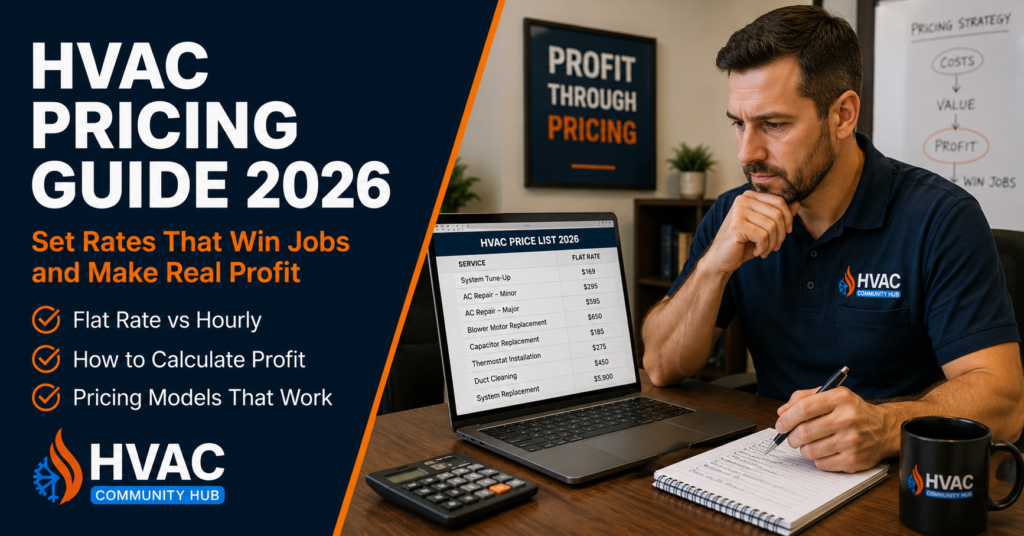
You can also read our HVAC True Costs guide and our HVAC Pricing Strategies guide to understand how operating costs and pricing decisions connect directly to HVAC profitability.
Responses